 TEKZARO
Pakistan
LG Responds to Claims Its Smart TVs Are Spying on Users
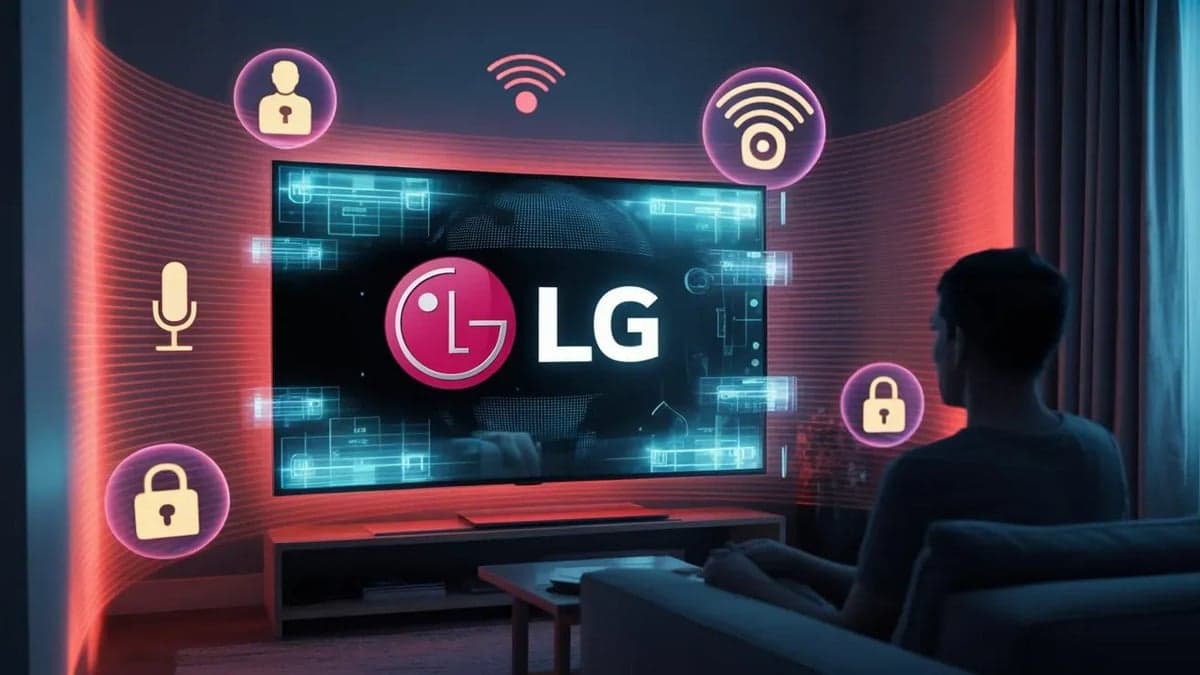
LG has issued a public statement rejecting allegations that its smart TVs record household conversations and continuously upload user data, following a two-hour investigation published by the YouTube channel Gamers Nexus that has drawn more than four million views.
The company's response is a partial denial rather than a blanket one, and the distinction between what LG disputes and what it confirms is where the actual story sits.
What the Investigation Alleged
The video, published on September 6 and produced in collaboration with security researchers MrBruh and uturn, used packet capture and firmware analysis to examine LG's webOS televisions.
Its claims: that LG smart TVs constantly log and upload user data, including when offline or in standby mode; that they scan Wi-Fi networks and enumerate connected devices; that they record audio logs and are capable of transcribing ambient conversations even with the screen off; and that they sample audio and video inputs to identify what is being watched, including over HDMI.
The investigation also alleged that a third party could compromise an LG TV and use it to listen to conversations even with the microphone disabled, potentially pulling audio from an HDMI input or a connected USB webcam.
Gamers Nexus framed the scale of the issue around an installed base it put at 216 million televisions.
What LG Denies
LG's statement is direct on the voice question. The company says the claims made in the video are not true, and that its TVs process voice data only in two circumstances: when the voice button on the remote control is pressed and held, or when a wake word such as "Hi LG" is recognised after the user has manually enabled Far-Field Voice Recognition.
Outside those circumstances, LG states its televisions do not collect, record or transmit ambient conversations. The company says wake-word detection is performed locally on the television itself, and that audio is immediately deleted without being sent to LG's servers if no wake word is recognised.
What LG Confirms
Network scanning is acknowledged. LG says its TVs scan for and connect to nearby devices on the same network, describing this as a standard function commonly provided by smart TVs and smart home devices, necessary for casting, device control and general connectivity.
That framing is accurate as far as it goes. It is also worth noting that features like casting do not obviously require a TV to enumerate every device on a home network, and most buyers do not expect their television to be building an inventory of what else is connected.
Automatic Content Recognition is also confirmed. LG says ACR is provided on an opt-in basis for personalised content recommendations, services and advertisements, and that if a user does not consent to the applicable optional agreement, ACR data is not used for advertising purposes. The company added that it is committed to transparency and to rejecting deceptive practices, specifically naming dark patterns.
LG did not address several of the more specific technical allegations, including claims that transcripts were stored in plain text and that voice recordings were saved on the televisions themselves.
The ACR Question Is Not LG-Specific
One point of context that has been raised in response to the investigation: ACR is not an LG invention or an LG-only practice. Every major television manufacturer has been documented for years capturing screenshots of on-screen content multiple times per second, including content arriving over HDMI from external devices.
That does not make the practice benign. It does mean the framing of LG as uniquely invasive is difficult to sustain, and several outlets covering the story have questioned why the investigation singled the company out on this particular point.
The underlying commercial reality applies across the industry. Smart TVs have become advertising platforms, generating recurring revenue from viewing data long after the hardware sale is complete. LG Ad Solutions markets ACR capabilities to advertisers openly.
The Arbitration Clause
A separate finding in the investigation has drawn less attention but may matter more practically. Gamers Nexus documented LG adding binding arbitration to its US terms of service on July 28, 2026.
Binding arbitration clauses typically limit a consumer's ability to bring claims in court or participate in class actions. LG has not publicly addressed the timing.
Where This Leaves Owners
The security researchers' hacking scenario and LG's privacy denial are addressing slightly different questions. LG is saying it does not record you. The researchers are saying an attacker who compromises the TV could.
Both can be true simultaneously, and the second is the harder problem to fix.
For owners who want to reduce exposure regardless of which account they find more convincing, the practical steps are the familiar ones: disable Far-Field Voice Recognition in settings, decline the optional ACR and advertising agreements, review the privacy menu rather than accepting setup defaults, and consider isolating the TV on a guest network so its device scanning returns nothing of interest.
The more thorough option, which a growing number of people are taking, is to leave the television off the network entirely and drive it with a separate streaming device that can be replaced more easily than a display panel.
Sources
Related Articles