 TEKZARO
AI
Primer's Gabriel Le Roux on unified payments infrastructure, the $100m Series C and AI agent Companion - Dealroom
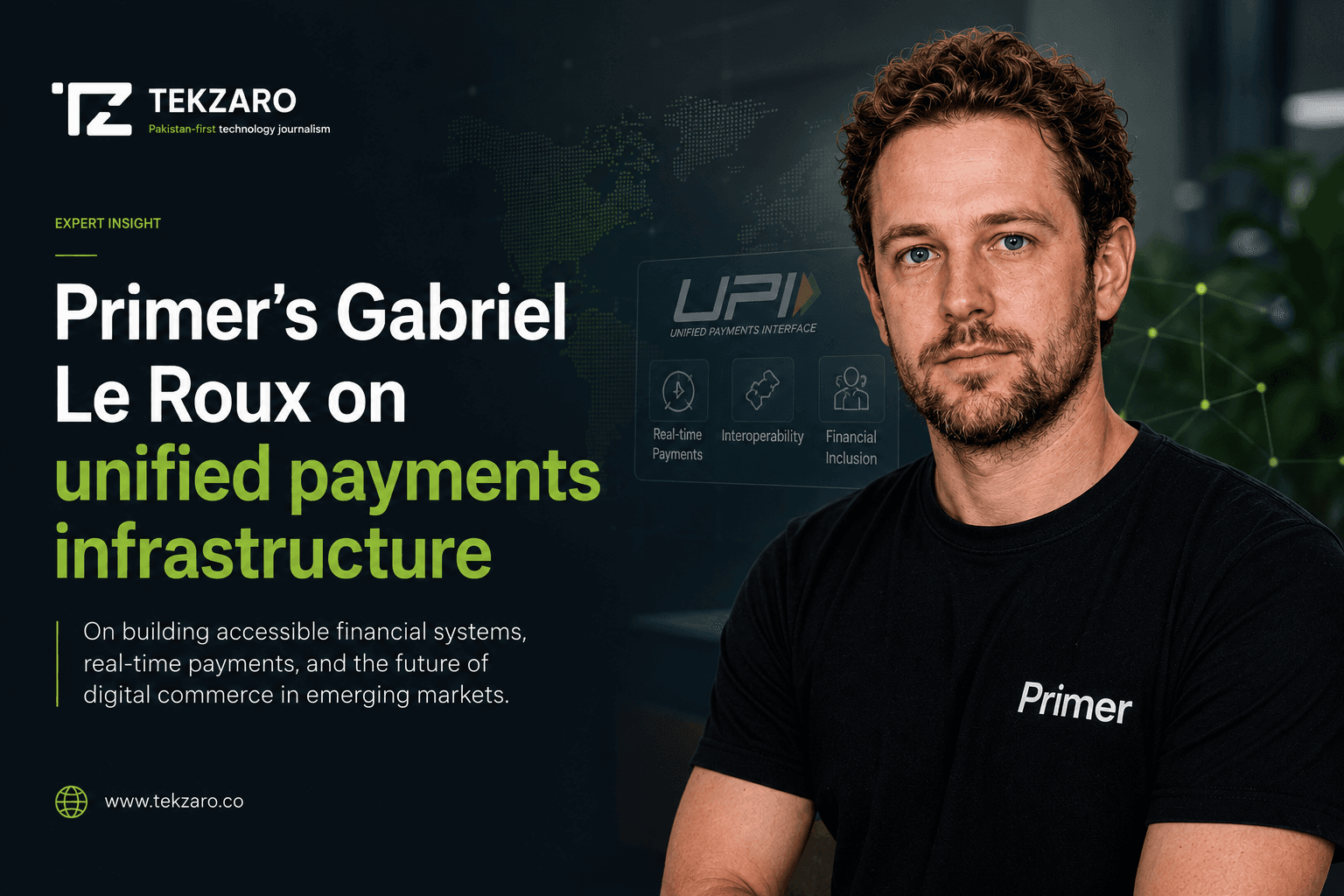
Primer, the AI-powered payments infrastructure platform founded in 2020, announced a $100 million Series C funding round in May 2026, led by Sofina with participation from Peak XV Partners and existing backers including Balderton, Accel, ICONIQ, Tencent, and Speedinvest. The round, which was oversubscribed, reflects investor conviction that Primer has solved a foundational problem: before artificial intelligence can meaningfully optimize payments, the underlying data infrastructure must be unified across fragmented processors, acquirers, and fraud systems. CEO and Co-Founder Gabriel Le Roux articulated the company's vision in statements accompanying the fundraise: the next few years will see every major payment decision initiated, optimized, or audited by AI—but only if those AI systems run on complete, consolidated data rather than fragmented sources.
The Problem: Fragmentation That Breaks AI
Le Roux's core insight is deceptively simple but profound in its implications: AI is only as good as the data it runs on. When AI agents operate across fragmented data sources, they don't merely underperform—they make actively wrong decisions. In the payments world, this fragmentation is endemic. A typical enterprise merchant works with multiple payment processors, acquirers, fraud detection tools, reconciliation systems, and compliance platforms. Each system contains partial information. No single system has complete visibility across a transaction's entire lifecycle, from checkout through fraud screening to settlement and payout. Traditional payment operations teams cope with this fragmentation through manual work: pulling reports from multiple systems, reconciling inconsistencies, making optimization decisions on incomplete information. This works—barely—for human decision-makers who can apply judgment and intuition to fill gaps. But when you introduce an AI agent into this fragmented environment, those gaps become fatal. An agent might optimize checkout conversion without visibility into fraud patterns. Another might adjust routing between acquirers without knowing about settlement delays at specific partners. The result: decisions that optimize for a partial view of the problem, often creating new problems elsewhere.
Primer's Unified Infrastructure Approach
Primer solved this by building what Le Roux calls "the AI-enabled operating layer for global payments and finance." Rather than another point solution layered on top of existing fragmentation, Primer replaces the fragmentation itself. The platform consolidates payment processors, acquirers, fraud tools, and other systems into a unified layer. Primer then captures over 400 data points per transaction across the entire lifecycle: checkout, fraud prevention, routing, settlement, and payout. On average, Primer handles over 95% of customer payment volume, giving merchants complete visibility into their payment flows. This unified data foundation is where the AI opportunity emerges. When Primer Companion, the company's proprietary AI agent, looks at a payment decision, it has access to comprehensive context: transaction characteristics, fraud signals, processor performance, acquirer settlement patterns, regulatory requirements, and historical patterns. With that complete context, the agent can make sophisticated decisions about optimization: Which processor should handle this transaction? Should fraud screening be more or less conservative based on the transaction profile? How should we dynamically route to optimize for settlement speed versus cost? What merchant account should receive this transaction to spread risk?
Primer Companion: From Decision Support to Autonomous Execution
Primer Companion was launched in 2025 and is already deployed with merchants including GetYourGuide, Dialpad, and Printful. The agent's current capabilities center on decision support: analyzing complex payment data, identifying operational issues, and surfacing insights that help finance teams understand what's happening and why. But the Series C funding is being deployed to evolve Companion from a decision-support tool to an autonomous agent that can execute decisions within merchant-defined parameters. This is a significant escalation. Rather than surfacing insights that humans then act on, Companion will increasingly handle payment optimization autonomously: adjusting routes to processors, modifying fraud thresholds, distributing transactions across merchant accounts, and optimizing for whichever metrics matter to the specific merchant. All of this happens within a framework set by the merchant. The merchant decides: Optimize for lowest cost, or highest conversion, or fastest settlement, or lowest fraud? Companion optimizes within that frame, experimenting, measuring, and adapting continuously. Le Roux's vision is explicit: "In the next few years, every payment decision in a large business will be initiated, optimized or audited by AI. The question is whether the data those systems run on is complete." Primer's claim is that it's the only platform providing complete data, and therefore the only one where AI agents will reliably make the right decisions.
US Expansion: Where the Problem Hits Hardest
The $100 million Series C funding is being deployed primarily toward two goals: accelerating investment in AI capabilities and driving expansion in the United States. The US is instructive as a priority market. It's the world's largest payments market—but more importantly, it's the clearest expression of the problem Primer was built to solve. US payments infrastructure is the most fragmented globally. Merchants work with multiple acquirers, international processors, regional networks, and proprietary systems. The complexity is both a function of market maturity and regulatory geography. Primer already has established traction in the US, where the company now generates approximately a fifth of revenue. More significantly, US ARR (annual recurring revenue) is doubling year-on-year, suggesting strong product-market fit and growth momentum. The company plans to grow US revenue to more than one-third of total revenue by 2028. To support that expansion, Primer will hire up to 50 roles in the US region over the next two years.
The Fintech Context: Why This Matters Now
Primer's emergence reflects a broader shift in fintech thinking. The first wave of fintech was about disrupting individual components: payment processors, fraud detection, reconciliation. Each claimed to be faster, cheaper, or better than incumbent alternatives. But as companies accumulated multiple specialized fintech tools, a new problem emerged: the specialized tools themselves became fragmented. A merchant using Stripe for processing, Sift for fraud, Unit for banking infrastructure, and a custom reconciliation system faced the same fragmentation problem that existed before—just applied to specialized solutions rather than legacy incumbents. Primer represents the consolidation wave: the realization that before you can automate, you must unify. You can't optimize what you can't see. You can't deploy AI agents into fragmented systems and expect them to make good decisions. This creates a powerful competitive moat. If Primer truly owns the unified layer through which payment decisions flow, every incremental AI capability the company builds becomes exponentially more valuable. The agent improves by learning from billions of transactions flowing through unified data. Competitors offering point solutions in payments cannot match that. A fraud detection startup cannot see the full payment flow. A processor cannot see the complete transaction picture across competitors' systems. Only Primer sees the complete picture.
Capital Efficiency and Scale Economics
The Series C raise values Primer at an attractive level for both the company and investors given the scale it's already achieved. Processing billions of transactions annually, Primer has demonstrated product-market fit and the ability to integrate deeply with enterprise customers. The company's existing customer base—which includes global companies like GetYourGuide (travel), Dialpad (communications), and Printful (print-on-demand)—spans multiple industries, suggesting the unified infrastructure approach applies broadly. The round's oversubscription indicates investor confidence not just in Primer's technology but in the business model. Payments infrastructure is a recurring revenue business. Merchants can't switch easily once Primer is embedded in their payment flows. Expansion revenue is organic: as merchants grow, they transact more volume through Primer.
The Path Forward
With $100 million in fresh capital, Primer's near-term priorities are clear: Expand Companion's autonomous capabilities: Move from decision support to autonomous execution of payment optimizations within merchant parameters. Invest in AI training and tuning: More capital means more compute, more experimentation, and faster iteration on the AI models driving optimization. Build US go-to-market: 50 new US hires will focus on sales, customer success, and local partnerships to accelerate US growth. Expand the developer ecosystem: Tools and APIs for merchants to build custom optimization logic on top of Primer's unified infrastructure. Le Roux's strategic direction suggests Primer sees itself not as a payments processor—it's not competing with Stripe or Adyen on processing—but as the operating system layer enabling intelligent payments. The processor sits below Primer. Merchant applications sit above Primer. Primer's role is to consolidate data and run agents. That positioning has significant long-term implications. If successful, Primer becomes infrastructure that every enterprise merchant needs, similar to how AWS became essential infrastructure for application developers.
Challenges and Risks
Primer faces challenges worth noting. Integration with every payment processor, acquirer, and fraud tool is technically complex and time-consuming. Merchants are wary of centralizing payment flows through a third party. Regulatory complexity around data handling in payments is significant. Most directly, Primer competes against the consolidation efforts of incumbent payment processors. Stripe, Adyen, and others are adding unified features, attempting to reduce fragmentation within their ecosystems. An incumbent processor has customer relationships, existing integrations, and trust. Primer starts from zero on those dimensions. But Primer has one strategic advantage: incumbents are fundamentally limited by their commitment to competitive neutrality. Stripe cannot fully optimize customer flows through competitors' processors without upsetting those competitors and risking relationships. Primer has no such constraint. Primer's incentive is precisely to optimize across all processors equally. The AI agents running on Primer's data, with complete context and freedom to optimize across the entire ecosystem, should make decisions that are systematically better than those an incumbent processor could make while maintaining industry relationships. That's Le Roux's bet. With $100 million in new capital and a complete technical foundation in place, Primer has resources to execute it.
Sources
Related Articles