 TEKZARO
Smartphones
Google Home will soon let you swap Gemini for Claude, or another agent of your choice
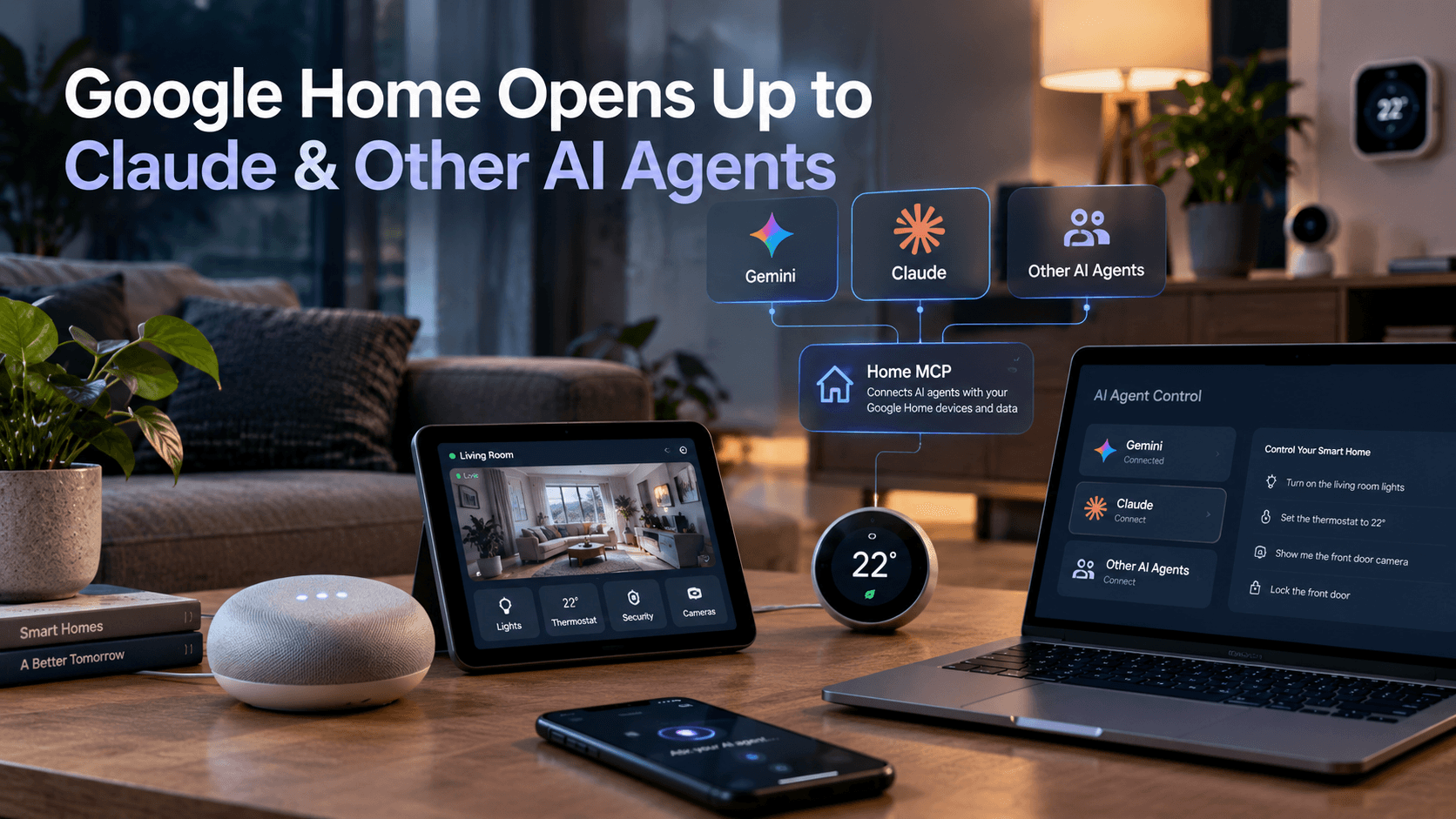
Google is bringing Model Context Protocol support to Google Home, which means the assistant controlling your smart home no longer has to be Gemini.
The connector will let AI agents including Claude, Hermes, OpenClaw and Google's own Antigravity access smart home devices and data, monitor activity, control hardware and build custom dashboards.
What MCP Actually Does Here
MCP is an open-source standard that lets AI models and chatbots communicate with external apps and services, and pull data from them.
Applied to Google Home, that means a connector exposing your smart home to whatever client you prefer. Instead of asking Gemini about your house, you ask Claude, and Claude queries Google Home in the background.
The capabilities go well beyond toggling lights. Agents can read information from cameras and connected devices, analyse event history, act on a user's behalf, send voice messages through Google Home speakers, and generate custom dashboards.
The examples being cited are the ones a traditional voice assistant handles badly: analysing footage across multiple cameras, working out how long lights were left on, or calculating how many loads of laundry ran in a given period. Those are aggregation-and-reasoning tasks rather than commands, and they are precisely what a general-purpose agent does better than a purpose-built home assistant.
Gemini Is Not Being Replaced
Worth being clear on the scope. Gemini for Home remains Google's primary assistant across the Home app and Nest speakers. MCP adds an alternative route in; it does not remove the default.
The practical effect is that your smart home becomes addressable from outside Google's assistant, not that Gemini disappears from it.
Who Gets It, and When
The rollout is narrow. Google Home MCP will be available in early preview over the coming weeks, limited to users in the United States with a Google Home Premium Advanced subscription.
Paid tier, single country, preview status. This is not a general release.
Why Google Would Do This
The obvious question is why a company whose entire smart home strategy runs through Gemini would open the door to competitors.
Part of the answer is user sentiment. Gemini's arrival on Google Home last October was not universally welcomed, and a meaningful share of users have been vocal about preferring the older Assistant behaviour. Giving those users an exit that keeps them on Google hardware is better than losing them to another ecosystem entirely.
The larger answer is that MCP has become the de facto standard for agent-to-service connections, and services that do not expose an MCP endpoint get routed around. Google Home's value lies in the devices connected to it. Making that graph accessible to any agent keeps Google as the infrastructure layer even when someone else supplies the conversation.
There is a broader pattern here too. Google recently expanded internal access to Claude Opus 5 for engineering work through Antigravity, while maintaining Gemini as its primary model. The company appears increasingly comfortable letting rival models operate inside its stack where the alternative is friction.
The Practical Upside
For anyone already running Claude or another agent as their main assistant, this removes a genuine gap. Smart home control has been one of the few areas where you had to switch apps regardless of preference.
It also opens the automation side. An agent that can read your home's event history and act on it is a different proposition from a voice assistant executing commands — you can ask questions that require correlating data across devices and time, which the Home app has never handled well.
The Thing Worth Considering
Handing a third-party agent access to your cameras, door sensors and device history is a meaningful expansion of what that agent knows about you.
MCP connections are permissioned, and users grant access deliberately. But the data involved — when you leave, when you return, what rooms you occupy, what your cameras recorded — is among the most sensitive a household generates, and it will now be flowing to whichever agent you connect.
That is a reasonable trade for people who want it. It is worth making consciously rather than by default, and it is the detail most coverage of this announcement will skip.
Sources
Related Articles