 TEKZARO
Pakistan Tech
SECP Greenlights Regulatory Overhaul Targeting Higher B-READY Rankings
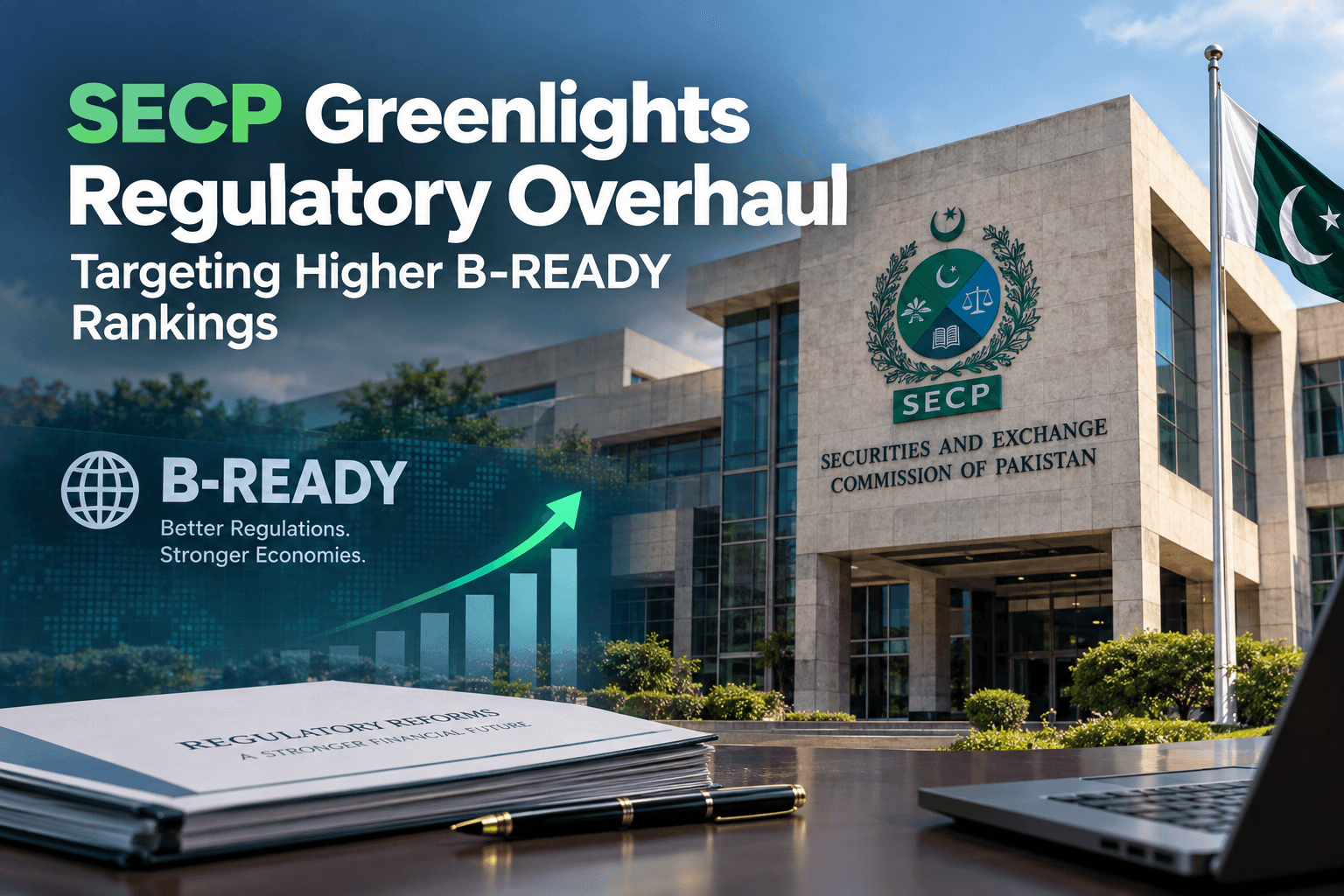
SECP Greenlights Regulatory Overhaul Targeting Higher B-READY Rankings
Pakistan's Securities and Exchange Commission (SECP) has approved a comprehensive set of regulatory reforms aimed at improving the country's performance in the World Bank Group's Business Ready (B-READY) assessment. The reforms represent a strategic effort to close remaining gaps in Pakistan's business regulatory framework and position the country more competitively on the global business environment index.
Pakistan currently ranks 17th among 101 economies in the Business Entry category of the B-READY 2025 Report, with a score of 86.64 points. The newly approved measures target specific areas where regulatory improvements can boost this ranking and bring Pakistan's business regulations closer to international standards.
Understanding B-READY and Its Significance
The Business Ready (B-READY) assessment is the World Bank Group's comprehensive benchmarking exercise that evaluates the business environment for private sector development. The evaluation produces granular quantitative data and provides annual rankings across most economies worldwide, making it a critical indicator of a country's regulatory competitiveness.
B-READY assesses regulatory frameworks across ten topics, measuring performance against three pillars: Regulatory Framework, Public Services, and Operational Efficiency. Countries are evaluated on their ability to facilitate business entry, growth, and operations through clear, accessible regulatory processes.
For Pakistan, a 17th-place ranking in the Business Entry category represents strong performance relative to other developing economies. However, the remaining gaps between Pakistan's score (86.64) and top performers (typically scoring 95+) represent opportunities for meaningful regulatory improvement that could position the country more attractively to both domestic and international investors.
Key Reforms Approved by SECP
SECP's approved reforms address multiple dimensions of business regulatory efficiency and transparency:
Automated Information Sharing With Revenue Authorities — SECP will expand the automated sharing of updated company information with the Federal Board of Revenue (FBR) through application programming interfaces (APIs), in coordination with the Board of Investment. This measure directly addresses one of the most common compliance burdens for businesses: providing the same information to multiple government agencies. By automating data sharing between regulatory bodies, businesses avoid duplicate compliance requirements and reduce administrative friction.
Environmental and Operating Permit Information — SECP will publish information on environmental approvals and operating permits on its website once the relevant authorities provide the data. This creates a centralized information hub where businesses can access permit status and requirements without navigating multiple agency websites or contacting various offices directly.
SME and Women Entrepreneur Support Programs — SECP will make information about publicly funded programmes for small and medium-sized enterprises (SMEs) and women entrepreneurs available through its digital platforms. This improves access to government support resources by consolidating information in one discoverable location.
Gender-Related Data on Business Incorporation — SECP will publish gender-related data on newly incorporated companies, including information on women shareholders, directors, chief executives, and ultimate beneficial owners. This transparency serves multiple purposes: it provides data for monitoring women's economic participation, allows potential investors to understand company governance structures, and contributes to accountability in corporate ownership.
Collaborative Reform Effort
The reforms result from collaboration between SECP and the Board of Investment (BoI). The BoI identified 14 priority reform areas targeting Pakistan's B-READY performance under the Business Entry indicator. Notably, SECP has already implemented most of these proposed measures ahead of formal approval, demonstrating administrative responsiveness.
The timeline matters strategically: reforms completed by September 1, 2026, are eligible for inclusion in the World Bank's next B-READY assessment cycle. By completing reforms ahead of the deadline, Pakistan maximizes the likelihood that improvements will be reflected in the next ranking announcement, potentially raising the country's score and comparative standing.
Regulatory Cooperation and Investor Attraction
Both SECP and the Board of Investment have committed to continuing close collaboration aimed at strengthening regulatory cooperation, removing regulatory bottlenecks, and promoting "a more efficient, transparent, and investor-friendly business environment in Pakistan."
This explicit commitment to investor-friendliness reflects recognition that regulatory competitiveness directly influences investment attraction. International investors evaluating countries for expansion or capital deployment consider regulatory efficiency and transparency as key decision factors. By improving B-READY performance, Pakistan signals to global investors that the government is serious about reducing business regulatory friction.
Reducing Compliance Burden for Businesses
A central theme across these reforms is reducing duplicate compliance requirements and administrative burden for businesses. When companies must provide the same information to multiple government agencies, report to multiple regulatory bodies, or search across multiple websites for government information, the cumulative burden discourages business formation and growth.
By automating inter-agency data sharing, consolidating government information on a single platform, and centralizing business support program information, Pakistan reduces the "compliance tax" that businesses face. This is particularly important for SMEs, which typically have limited dedicated compliance staff and cannot absorb the costs of navigating complex, fragmented regulatory requirements.
Alignment With International Standards
A stated goal of these reforms is bringing Pakistan's business framework "closer to leading international practices." This alignment is significant because investors and businesses operating globally benefit from regulatory consistency across jurisdictions. When countries adopt similar regulatory approaches and frameworks, companies can more easily scale operations internationally.
Pakistan's effort to align with leading international practices also positions the country as a serious participant in global business governance standards. It signals to international organizations, trading partners, and investors that Pakistan is committed to reducing regulatory divergence and participating in global business environment best practices.
Women Entrepreneurship and Economic Participation
The commitment to publish gender-related data on business incorporation reflects broader government recognition of women's economic participation as a development priority. By making data on women shareholders, directors, and CEOs publicly available, Pakistan:
Creates transparency — Stakeholders can see real-time data on women's business leadership and ownership participation.
Enables accountability — Government and civil society can track progress on women's economic participation and identify remaining barriers.
Allows comparative analysis — Policymakers can benchmark Pakistan's women's entrepreneurship rates against other countries and identify best practices.
Signals commitment — Publicizing this data demonstrates government commitment to women's economic rights and participation.
The inclusion of women entrepreneurship support programs on SECP's digital platform also directly improves women entrepreneurs' ability to access government resources and financing.
Implementation Timeline and Assessment Cycle
The September 1, 2026 deadline for reform implementation creates a critical window for the next World Bank B-READY assessment cycle. The World Bank typically releases annual B-READY reports assessing countries' business regulatory performance based on a snapshot of their regulatory framework at a specific point in time.
By implementing reforms before this deadline, Pakistan ensures that the improvements are captured in the next assessment. If Pakistan successfully implements all approved reforms and maintains implementation quality, the country could see meaningful improvement in its B-READY score and ranking in the next report cycle.
Broader Regulatory Environment
These reforms must be understood within the context of SECP's broader regulatory modernization. Earlier in 2026, SECP submitted draft amendments to the Companies Act, 2017, to the Finance Division for consideration. These amendments represent deeper structural changes to Pakistan's company law framework, while the current reforms address administrative efficiency and information transparency.
Together, these efforts suggest a comprehensive regulatory modernization strategy spanning both substantive legal changes and operational/administrative improvements. This two-pronged approach—legal reforms plus operational efficiency—provides the most comprehensive pathway to improving Pakistan's business regulatory environment.
Potential Impact and Next Steps
If successfully implemented, these reforms could meaningfully improve Pakistan's business competitiveness and B-READY ranking. The impact extends beyond rankings to tangible benefits for businesses:
Faster business registration — Automation and reduced duplicate compliance reduce registration timeframes.
Lower compliance costs — Fewer touchpoints with government agencies reduce administrative spending.
Better information access — Centralized, accessible government information reduces search costs and confusion.
Improved resource access — SMEs and women entrepreneurs can more easily discover support programs.
The reforms represent incremental but meaningful progress toward a more efficient, transparent business environment. Whether Pakistan's B-READY ranking improves materially will depend on implementation quality and sustained government commitment to these principles.
For Pakistan's business community and potential investors, these reforms signal that regulatory modernization remains a government priority. For SECP specifically, the approved measures demonstrate institutional commitment to the World Bank's Business Ready framework as a roadmap for continuous regulatory improvement.
Sponsored

Sources
Related Articles