 TEKZARO
AI
6% Gap Between NVIDIA & Huawei: China's AI Chip Market Competitive Landscape Shifts
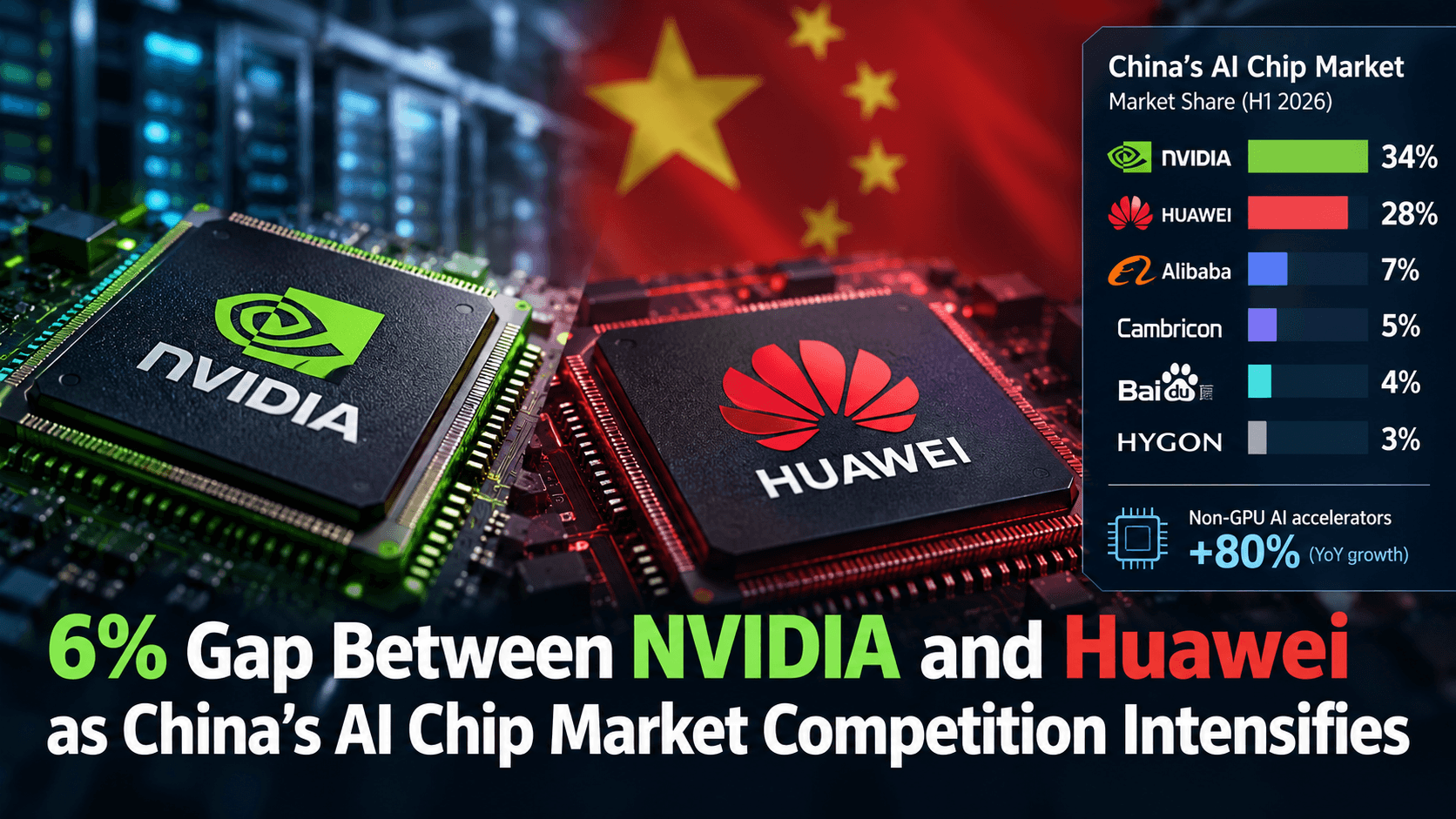
6% Gap Between NVIDIA and Huawei as China's AI Chip Market Competition Intensifies
China’s artificial intelligence chip market is becoming increasingly competitive as Huawei narrows the gap with NVIDIA, leaving the US chipmaker with a six-percentage-point lead in China’s data-centre AI accelerator market during the first half of 2026.
According to market research firm IDC, cited in a Reuters report published on October 13, NVIDIA held 34% of the market between January and June, while Huawei secured 28%. The figures highlight the growing presence of Chinese semiconductor companies as US export restrictions continue to affect access to advanced AI chips.
NVIDIA's Market Share Declines
NVIDIA shipped approximately 678,000 AI accelerators to China during the first half of 2026, representing a 44% decline compared with the same period a year earlier.
The restrictions on advanced semiconductor exports have limited NVIDIA’s ability to supply certain products to the Chinese market. Meanwhile, domestic manufacturers are expanding their offerings as Beijing pushes for greater technological self-reliance.
Although NVIDIA remains a major supplier of AI computing hardware, its declining market share reflects a changing competitive environment in one of the world's largest technology markets.
Huawei Gains Ground
Huawei shipped approximately 572,000 AI accelerators in China during the first six months of 2026, nearly doubling its shipments from just over 300,000 units in the corresponding period last year.
Its 28% market share puts it closer to NVIDIA than in the previous year, demonstrating the progress made by China's domestic AI semiconductor industry.
Huawei's AI computing portfolio, including its Ascend processors, forms part of the country's broader effort to develop alternatives to foreign semiconductor technology.
Other Chinese Chipmakers Expand
Competition is also increasing beyond Huawei. Other Chinese technology companies are strengthening their positions in the AI accelerator market.
According to the reported IDC figures, Alibaba's T-Head held a 7% share, followed by Cambricon at 5%, Baidu's Kunlunxin at 4%, and Hygon at 3%.
The growing presence of these manufacturers indicates that China's AI computing industry is developing into a more diversified market rather than relying on a single domestic alternative.
China's AI Chip Market Is Changing
The market is also seeing a shift in the types of processors being deployed. IDC data showed that shipments of non-GPU AI accelerators increased by approximately 80% year over year in the first half of 2026, surpassing shipments of traditional GPUs.
This trend suggests that Chinese businesses are exploring different chip architectures to meet their AI computing requirements, including specialised processors designed for particular workloads.
However, market share alone does not establish that domestic chips match NVIDIA products in every measure of performance, software compatibility, or efficiency. The ability to build complete computing systems and support large-scale AI workloads remains important to the competitive picture.
What This Means for the Global AI Industry
The narrowing gap between NVIDIA and Huawei illustrates how export restrictions and domestic investment are reshaping the global semiconductor landscape.
For China, expanding domestic chip production could reduce dependence on overseas suppliers. For NVIDIA, restrictions on access to the Chinese market create a commercial challenge even as demand for AI computing continues to evolve.
The longer-term outcome will depend on chip performance, manufacturing capacity, software ecosystems, supply chains, and the direction of future export policies.
For now, the reported six-percentage-point difference provides a clear snapshot of an increasingly competitive Chinese AI chip market in which domestic suppliers are gaining ground.
Sources
Related Articles