 TEKZARO
Pakistan
Punjab Schools Get New Curriculum With AI and QR Video Lessons
<br># Punjab Schools Get New Curriculum With AI and QR Video Lessons
Punjab Chief Minister Maryam Nawaz Sharif has approved a new school curriculum for government schools across the province, combining a lighter textbook load, QR code-linked video lessons and a mandate to develop a full AI curriculum from Grade 1 to Grade 12.
The decision was taken at a special education reforms meeting chaired by the chief minister, where the Punjab Education Curriculum, Training and Assessment Authority briefed participants on the revised curriculum covering English, Mathematics, Social Studies, Urdu and Early Childhood Education.
The Core Changes
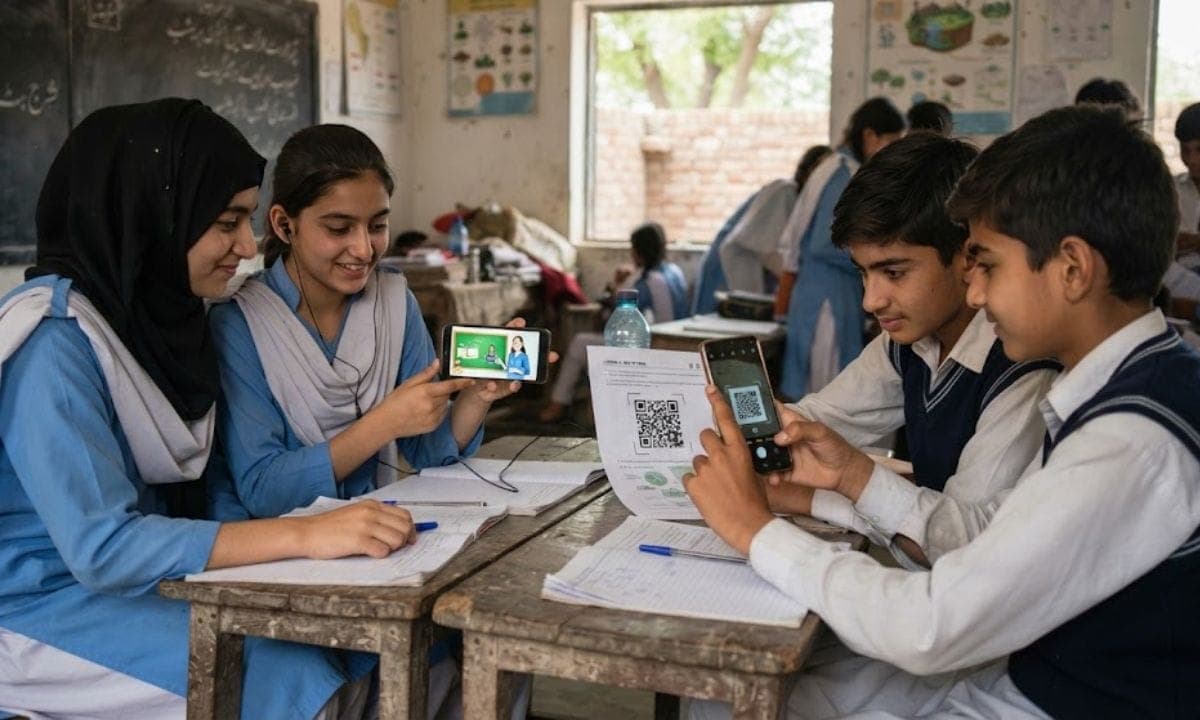
Every textbook in the new curriculum will carry a QR code that students can scan to watch a video lesson on the relevant topic. The approach is designed to shift learning away from rote memorisation toward interactive, multimedia-supported understanding.
The overall textbook burden on students will be reduced by 25 percent — a recognition that the volume of printed material has been a practical barrier to effective learning rather than an aid to it.
The curriculum aims to strengthen academic foundations in core subjects while building the digital literacy habits students will need outside the classroom.
The AI Curriculum Directive
Chief Minister Nawaz directed officials to develop an AI curriculum covering Grades 1 through 12 — the full span of school education. She also ordered that AI laboratories be established in schools alongside the curriculum.
That is a significant mandate. Most countries introducing AI into school education have started with secondary grades and worked downward. Covering Grade 1 through 12 simultaneously, with age-appropriate content across all levels, is an ambitious scope that will require substantial curriculum development work.
Printing of all new textbooks is to be completed before March — ahead of the next academic cycle.
Teacher Training and Student Wellbeing
The meeting produced several decisions beyond the curriculum itself.
Punjab will launch mental health training for teachers for the first time. Psychologists will be considered for appointment in every district, and online counselling services will be made available to students. A proposal to establish discipline corners in classrooms was discussed as an alternative to physical punishment.
Legislation to end corporal punishment in schools is being prepared. The meeting agreed that the practice leaves a lifelong impact on children.
One day each week will be dedicated to teacher training going forward. Authors of the new textbooks will train teachers directly to help them deliver the revised curriculum effectively.
The chief minister said English language training for 35,000 teachers across 31 tehsils in 12 districts has already been completed.
The Implementation Questions
The decisions are ambitious and the timeline is tight. Developing a Grade 1-to-12 AI curriculum, establishing laboratories across Punjab's thousands of government schools, completing textbook printing before March, and embedding QR-linked video content into every subject — all simultaneously — is a large programme.
Previous Punjab education reform announcements have sometimes outpaced implementation. The daily testing and monthly assessment mandate issued earlier this month, alongside 100 percent school inspections and crackdowns on zero-result schools, suggests a government trying to move on multiple reform fronts at once.
Whether the QR video content will be accessible to students in rural districts with limited or unreliable internet connectivity is also an open question — and a significant one given that the students most likely to benefit from supplementary video lessons are in areas with the weakest connectivity.
Sources: TechJuice, 24 News HD, Bloom Pakistan
Sources
Related Articles