 TEKZARO
Computing
Single-Slot 75W RTX 3060 Drops Power Connectors, Pays for It in Performance and Heat
Single-Slot 75W RTX 3060 With No Power Connectors Disappoints in Tests
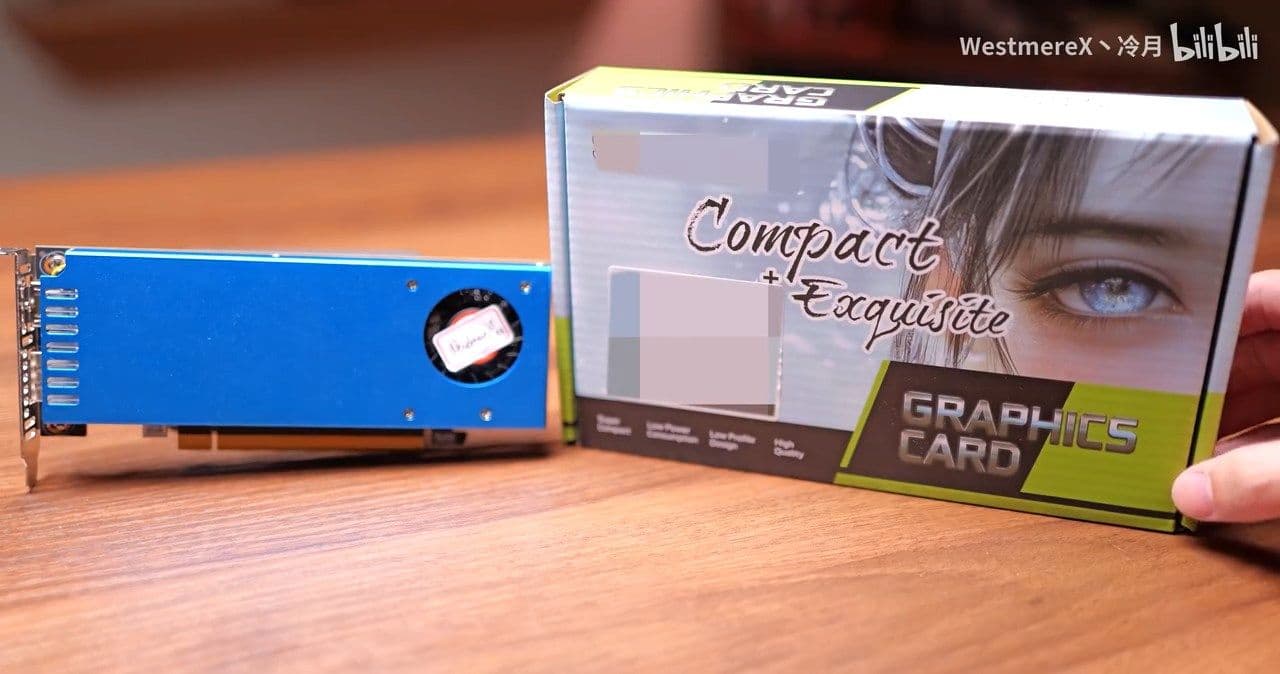
A heavily modified GeForce RTX 3060 that draws power exclusively from a PCIe slot has emerged from the Chinese maker community, but testing reveals performance so crippled that older budget GPUs significantly outperform it. The card, showcased in a Bilibili video, represents an extreme engineering compromise: maximum physical compactness at the cost of usable performance.
The Extreme Compact Design
The modified RTX 3060 is a single-slot, low-profile card about the size of a smartphone. It features just one HDMI and one DisplayPort output. There is no external 6-pin or 8-pin power connector—the card draws all power through the PCIe slot it connects to, which is limited to a maximum 75 watts.
To achieve this, the builder used a shunt mod that alters the power-sensing circuit on the PCB. This modification tricks the GPU into accepting a 75W power limit, far below the RTX 3060's standard 170W power budget. The cooling solution is equally minimal: a thin metal shroud with a rudimentary heatsink in the middle and a blower-style fan. There is no fin stack, no backplate, and no sophisticated heat management infrastructure.
Catastrophic Performance Loss
Testing reveals how poorly the system performs under constraint. The card barely reaches 900 MHz core clock during loaded workloads, despite being rated for 1,770 MHz boost clocks. This represents a 49% reduction in clock speed from specification.
In 3DMark Time Spy benchmarks, the card scores just 4,821 points. A standard RTX 3060 easily exceeds 9,000 points in the same test—more than double the performance. Remarkably, the modified card underperforms older budget GPUs significantly. AMD's RX 580 and Nvidia's GTX 1060—both from 2016—score higher in Time Spy than this 2026-era card running at 75W.
This is not a marginal performance penalty. It is a fundamental uselessness of the device compared to anything released in the past decade.
Alarming Thermal Performance
During testing, the GPU hotspot exceeded 90 degrees Celsius even while severely thermal throttling. The inadequate cooling solution cannot manage even the reduced power draw of the 75W limit. The blower-style cooler is overwhelmed by the heat generated in such a tiny form factor.
This means the card experiences both power throttling (reducing clocks because of power limit) and thermal throttling (reducing clocks because of heat). The combination creates a performance spiral where the card cannot sustain any meaningful clock speeds regardless of how much headroom remains in the power budget.
Who Would Use This?
The only conceivable use case for such a card would be an ultra-compact system with absolutely no internal space for external GPU power cables and no alternative options. However, this scenario has become largely irrelevant in 2026.
Modern mini PCs with integrated graphics—particularly newer Intel and AMD solutions—can match or exceed the performance delivered by this 75W RTX 3060. Nvidia's GeForce GTX 1650 with 50W power consumption would deliver several times the performance in the same physical space. Even ARM-based integrated graphics in compact systems offer better performance-per-watt than this modified card.
Why This Failed Experiment Matters
This modification demonstrates a fundamental engineering principle: removing external power connectors does not make a GPU more efficient. It simply forces the entire system to operate within a much smaller power envelope. The cascading consequences are inescapable: reduced clock speeds, inadequate cooling, severe thermal throttling, and effectively non-functional performance.
A desktop GPU like the RTX 3060 was designed with a power budget, thermal solution, and clock speeds calibrated around the typical 170W power consumption. Cutting that to 75W without corresponding GPU redesign creates a system that can only operate at a fraction of intended performance.
The builder's use of a shunt mod is technically clever—modifying power-sensing circuitry to permit operation outside normal specifications. But cleverness does not solve physics. A small metal sheet cannot dissipate heat that a full heatsink struggles to manage. Throttling to 900 MHz is not a feature; it is a failure mode.
Performance Comparison
To illustrate the scale of the compromise:
- Standard RTX 3060 (170W): 9,000+ Time Spy points, boost clocks 1,770 MHz, typical temps 70-80°C
- Modified 75W RTX 3060: 4,821 Time Spy points, limited to ~900 MHz, temps exceed 90°C
- GTX 1060 (120W): ~5,500 Time Spy points, boost clocks 1,835 MHz, comparable thermals
- RX 580 (185W): ~5,900 Time Spy points, boost clocks 1,386 MHz
The RTX 3060 at 75W sits below decade-old budget GPUs on the performance chart.
The One-Off Nature
This appears to be a custom one-off modification rather than a commercial product. It was created by a Bilibili channel (WestmereX丶冷月) as an extreme engineering experiment. There is no indication this represents a manufacturable approach or that any commercial vendors are planning similar products.
Commercial GPU makers remain uninterested in such designs because the compromises are unjustifiable. Even manufacturers of fanless, low-power GPUs target more reasonable performance envelopes. The RTX 3060 at 75W crosses from "acceptable trade-off" into "fundamentally broken."
The Broader Context
Nvidia's RTX 3060 already takes well to undervolting, allowing the standard card to reduce power consumption to 100W with modest performance loss. But even that 100W figure is 33% higher than what this 75W modification attempts. There is a reason commercial designs don't go below the PCIe slot's 75W limit: the performance collapse begins immediately at that threshold.
For actual ultra-compact system builders in 2026, better alternatives exist. Lower-power RTX cards (RTX 4050, RTX 4060 with 50-60W), or simply accepting integrated graphics performance, represents a more rational approach than forcing a GPU designed for 170W into a 75W straitjacket.
The Verdict
The single-slot 75W RTX 3060 with no power connectors succeeds in one dimension: physical size. It fails catastrophically in every other dimension that matters—performance, thermals, reliability, and practical usability.
This is a cautionary tale about engineering trade-offs. Some compromises cross from "acceptable" into "self-defeating." The RTX 3060 at 75W sits squarely in that territory. It is too slow to be useful, too hot to be reliable, and too compromised to justify the engineering effort that went into it.
For anyone tempted by the concept of an ultra-compact GPU, this test serves as a reminder: sometimes the compactness itself becomes the enemy of usability. The smartphones it was compared to in size contain more computational capability than this card is able to deliver.
Sources
Related Articles