 TEKZARO
Gadgets
The incredible flying Tesla Roadster is just for show
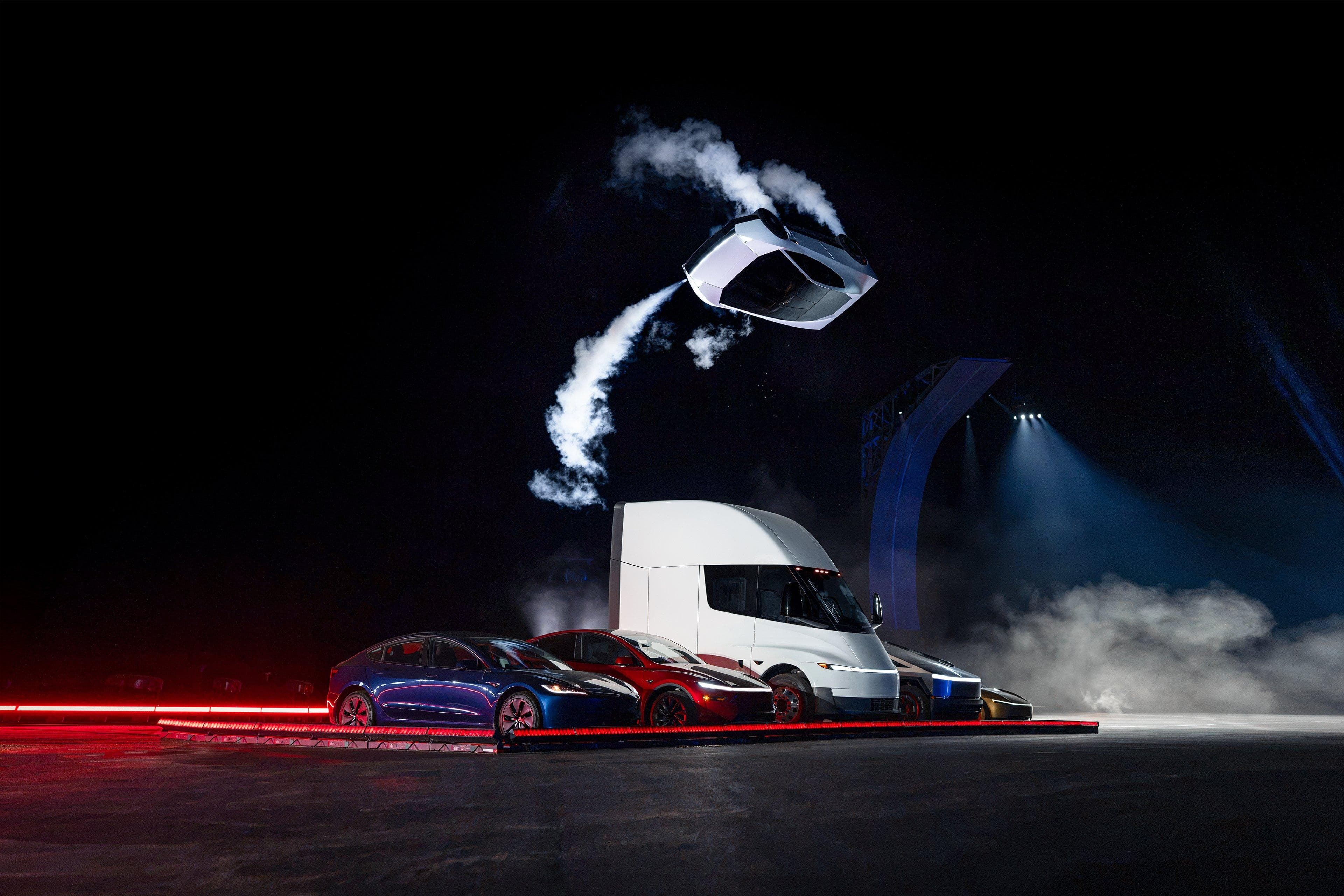
Tesla’s long-awaited next-generation Roadster has finally returned to the spotlight, and this time the electric sports car has taken its performance claims to new heights — literally. During a demonstration in Texas on October 15, 2026, the vehicle performed airborne manoeuvres using propulsion technology associated with Elon Musk’s aerospace company, SpaceX.
The spectacle included the Roadster launching from a curved ramp, rotating in mid-air and landing back on its wheels. However, despite the dramatic demonstration, the vehicle is not yet a practical flying car that consumers can expect to use on public roads.
Tesla Demonstrates a Rocket-Powered Roadster
The demonstration took place at a SpaceX testing facility in Texas, where Tesla showcased the redesigned second-generation Roadster after years of delays.
The prototype used specialised hardware to perform stunts that go far beyond conventional electric-car performance. Tesla has discussed cold-gas thrusters for the vehicle’s most extreme configuration, allowing it to produce brief bursts of thrust for manoeuvres.
Elon Musk has presented the Roadster as a glimpse of a future in which cars could achieve capabilities previously associated with science fiction. Yet a controlled demonstration is not the same as proving that the technology can operate safely, reliably and legally in everyday driving conditions.
The Flying Capability Comes With Major Limitations
Tesla’s proposed Rocket configuration is expected to be the version equipped for airborne manoeuvres. Reporting following the unveiling indicates that this setup differs substantially from a conventional sports car.
The configuration is expected to use compressed-gas equipment and specialised thrusters. Those systems introduce practical trade-offs involving weight, packaging, passenger space and operating limitations.
The Rocket version has also been described as an invite-only configuration with just one seat, unlike the two-seat Performance and Thrust variants.
Most importantly, the demonstration does not establish that owners will be able to use the vehicle’s airborne capabilities on public roads. Aviation rules, safety requirements and the technical challenges of controlling a car in the air remain substantial obstacles.
Tesla Is Still Years Away From Production
Despite the eye-catching reveal, customers will have to wait before the next-generation Roadster becomes a production vehicle.
Musk said Tesla plans to begin building the new Roadster in 2028. The company did not announce a confirmed retail price during the unveiling, leaving important questions about affordability, specifications and availability unanswered.
Tesla has previously made ambitious promises about the Roadster, and the project has experienced repeated delays since its original unveiling in 2017. The latest demonstration is a significant development, but it does not by itself confirm that production targets will be met.
What About the Claimed Performance?
Tesla has made extraordinary performance claims for the new Roadster, including acceleration from zero to 60 miles per hour in less than one second.
Such figures would be exceptional for a production car, but they should be treated as manufacturer claims until independently verified under clearly documented testing conditions.
The same distinction applies to its airborne manoeuvres. Footage of a prototype performing a stunt demonstrates what happened during that specific demonstration; it does not prove that a customer vehicle can repeat the performance consistently or safely in normal use.
A Technology Showcase Rather Than a Ready-to-Use Flying Car
The Roadster reveal serves as both a technology demonstration and a high-profile showcase for Tesla’s engineering ambitions. Its combination of electric propulsion and specialised thrust systems could attract attention to new approaches to vehicle performance.
However, a useful consumer product must offer more than spectacular demonstrations. Reliability, safety, regulatory approval, maintenance, cost and real-world usability will determine whether the technology becomes commercially viable.
For now, buyers should view the flying capability as an experimental feature associated with a specialised configuration, not as an everyday transportation solution.
The Bottom Line
Tesla’s new Roadster has delivered one of the most unusual sports-car demonstrations in recent memory, using specialised propulsion technology to perform airborne manoeuvres. But the vehicle is still awaiting production, its price remains unannounced, and the demonstration does not establish that its flying features will be practical or approved for public-road use.
The flying Roadster is an impressive engineering spectacle, but turning it into a safe, usable production car is a much bigger challenge than performing a stunt at a controlled test facility.
Sources
Related Articles