 TEKZARO
Pakistan
Zong Partners with ISP Environmental Solutions to Launch Pakistan’s First-of-Its-Kind Smart Waste Management Stations
Zong Partners With ISP Environmental Solutions to Launch Pakistan's First-of-Its-Kind Smart Waste Management Stations
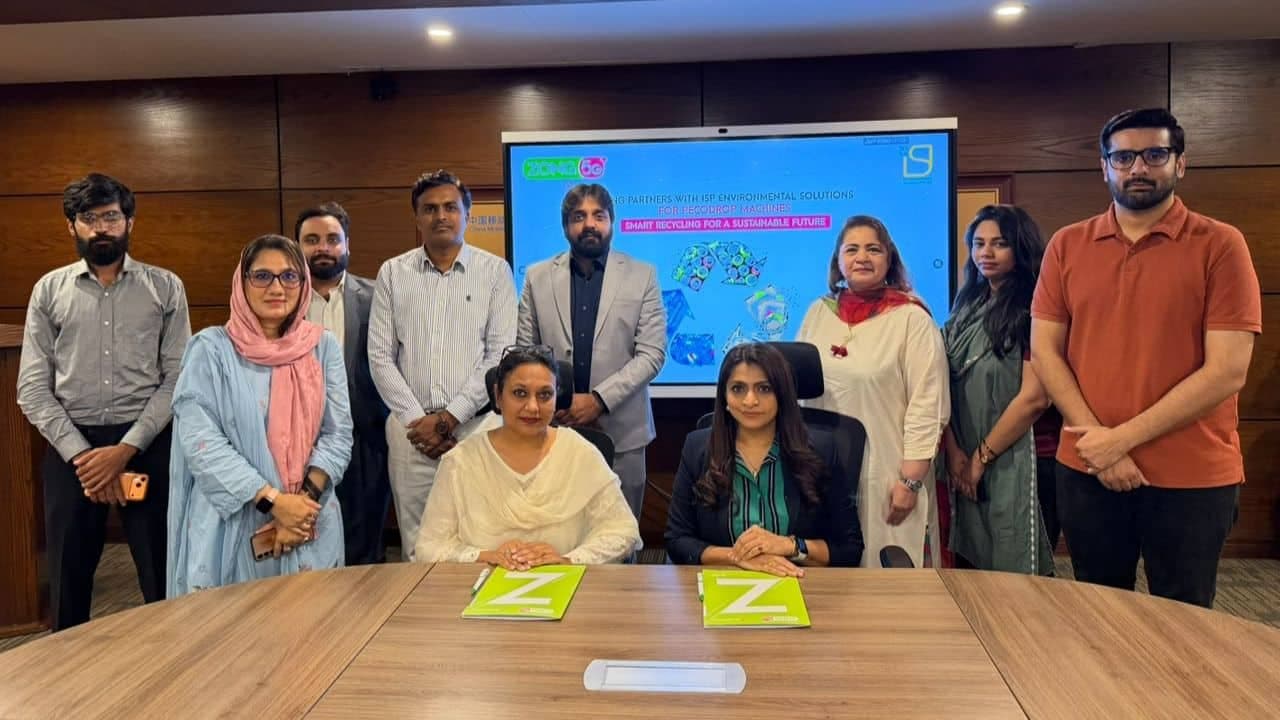
Zong has partnered with ISP Environmental Solutions to deploy PecoDrop, a networked smart waste management system, across Zong facilities in Pakistan.
The stations enable source-level segregation of recyclable plastic, paper and metal, supported by a digital tracking system that logs material deposits, volumes and collections from the point of disposal through to recovery.
What PecoDrop Actually Does
The station's core function is moving segregation to the bin rather than relying on waste handlers to sort material afterwards.
Most corporate recycling programmes fail at exactly this point. Mixed waste arrives at collection, labour is required to sort it, and contamination reduces the value of whatever gets recovered. PecoDrop attempts to solve that by making the separation happen when the material is discarded.
The digital layer is what makes it different from an ordinary recycling bin array. Each deposit is logged, building a data chain that tracks what goes in, in what quantities, and when it is collected. That traceability is what allows the system to verify that recyclables are actually recovered rather than simply mixed back into general waste further down the chain.
The Employee Incentive Mechanism
Zong employees earn Credits for depositing recyclable materials at PecoDrop stations, can track their contributions digitally, and redeem accumulated rewards.
The mechanic is sensible. Segregation at source requires behaviour change, and behaviour change in workplace settings is most reliably produced by making the desired action easier and giving it some form of recognition.
A credits system does not scale to producing meaningful environmental outcomes on its own — the tonnes of material matter more than the gamification. But it is the right design for onboarding participants and making the first deposit feel intentional rather than habitual.
What the Companies Said
Nabila Yazdani, Zong's Head of Strategy and Company Spokesperson, framed the initiative as demonstrating how technology, data and employee participation can create a smarter and more measurable approach to waste management. She said Zong sees technology as a force for sustainable operations and responsible resource use alongside its role in connectivity, and described PecoDrop as a practical step toward building a scalable model.
Dr. Zillay Maryam, CEO of ISPES, said the partnership goes beyond collection — though the quote was not reproduced in full in the available reports.
ISPES was founded in 2018 to develop integrated solid waste management solutions for Pakistan's corporate, industrial and residential sectors. The company has its own upcycling facility for recyclable plastic and provides online access to a waste tracking system for clients. It already has an existing relationship with Zong, having partnered on a coastal clean-up at Hawksbay, Karachi during Plastic Free July in 2026.
The Problem It Addresses
Pakistan's solid waste system generates large volumes of material that could re-enter the economy as raw material but instead goes to landfill or is burned.
The burning point is significant. When waste is not landfilled, it is typically burned informally, which generates carbon dioxide and particulate pollution at the point of disposal rather than at an industrial facility with any controls.
Mixed waste in landfills also destroys value. A plastic bottle sitting in a landfill is worth zero; the same bottle cleaned and processed can re-enter manufacturing. The economics of recovery depend on segregation at source, which is exactly the problem PecoDrop is addressing.
The "First of Its Kind" Claim
The initiative is specifically described as the first of its kind in Pakistan for smart, digitally tracked waste segregation stations deployed in a corporate workplace setting.
That is a narrower claim than it first sounds, and it is the accurate one. Waste segregation stations exist in Pakistan. Employer-provided recycling facilities exist. Digitally tracked collection systems exist at municipal and commercial scale. What the partnership is claiming is the specific combination: a networked, data-generating, employee-incentivised segregation system deployed at a corporate facility, which is a reasonable distinction.
Scale and Next Steps
No facility count or tonnage target has been disclosed. The announcement describes deployment across Zong facilities, which is a starting point rather than a national rollout.
The scalability question is the right one to ask. Corporate sustainability pilots that stay within their originating company are exercises in branding. The more interesting outcome is whether the PecoDrop model is licensed or expanded to other corporate clients, or whether ISPES deploys it as a service offering to the broader market.
ISPES has the upcycling infrastructure on the recovery side. If the stations generate clean, segregated streams at sufficient volume, there is a commercial case for expansion independent of any single partner's sustainability commitments.
Sources: ProPakistani, APP
Sources
Related Articles