 TEKZARO
Computing
Desktop graphics card shipments hit four-year high of 12.5 million despite increasing prices — Nvidia takes 90% share as gamers rush to beat looming price spikes
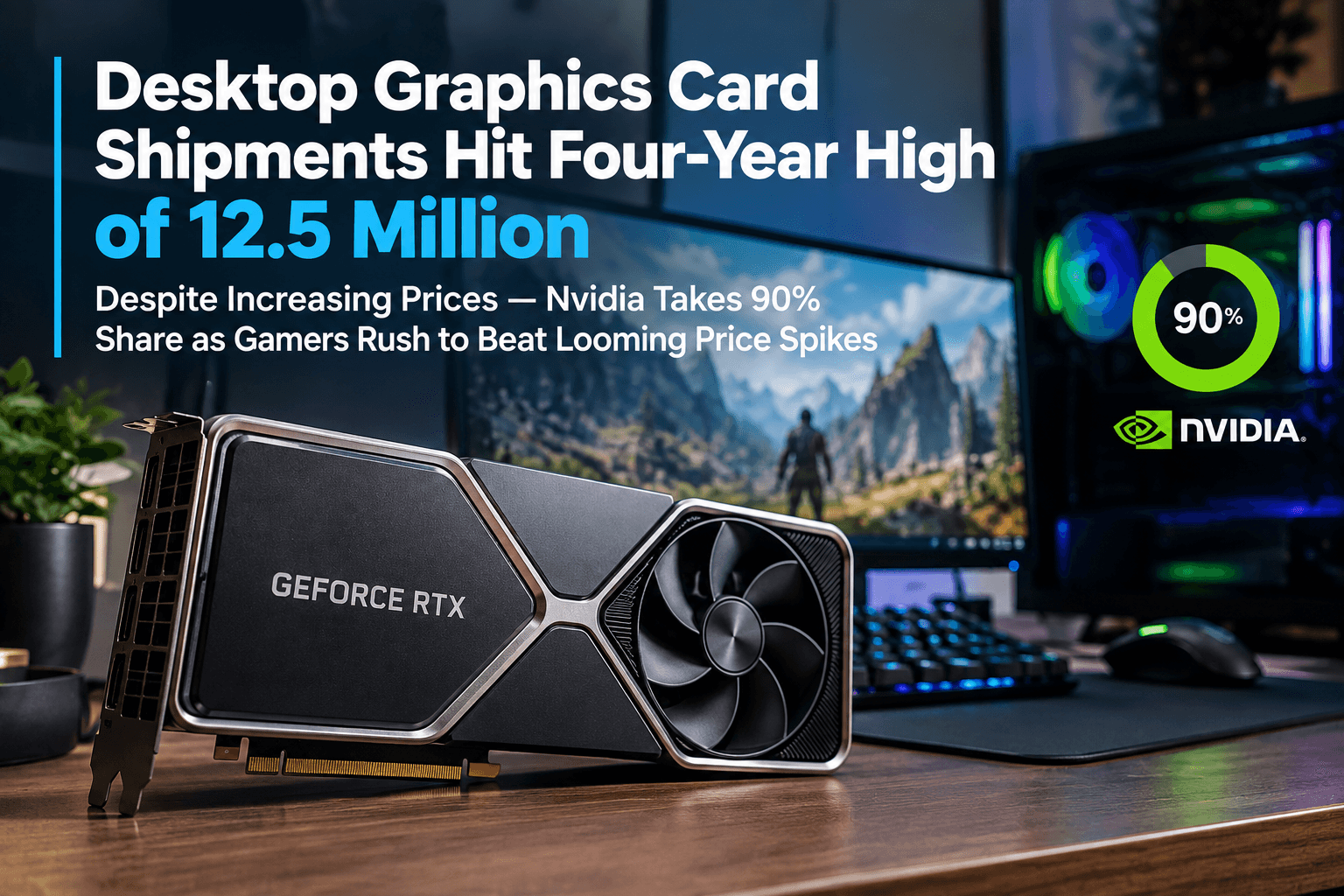
Desktop Graphics Card Shipments Hit Four-Year High of 12.5 Million Despite Rising Prices
The graphics card market did something counterintuitive last quarter. Prices went up, and so did sales.
The industry shipped 12.5 million discrete graphics cards for desktop PCs in Q2 2026, according to Jon Peddie Research. That is up 5.9 percent sequentially and 7.8 percent year over year, and it is the highest quarterly figure since Q1 2022, when 13.38 million add-in boards went out the door during the tail end of the pandemic-era buying frenzy.
It happened alongside record-high card prices and a sharp drop in desktop CPU shipments, a combination that usually points in the opposite direction.
Buying Ahead of the Curve
JPR's explanation is that buyers are front-running further increases rather than ignoring current ones.
"Defying common wisdom, high-end AIB sales spiked as prices increased," said Jon Peddie, president of the firm. His theory is that consumers rushed to buy before prices climbed further, with the war in Iran pushing costs up across all segments.
That reading is consistent with what happened at the high end specifically. If price sensitivity were driving behaviour, the expensive cards would be the first to stall. Instead they spiked, which is the pattern you see when people expect the situation to get worse rather than better.
Memory costs are the other pressure point. Analysts have already forecast further increases through Q3 and Q4 2026, and DRAM pricing feeds directly into card BOM costs. Anyone following that reporting has a rational reason to buy now.
Nvidia at 90 Percent
Nvidia shipped roughly 11.25 million discrete desktop GPUs in the quarter, holding around 90 percent of the market.
AMD took approximately 8 percent on shipments of about one million cards. Intel climbed to 2 percent on several hundred thousand units.
JPR notes that quarter-over-quarter share movement was negligible, which is its own kind of story. A 90-10 split that refuses to budge across multiple quarters suggests the competitive dynamic has settled rather than that it is still being contested.
The trajectory has been building for a while. Nvidia's desktop share sat at 88 percent in Q1 2024. By the end of 2025, AMD's quarterly shipments had fallen to 570,000 units, the lowest quarterly result in the history of both AMD and its ATI predecessor. Intel's Battlemage-based Arc cards, launched into select niches, have not shifted the balance meaningfully.
Intel's 2 percent is worth a small note, though. Earlier JPR data suggested some of Intel's discrete GPU movement may be tied to AI-sector demand rather than gaming, which would make its share gain less about competing for the gaming customer.
Reading the Numbers Carefully
There is a confusing overlap in this reporting cycle that is worth untangling, because two different JPR datasets are circulating and they measure different things.
The 12.5 million figure covers discrete graphics cards for desktop PCs — actual add-in boards.
A separate JPR report covering total consumer PC GPU shipments put the figure at 75.5 million units for Q2 2026, up 10.4 percent quarter over quarter and 1.1 percent year over year. That number includes integrated graphics inside CPUs, and spans desktops, notebooks and workstations. In that dataset, notebook GPU shipments surged 16.8 percent while desktop GPU shipments fell 4 percent.
Those two datasets are not in conflict. The 4 percent desktop decline covers the entire desktop GPU category including integrated graphics, so it cannot be read as a decline in the card market. Likewise, the 12.2 percent discrete GPU growth in that broader report includes gaming notebooks and cannot be read as card market growth either.
In the total consumer GPU market, Intel remains the largest supplier at 56 percent on the strength of integrated graphics in its CPUs. Nvidia sits second at 23 percent, and AMD holds 21 percent, up from 14 percent a year earlier — a gain tied to increased consumer CPU shipments carrying integrated Radeon graphics rather than to any recovery in standalone cards.
What It Means Going Forward
The last comparable moment of demand this strong was Q1 2022, and that quarter was followed by a collapse when crypto demand evaporated and the market flooded with used cards.
The current situation has a different driver but a similar structural risk. If a meaningful share of Q2's 12.5 million units represents purchases pulled forward from later quarters, the correction shows up in Q3 and Q4 regardless of what prices do.
Calendar 2025 closed at 44.28 million cards shipped, up from 34.7 million in 2024, driven largely by Nvidia's RTX 50-series launch. 2026 is tracking ahead of that pace so far.
Whether it stays ahead depends on whether buyers were genuinely ready to upgrade or simply moving their timeline up.
Sources
Related Articles