 TEKZARO
Enterprise
Nokia Defense, C3IA sign UK defence digital transformation MoU
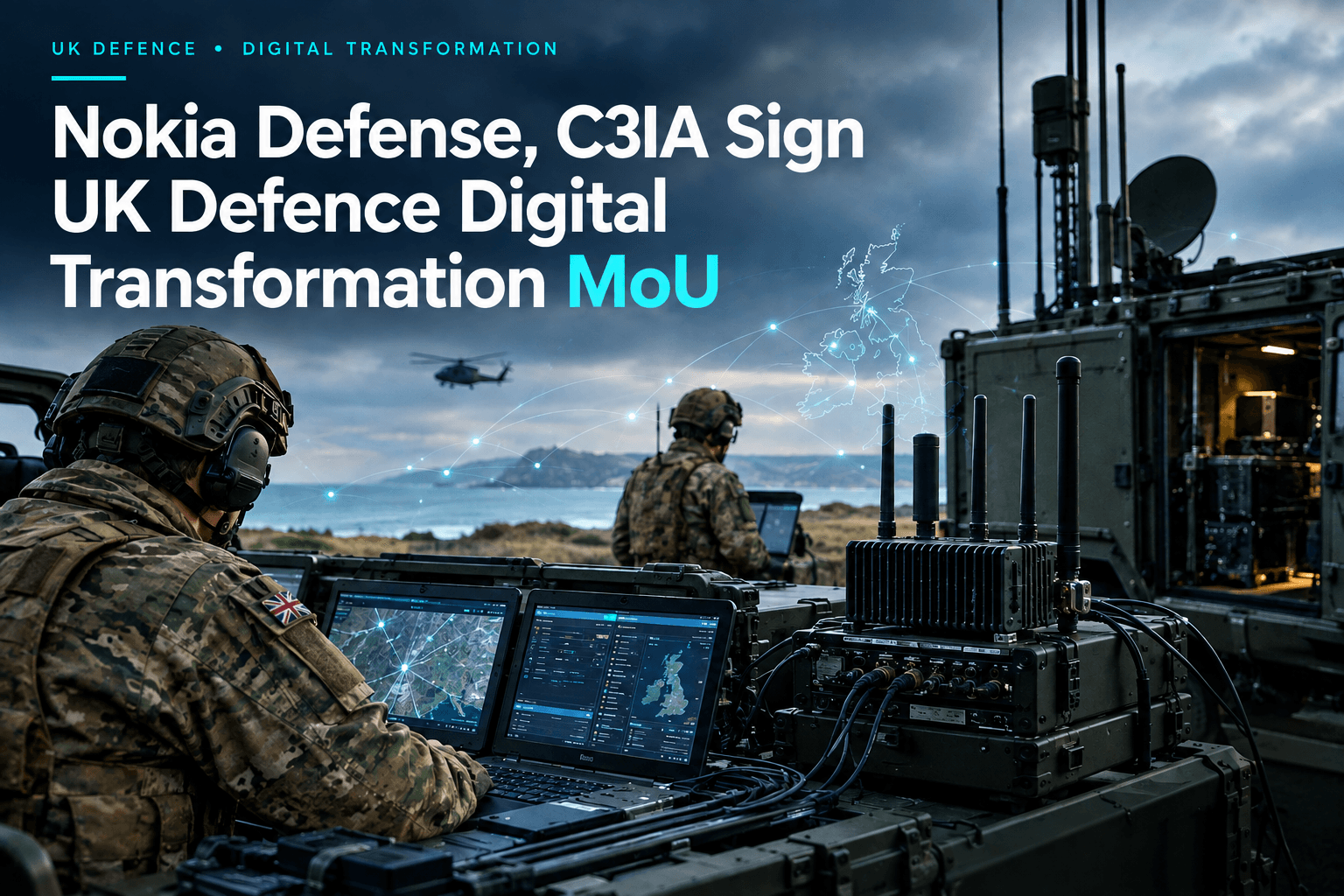
Nokia Defense and C3IA have signed a memorandum of understanding to support the digital transformation of UK defence, announced at the 2026 Defence Vehicle Dynamics event.
C3IA is a UK specialist in systems engineering, capability integration and security services. The partnership pairs its engineering and support capabilities with Nokia's connectivity portfolio.
What the Partnership Covers
The stated aim is delivering resilient communications, secure information sharing and network interoperability across five domains: land, air, maritime, cyber and space.
Co-development work will span tactical and operational communications, private 4G and 5G networks, situational awareness, command and control, sensing, autonomous systems and edge computing.
That list reads broadly because the MoU is broad. No specific programme, contract value or delivery timeline has been attached to it.
What the Companies Said
Mikko Viitaniemi, Vice President and Head of Nokia Defense, framed the arrangement as combining mission-critical connectivity with defence systems engineering expertise to convert technology into operational capability, advancing tactical communications and interoperability across future UK defence programmes.
Steve Brown, Managing Director of C3IA, made the sharper point. Delivering defence capability at pace requires more than technology alone, he said — it needs the right combination of secure communications, sector expertise and systems integration. He described the shared goal as connecting the battlespace, strengthening national security and helping equip the MOD for the future.
Brown's framing is the more informative of the two. The bottleneck in defence procurement is rarely the existence of capable technology. It is integrating that technology into environments with legacy systems, security accreditation requirements and operational constraints that commercial deployments never face.
The TacSys Route
The practical mechanism behind the announcement is procurement positioning.
Both companies already participate in the UK Government's TacSys framework, RM6393 — Nokia Defense and C3IA in Lot 1 (Services) and Lot 3 (Components). That framework gives the MOD and other public sector bodies a route to procure Nokia's connectivity portfolio for future tactical communications requirements.
A framework place means eligibility to bid without repeating full procurement qualification. An MoU between two parties already on the framework means they can approach requirements as a combined offer rather than as separate suppliers who would otherwise need integrating by someone else.
That is the commercially meaningful part of this announcement, and it is easy to miss underneath the multi-domain language.
Why C3IA Matters Here
C3IA specialises in systems engineering, ICT, information assurance and NCSC-assured cyber services, and supports delivery of critical defence programmes.
The NCSC assurance is the relevant credential. Anything touching MOD networks requires security accreditation that commercial telecom vendors typically cannot supply on their own, and the accreditation process is frequently what determines whether a capability reaches the field or stalls in evaluation.
Nokia brings network technology. C3IA brings the ability to get that technology through the door.
Private 5G on the Battlefield
The tactical private 5G element is the technically interesting piece.
Military communications have historically run on purpose-built radio systems. Private cellular networks offer substantially higher bandwidth and better support for the data volumes that sensors, autonomous platforms and edge computing generate — which is precisely what multi-domain operations require.
The obstacles are the ones that have always applied: resilience when infrastructure is contested, electronic warfare exposure, spectrum management in coalition environments, and the security posture of equipment originally designed for commercial deployment.
None of those are addressed in the announcement, which is normal for an MoU and worth noting for anyone reading it as a capability claim.
Market Reaction
Nokia shares rose around 5 percent in premarket trading, though the defence announcement was not the only driver — the company also reported expanding AI-RAN trials with Nvidia on the same day.
The broader context is that European defence spending has risen sharply, and telecom vendors with dual-use technology portfolios have been repositioning to capture it. Nokia Defense exists as a distinct unit for exactly that reason.
What an MoU Is Not
Worth stating plainly: a memorandum of understanding is a statement of intent to work together. It is not a contract, it carries no committed spending, and it creates no obligation on the MOD to procure anything.
What it does is establish the commercial relationship ahead of specific requirements coming to market, so that when a tender appears, the joint offer already exists.
Whether it produces deployed capability depends entirely on what the MOD buys next.
Sources
Related Articles