 TEKZARO
Computing
Proven 8-pin PCIe plugs aren't immune to melting — Thermal Grizzly WireView adapter burns out on Radeon RX 7900 XTX
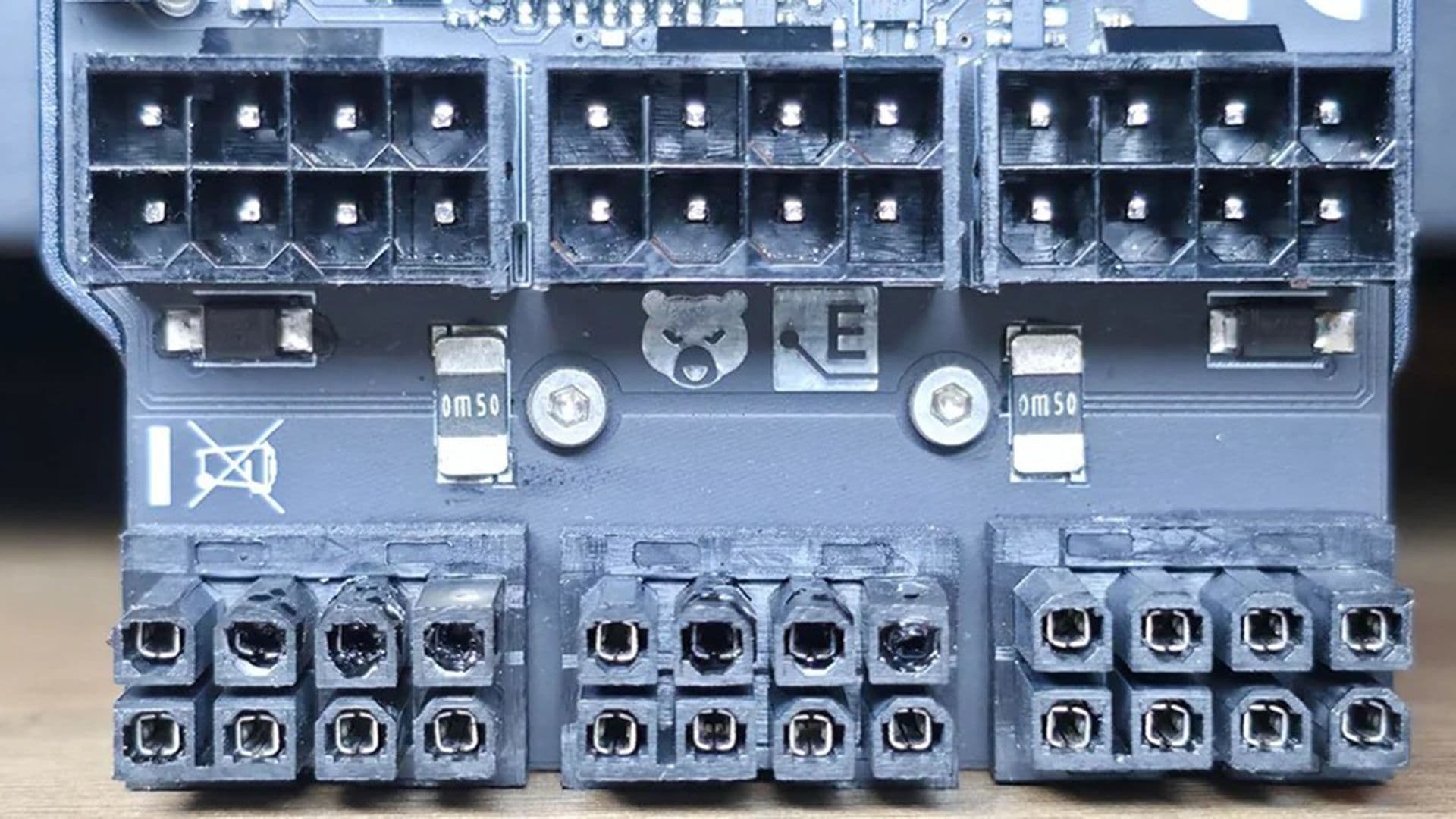
A Radeon RX 7900 XTX owner has found severe heat damage on a Thermal Grizzly WireView power monitoring adapter — not on the 12VHPWR connector everyone has spent three years worrying about, but on conventional 8-pin PCIe plugs.
The case is notable precisely because 8-pin is the connector standard nobody has been worried about.
What Happened
Reddit user AwarenessHour9192 posted images of the damaged hardware after months of chasing an intermittent fault.
The symptoms came first: frequent black screens and system freezes, persisting over several months without an obvious cause. The owner eventually decided to reinstall the graphics card, and found the WireView adapter unusually difficult to remove from the card.
On inspection, two of the three 8-pin connectors showed significant melting — damaged pins and deformed plastic housing around the male side of the adapter. The difficulty removing it was almost certainly the melted plastic itself.
The unit was a reversed-orientation WireView with three 8-pin connections. The owner states the plugs were fully inserted, and that they are ordinarily hard to remove by design.
The Undervolt Detail
This is the part that makes the case genuinely puzzling.
The card was reportedly running an undervolt profile keeping power draw below roughly 300W. A reference RX 7900 XTX has a board power around 355W, and three 8-pin connectors provide 450W of rated capacity before counting the slot.
So the connectors burned while operating well inside their combined rating, on a card pulling less than its stock power budget.
A second user reported the same failure with the same reversed 3x 8-pin WireView model and received a refund after returning it. That user's RX 7900 XTX survived, and their system was also undervolted below approximately 300W.
Two reports is not a pattern. Two reports of the same failure mode on the same specific product variant is worth watching.
Why Total Rating Doesn't Protect You
The physics here is worth spelling out, because "it was under the rated power" is the wrong reassurance.
An 8-pin PCIe connector carries power through three 12V conductors plus grounds. Aggregate capacity across three plugs is substantial. But current does not distribute evenly by decree — it follows the path of least resistance.
If one pin has degraded contact, a bad crimp, a cold solder joint or a compromised trace on the adapter PCB, resistance at that point rises. Heating scales with the square of current through a resistance, so a single compromised contact concentrates heat locally while the other conductors quietly carry more load than designed.
The connector never needs to approach its theoretical total rating for one bad contact to reach melting temperature. This is the same failure mechanism behind the 12VHPWR incidents. The difference is that 12VHPWR has less margin and tighter tolerances, which is why it fails more often — not why it fails differently.
Thermal Grizzly's Response
The company joined the discussion quickly and asked the owner to contact its support team so the damaged unit can be examined.
Thermal Grizzly has previously pointed to improper seating, backplate interference, or incorrectly aligned or soldered contacts as possible causes of connector damage, though it has not identified a cause for this specific incident.
It is not the company's first 8-pin WireView case. In 2024 it documented a separate RX 7900 XTX failure where a custom water block backplate prevented the adapter from seating correctly.
The investigation could determine whether the failure originated in the adapter, the connectors, the GPU, or some combination. That distinction matters commercially — an adapter defect is Thermal Grizzly's problem, a seating issue is a user-installation problem, and a card-side socket problem is AMD's.
What This Does and Doesn't Mean
It does not establish a defect in WireView adapters or in 8-pin PCIe connectors generally. This is a single reported incident plus one similar report, with no independent failure analysis and no teardown yet published.
What it does establish is that the mental model many builders carry — 16-pin is dangerous, 8-pin is safe — is wrong in kind rather than in degree. 8-pin has more margin and a longer track record. It is not immune.
It also highlights an underappreciated risk with inline monitoring hardware. Any adapter in the power path adds two more contact interfaces per connector and a PCB trace between them. That is three additional failure points where there were none, on a device whose entire purpose is measurement rather than function.
Practical Advice
If you run a high-power graphics card, the symptoms in this case are the ones to take seriously: unexplained black screens, system freezes, any burning smell, or connectors that feel hot to the touch after a gaming session.
The owner here spent months treating the freezes as a software or driver problem. That is the natural assumption, and it is why the damage progressed as far as it did.
Check that every power connector is fully seated. Inspect cables and adapters periodically, particularly at the GPU end where the plastic housing sits closest to heat. If an adapter that should slide out is suddenly stuck, that resistance is information.
And if you are running an inline power meter purely out of curiosity rather than for a specific diagnostic purpose, it is reasonable to ask whether the data is worth the extra connections.
Sources
Related Articles