 TEKZARO
AI
Google plans first AI chip test in space under project Suncatcher
<br># Google Plans First AI Chip Test in Space Under Project Suncatcher
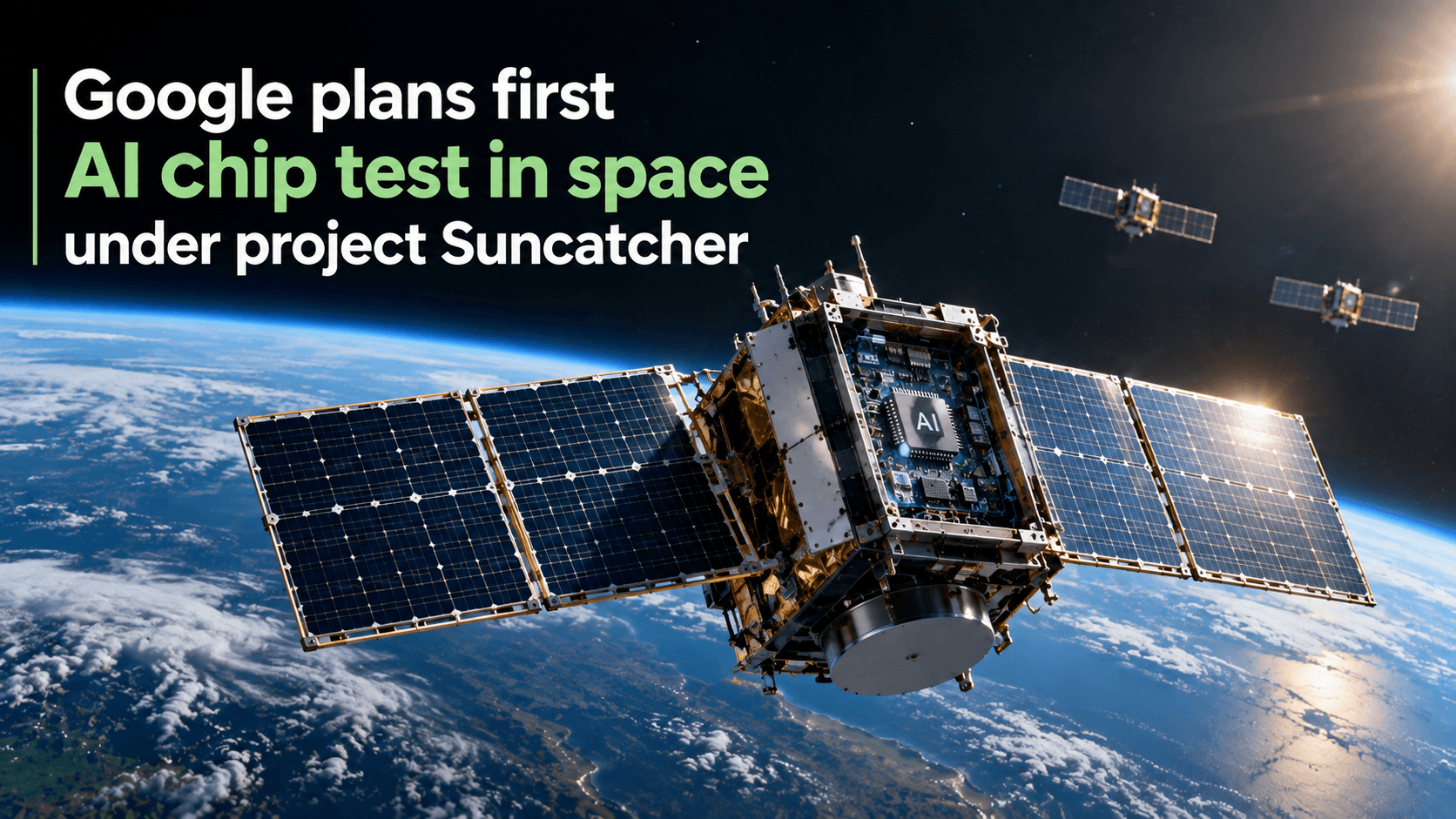
Google will launch a prototype satellite next week carrying its Tensor Processing Units into low Earth orbit, marking the company's first in-orbit test of Project Suncatcher — a research initiative to determine whether space can host large-scale AI computing infrastructure.
The mission is scheduled to fly on SpaceX's upcoming Transporter-18 rideshare launch, in partnership with satellite company Planet Labs.
What Project Suncatcher Is
Announced in November 2025, Project Suncatcher is Google's research moonshot to explore whether an interconnected network of solar-powered satellites equipped with TPU AI chips could one day run machine learning workloads in orbit, powered by near-continuous sunlight.
The idea addresses two constraints that ground-based AI data centres face simultaneously: electricity supply and land use. A satellite in low Earth orbit receives roughly eight times more solar energy per unit area than a ground installation, without the permitting, grid connections and physical footprint that terrestrial facilities require.
Google CEO Sundar Pichai acknowledged the ambition comes with formidable engineering hurdles, describing thermal management of chips and on-orbit system reliability as "significant challenges." He noted early research showed Trillium-generation TPUs survived without damage when tested in a particle accelerator simulating LEO radiation levels.
What This Mission Actually Tests
The first Suncatcher mission is explicitly a data-gathering exercise, not a demonstration of an operational orbital data centre.
The satellite will spend time in low Earth orbit while researchers assess three things. First, whether the TPUs can survive launch forces — the intense vibration of a rocket ascent is one of the fastest ways to find design weaknesses in electronics. Second, how the chips perform under space radiation, which can flip bits, degrade semiconductors and cause unexpected failures over time. Third, whether Google's custom cooling solution works in a vacuum.
That last challenge is the most unusual from an engineering standpoint. Conventional data centre cooling relies on airflow — fans pushing air across chips, cooling towers rejecting heat to the atmosphere. None of that works in space. Google's design uses heat pipes to transfer heat from the chips to radiators, which emit infrared radiation into the vacuum. Managing the high power densities of AI chips this way, across the temperature swings of an orbit that moves through full sunlight to Earth's shadow and back, has not been done before at this scale.
Ground testing at the University of California, Davis gave the team useful data. Orbital testing is necessary because the real environment — radiation environment, vacuum, thermal cycling — cannot be fully replicated on the ground.
The 2027 Roadmap
If the current mission collects useful data on chip survival and cooling performance, Google plans to launch two satellites in 2027 to test the next critical capability: high-bandwidth laser links.
Laser communication between satellites operates at speeds comparable to fibre optics and is what would make distributed space-based computing clusters possible — allowing computation to be spread across multiple satellites that communicate with each other and relay data to ground stations. Without laser links working reliably, individual satellites carrying TPUs are isolated units rather than a coordinated computing infrastructure.
Why Others Are Pursuing This Too
Google is not alone. SpaceX has ambitions in orbital computing through its Starshield programme. Starcloud, a startup specifically focused on space data centres, has been raising capital around the same thesis. The energy argument is the common thread: terrestrial AI infrastructure is consuming electricity at a rate that is straining grids in several regions, and the projections suggest the demand will continue to rise steeply.
Space avoids the electricity procurement problem entirely. The Sun delivers power continuously. The catch is everything else — launch costs, engineering complexity, the satellite production bottleneck that limits how quickly hardware can be deployed, and the latency of sending computation to orbit and results back to Earth.
The Commercial Timeline
Experts are consistent on the distance between today's experiment and a commercially viable orbital data centre. Google itself has said the concept could become economically feasible by the mid-2030s. The Transporter-18 mission is a first step in a programme that, if it proceeds without major setbacks, might produce a demonstration-scale system in the second half of this decade.
Pichai's framing is apt: "Like any moonshot, it's going to require us to solve a lot of complex engineering challenges." What distinguishes Suncatcher from prior moonshot announcements is that hardware is going to space next week rather than remaining in a research paper.
Sources: Dawn/Reuters, Google Blog, Inside AI
Sources
Related Articles