 TEKZARO
AI
Microsoft Rebuilds Copilot Around Chat, Coding and an AI Agent That Keeps Working
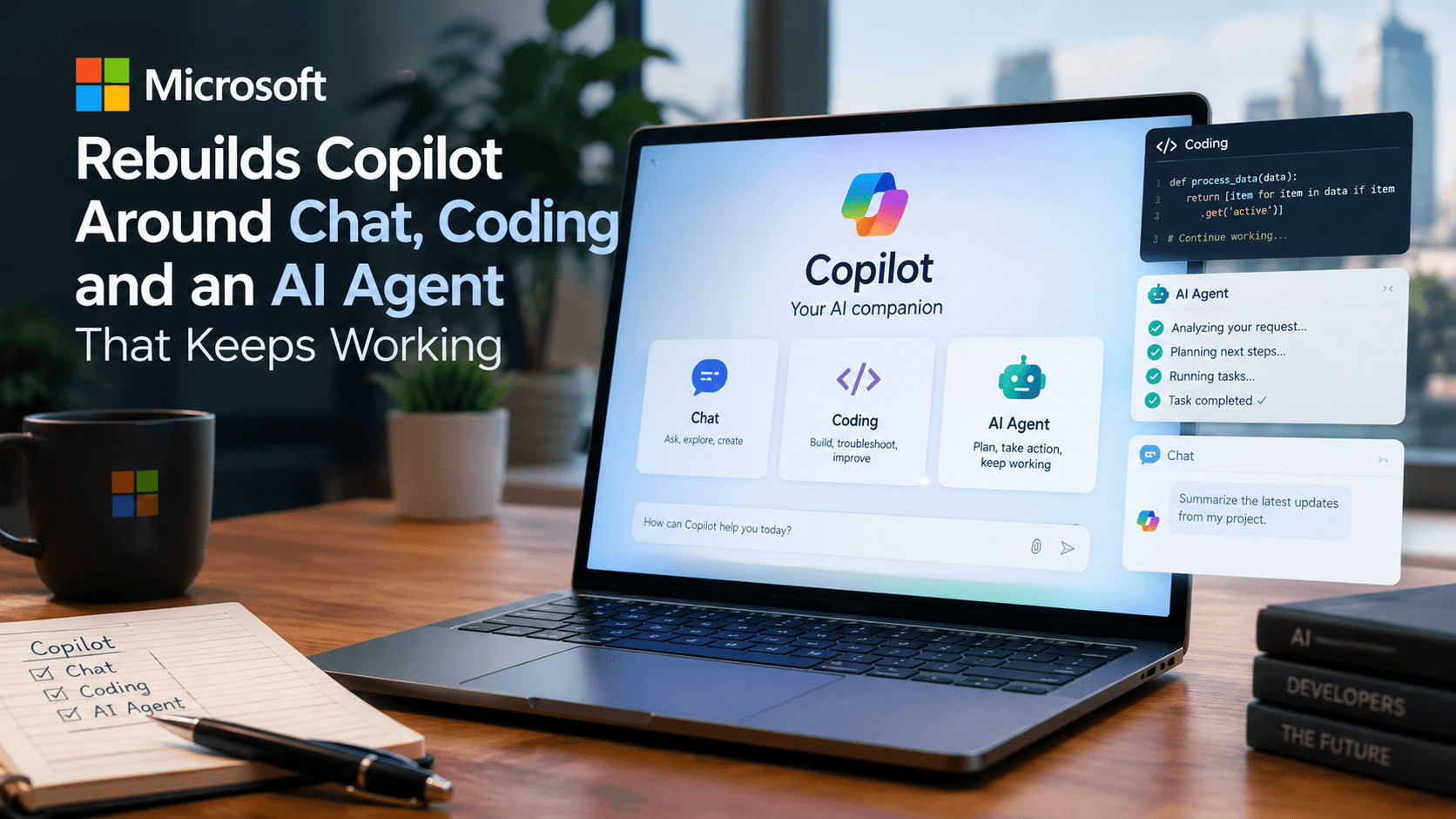
Microsoft unveiled the biggest overhaul of its Copilot AI assistant since launch on September 25, 2026, reorganising the product around three distinct surfaces — Home, Code and Autopilot — and explicitly framing it as a response to ground being ceded to Anthropic and OpenAI in enterprise AI.
CEO Satya Nadella called it the biggest update to Copilot yet. Microsoft shares rose about 3 percent following the announcement.
The Three Tabs
Home is the new default screen. It merges Copilot Chat and Microsoft's Cowork agent in one place, alongside full embedded versions of Word, Excel and PowerPoint. Chat handles instant, conversational work — quick questions, drafts, lookups. Cowork is for tasks worth delegating: an RFP response, a launch kit, a financial close package. You define the objective; Cowork runs it end-to-end and returns a completed result.
Code lets any employee build applications, dashboards and automations by describing them in plain English — no development background required. It generates a TypeScript/React application that deploys inside the company's Microsoft 365 tenant through a new hosting layer called Copilot Managed Runtime. The technology underlying it is similar to GitHub Copilot, but the target user is a non-developer creating tools for their team rather than a software engineer writing production code. Early-access customers get it at the end of September; Microsoft 365 Premium and Pro subscribers can preview it later in the year.
Autopilot is the renamed Scout agent, first shown at Build in June. It is persistent — it keeps working when the user is not present, with its own memory, identity and Outlook account managed by IT inside the company's Microsoft 365 tenant. It is an always-on digital teammate rather than a session-based assistant. Microsoft VP Annie Pearl said the architecture was built specifically to address security, compliance and governance concerns that had prevented enterprises from adopting agents until now.
A VS Code improvement tied to the update was cited as reducing data leaks from AI agents from 30 percent to 5.9 percent — a specific number, and a meaningful reduction for enterprise security teams.
The Model Roster
Copilot now routes requests across models from OpenAI, Anthropic and Microsoft's own MAI family, including MAI-Image-2.5 and MAI-Code-1-Flash. Nadella told the launch event that companies should be able to benchmark AI models against their own data and swap providers rather than depend on a single lab.
Notably, the Home tab offers no Microsoft model in its default configuration, according to CNBC's reporting — the experience runs on OpenAI and Anthropic models. That is an unusual position for a company that has invested heavily in its own AI research.
Pricing Shift
The familiar $30 per user per month Microsoft 365 Copilot seat licence remains for everyday conversational use. Cowork, Code, Autopilot and the most capable frontier models move to consumption-based billing through Copilot Credits, layered on top of the seat licence.
For enterprise customers, usage-based services remain off by default until an administrator creates a spending policy — addressing the concern that AI costs could scale unpredictably across large organisations.
The Strategic Context
Fewer than 7 percent of Microsoft's 450 million commercial Office 365 seats carry a Copilot licence, which is the adoption problem underlying this entire launch. At that penetration rate, Copilot is a premium add-on for a small fraction of Microsoft's existing customer base rather than a broadly used product.
The consolidation of consumer and business Copilot into one enterprise-first application signals that Microsoft is pulling back from competing in the personal AI assistant market where ChatGPT, Claude and Gemini have built consumer habits, and concentrating instead on the corporate accounts it already serves through Microsoft 365.
Jacob Andreou, the executive vice president leading Copilot, took a pointed shot at Anthropic's Claude Cowork during the event, saying that sending sensitive company files to a local virtual machine was not an option for Microsoft's customers — a reference to how Cowork on Claude processes documents locally. Microsoft's counter-argument is enterprise security posture: everything in the new Copilot stays inside the company's Microsoft 365 tenant.
Nadella framed the real test in a single question: will users trust the system enough to entrust it with meaningful work? The restructured Copilot is the answer Microsoft is betting on.
Sources
Related Articles