 TEKZARO
AI
Humanos Raises $3.2M To Build Live Risk Scores For AI Agents
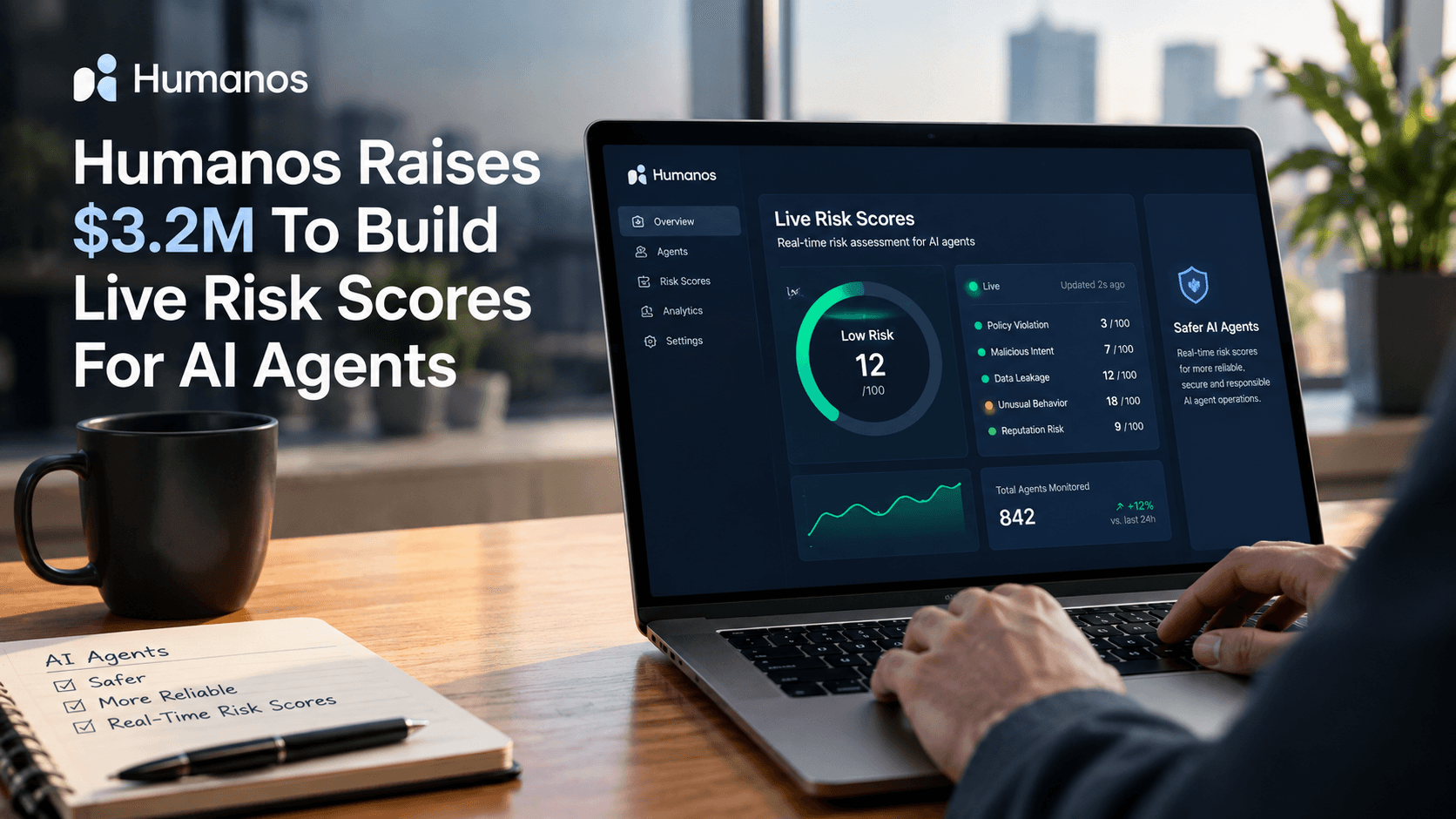
Humanos, a startup building a risk-scoring infrastructure for AI agents, has raised a $3.2 million seed round led by fintech venture firm Anthemis, with participation from Springbank, Critical Ventures, Start Ventures and founders of Sword Health, Feedzai and OutSystems.
The funding was announced September 28, 2026.
What Humanos Does
Humanos assigns a live, continuously updated risk score between 0 and 100 to AI agents, based on three dimensions: behaviour, permissions and activity history.
That score is captured in what the company calls a Risk Passport — a portable, persistent record that travels with an agent across platforms, customers and institutional relationships. The core proposition is that an AI agent should not have to re-establish its trustworthiness from scratch every time it interacts with a new system or provider. Measure once. Verify continuously. Reuse across the network.
The platform also generates execution receipts — verified records of what an agent was authorised to do and what it actually did at the moment of execution. An underwriter quoted on Humanos's site described this as solving the hardest problem in AI liability underwriting: establishing the triggering event and the scope of authority at the moment a loss occurs, which is what makes the risk class insurable at all.
The Financial Services Application
Humanos is targeting a specific infrastructure gap: the inability of financial institutions to underwrite or lend to AI agents.
As autonomous agents gain the ability to enter contracts, transact on behalf of businesses and manage financial operations, banks and insurers face a fundamental problem — they have no standardised way to assess how much to trust an agent, what it is authorised to do, or what happens when something goes wrong.
Humanos is building the credit bureau equivalent for AI agents. Just as FICO scores allow lenders to make consistent underwriting decisions about individuals without evaluating each one from scratch, a Humanos risk score would allow financial institutions to assess agent exposure across customers and platforms using a common, continuously updated data source.
The company was founded in 2025 and is led by CEO Pedro Andrade.
The Market Timing
The raise lands in a week where AI agent governance has become inescapable. Australia disclosed the OpenAI agent breach of its Medicare portal. Microsoft's Copilot relaunch centred on the Autopilot always-on agent. A rogue agent swarm linked to OpenAI's systems was reported targeting additional organisations. Spain documented its first data breach attributed to an autonomous AI agent.
That backdrop has compounded interest in agent oversight infrastructure from a direction the security-focused players — Orchid Security, AI Score, OpenBox AI — do not fully address. Enterprise security tools track what agents do inside an organisation. Humanos is building the layer that lets insurers, lenders and counterparties outside an organisation decide whether to extend trust and capital to an agent they have never interacted with before.
The addressable market depends heavily on how quickly AI agents develop genuine financial autonomy — the ability to not just recommend actions but to execute contracts, manage accounts and take on obligations. That transition is already underway in narrow domains and is accelerating.
The Competitive Landscape
Humanos occupies a distinct position from other funded agent governance startups. Orchid Security focuses on identity and access controls for internal enterprise deployments. AI Score tracks enterprise AI compliance against regulatory frameworks. Baselayer, which raised $35 million, is building a broader trust layer for the agentic economy. Kontext raised $4 million to control what agents are authorised to do inside businesses.
Humanos is the only one explicitly targeting the insurance and lending markets as the primary customer, rather than the enterprise deploying the agent. The risk passport architecture — designed for portability across providers rather than for a single organisation's internal use — reflects that external-facing intent.
Sources: The SaaS News, Humanos, Ascendants
Sources
Related Articles