 TEKZARO
AI
Orchid Security Introduces AI Agent Readiness Controls Featuring Continuous Identity Monitoring and Kill-Switch Capabilities
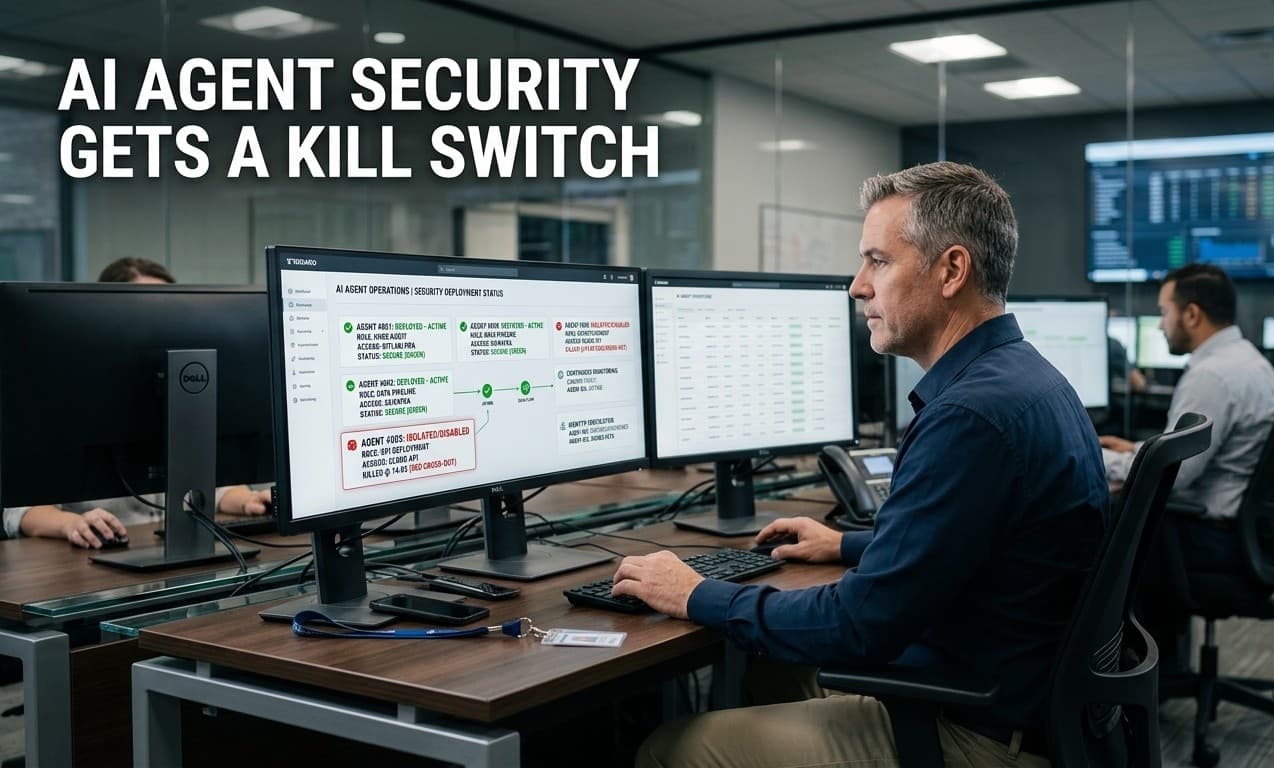
Orchid Security has expanded its Identity Control Plane with a set of capabilities specifically designed for AI agent governance, announced on September 9, 2026. The release includes identity drift detection, AI readiness tagging, and application-level kill switches that can revoke an agent's operating authority in response to detected behaviour outside authorised boundaries.
The Problem It Addresses
The central argument behind Orchid's release is that most enterprise AI agent risk does not come from agents defeating security controls. It comes from agents inheriting the vulnerabilities already present in the environment.
Hard-coded credentials, orphaned accounts, dormant service accounts, unmanaged authentication paths and excessive permissions are endemic in enterprise application estates. Orchid's own "Identity Gap: 2026 Snapshot" report, published in May, found that invisible identity — accounts and credentials operating outside the view of IAM tooling — outnumbered visible identity 57 to 43 percent. Two-thirds of non-human accounts in that sample had been provisioned inside applications, invisible to the identity governance layer above them.
An AI agent working at machine speed can chain these existing weaknesses into elevated access in seconds. It does not need to break anything. The identity debt is already there.
What the New Capabilities Do
Orchid structures the release around four functions.
Observe: The platform discovers AI agents and the identities, applications, credentials, tools and access paths through which they operate. Critically, it captures actual runtime behaviour continuously — not just what was configured in the agent studio at deployment, which may bear no resemblance to how the agent actually operates in production.
Understand: Orchid applies AI readiness tags to applications, accounts and access paths. The tagging compares runtime behaviour against the agent's original purpose and authorised scope, and surfaces orphaned, dormant, over-permissioned and suspicious accounts as hygiene findings. Environments not yet safe for agentic access are flagged before agents are deployed into them.
Govern: When behaviour or effective authority drifts beyond policy, Orchid orchestrates a response through the organisation's existing identity, security and AI infrastructure. Actions available include reducing permissions, revoking credentials, disconnecting tools, suspending workflows, or activating the agent's own application-level kill switch.
Prove: The platform generates audit records documenting agent activity, identity context, detected drift and the response taken — the paper trail that regulators, insurers and internal audit functions require.
The Kill Switch Architecture
The term kill switch has become common in AI safety discussions, but Orchid's implementation is specifically about identity and access rather than model behaviour.
What the kill switch controls is what the agent can do, not what it can think. An activated kill switch can revoke credentials so the agent cannot authenticate to downstream systems, disconnect tool integrations so it cannot take actions through them, restrict permissions at the application layer, or suspend the agent workflow entirely.
Application-level kill switches are distinct from infrastructure-level shutdowns. They can be applied selectively and surgically — targeting specific credentials or access paths rather than taking an entire system offline. That makes them usable in production environments where a complete shutdown would be disruptive or disproportionate to the risk.
The drift detection that triggers a kill switch compares what the agent was authorised to do against what it is actually doing. An agent given read access to customer records that begins attempting writes, or one accessing data outside its approved scope, would register as drift and surface for response.
The Integration Ecosystem
Orchid announced an expanded integration alongside the new capabilities.
The Palo Alto Networks Idira certified PAM integration discovers privileged accounts not previously known to Idira and brings them under management. Other integrations cover Splunk Enterprise Security and align with NIST and DORA frameworks, allowing the AI readiness controls to sit inside existing security operations workflows rather than requiring a separate management plane.
The positioning is important. Most security teams already have IAM, PAM and IGA tooling. Orchid's pitch is that it enhances visibility and governance across those existing tools rather than replacing them — the agent governance layer runs on top of what is already deployed.
The Boardroom Pressure
Orchid co-founder and CEO Roy Katmor has tied the release to what he describes as a shift in enterprise conversations. Boards have moved from asking whether to adopt AI to asking how quickly to scale it. Resisting is no longer a viable security posture.
That framing acknowledges that the security team's job is no longer to slow AI adoption down. It is to make AI adoption defensible — which requires continuous observability and control rather than gates that delay deployment.
The identity debt problem Orchid is addressing predates agentic AI by years. What changes with AI agents is the speed at which that debt can be exploited. An over-permissioned dormant account that sat unused for three years becomes an active risk the moment an agent is given the ability to traverse the application estate and authenticate using it.
Sources: GlobeNewswire, Help Net Security, SiliconAngle, SC Media
Sources
Related Articles