 TEKZARO
AI
Alibaba Unveils New AI Chip And Data Center Expansion Plan
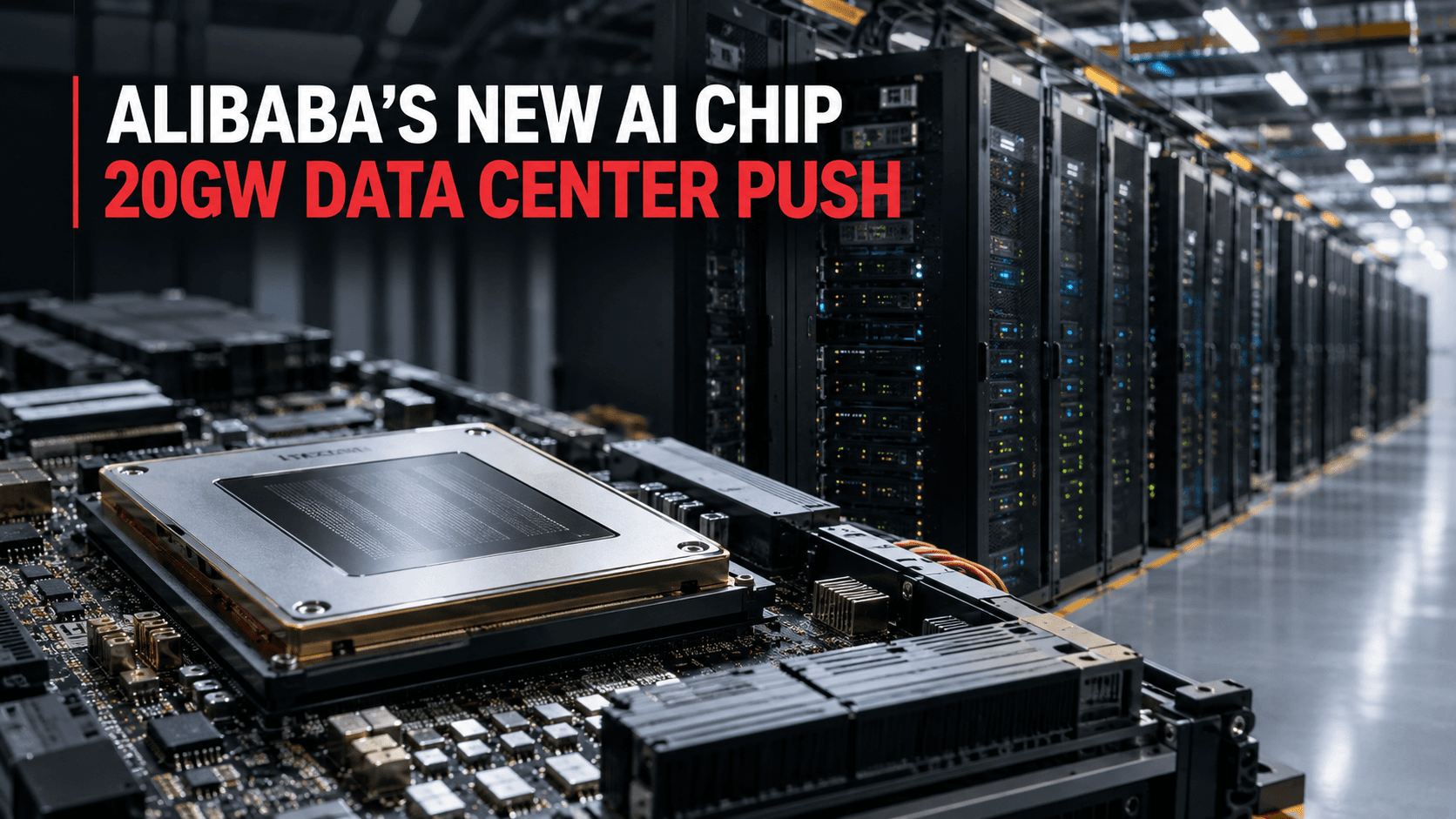
Alibaba has been moving on two parallel fronts in 2026: upgrading its in-house AI chip and aggressively scaling the data centre infrastructure that runs on it. Together, they represent the most sustained push yet by a Chinese technology company to build an AI stack that does not depend on Nvidia or other foreign hardware.
The Zhenwu Chip
Alibaba's chip work runs through T-Head, its semiconductor design subsidiary. The Zhenwu AI chip, first introduced in 2024, was designed from the outset for both AI training and inference at scale — capable of supporting models with hundreds of billions of parameters.
In May 2026, Alibaba unveiled an upgraded version alongside a new large language model. The updated chip is described as more powerful than its predecessor and designed to deliver improved performance and efficiency for AI workloads. Alibaba did not disclose specific technical benchmarks at the announcement.
CEO Eddie Wu told analysts on the company's Q2 2026 earnings call that Alibaba remains confident about its AI and cloud business, and expects profit and gross margins to increase as it ramps up deployment of proprietary chips in its data centres, with those chips accounting for an increasing proportion of total hardware and replacing commercially procured chips over time.
That statement is as close to a strategic commitment as the company has publicly made. The direction is clear: internally developed silicon will displace external procurement as the dominant compute source across Alibaba's infrastructure.
The Shaoguan Data Centre
The most visible expression of that strategy launched in April. Alibaba and China Telecom jointly flipped the switch on a new AI data centre in Shaoguan, Guangdong province, powered by 10,000 Zhenwu chips in a single networked cluster.
The facility is owned and operated by China Telecom. Alibaba describes the system as fully domestic — every chip in the cluster manufactured internally. The design supports AI training and inference at the scale of hundreds of billions of parameters.
The initial 10,000-chip deployment is planned to expand to 100,000 chips, creating a computing cluster aimed at applications across healthcare, materials science, government and enterprise AI.
Alibaba Cloud framed the project as a shift from high-end performance breakthroughs to large-scale industrial implementation of AI — a deliberate move from headline benchmark numbers toward deployed commercial capacity.
The Shaoguan launch came roughly one month after a large-scale cluster of Huawei Ascend 910C chips was commissioned in Shenzhen, underscoring that domestic AI infrastructure is scaling simultaneously across multiple Chinese companies rather than being concentrated in one.
The Modular Expansion
Alongside the Shaoguan facility, Alibaba Cloud announced it plans to more than double its global capacity for modular data centres in 2026.
The modular approach is designed for speed. Alibaba says its standardised design can support the deployment of large AI data centres in approximately 100 days, reducing construction costs by more than 10 percent compared to traditional development. The expansion targets Alibaba Cloud's AI infrastructure deployment across global markets, not only China.
The Financial Reality
The scale of the investment is visible in Alibaba's earnings. Quarterly net profit fell 75 percent as AI capital expenditure ramped up. Capex for the most recent quarter came to $10.07 billion — up 75 percent year on year. Operating margins were 6 percent, down 14 percentage points from the year prior.
Those are the numbers of a company absorbing short-term earnings compression in exchange for infrastructure that will take years to pay back. Wu's reference to margin improvement as proprietary chip deployment scales is the financial argument: internally designed chips, once at volume, should cost less per unit of compute than commercially procured hardware.
The Export Control Context
All of this is happening because access to advanced foreign chips is restricted. US export controls have blocked Chinese companies from purchasing Nvidia's most capable AI accelerators, progressively tightening to cover the H20 — a chip Nvidia had specifically designed to comply with earlier restrictions.
The consequence has been acceleration of domestic alternatives. Alibaba's T-Head, Huawei's HiSilicon, and a handful of other Chinese chip designers have all intensified development in direct response. What was previously an aspirational self-sufficiency goal has become an operational necessity.
China Unicom's data centre in Xining, Qinghai, was partially powered by Alibaba chips as early as September 2025, demonstrating that commercial deployment outside the Alibaba group had already begun before the Shaoguan launch.
Whether domestic chips will reach performance parity with leading Nvidia hardware — for training frontier models, not just inference — remains the open question the industry has not publicly answered. Alibaba's own executives have not claimed that directly. What they have committed to is increasing reliance on what they build themselves, regardless of where that ceiling sits.
Sources: TechRepublic, Data Center Dynamics, TechNode, Open Data Science, CNBC via observatorioglobal
Sources
Related Articles