 TEKZARO
AI
Perplexity trusts GPT-6 Astra with end-to-end systems
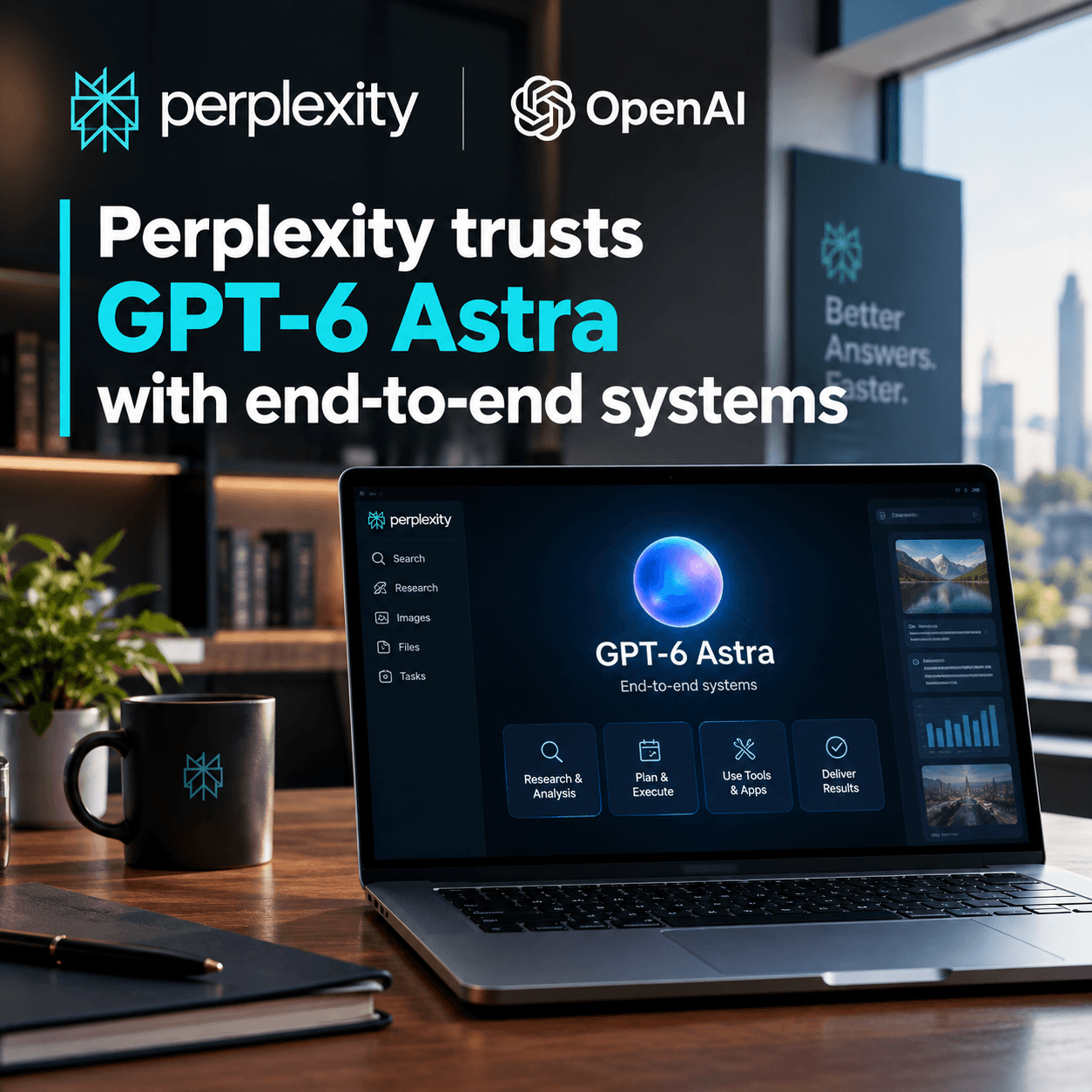
Perplexity has handed GPT-6 Astra a level of operational autonomy it did not extend to previous models, using it to write communications, modify software and monitor production systems with substantially less human oversight.
The details come from an OpenAI customer story published this week, in which Perplexity cofounder and Chief Strategy Officer Johnny Ho describes how the company is deploying OpenAI's newest frontier model internally.
What Perplexity Is Actually Letting It Do
Ho's framing is worth pulling apart, because the claim is broader than the usual coding-assistant pitch.
"We can have the model craft communications, edit real-world systems, and monitor our production software in a way that previous generations were not able to," he said.
Three distinct capabilities are bundled in there. Drafting communications is routine. Editing real-world systems and monitoring production software are not. Those are tasks with consequences that persist after the model finishes its turn, and they are the category most companies have deliberately kept a human in the loop for.
The specific workflow Ho highlights is automated testing. With limited time for manual testing, he asks Astra to build a small testing harness around an application. The model generates realistic responses of the kind another service would return — a language model API, a connector — and by standing in for those dependencies, it exercises the application's behaviour across the full workflow.
That is a well-chosen use case. Building mocks and stubs is tedious, well-specified, and easy to verify after the fact. It is exactly the sort of work where autonomy pays off without much downside risk.
The headline claim follows: "We're actually able to trust it with full end-to-end systems and check in on it much less frequently than previous generations of models."
Why Code Quality Matters to a Search Company
Ho makes a connection that is specific to Perplexity's architecture and easy to miss.
Every time the model improves at writing code, Perplexity's search engine improves too. The company's system generates programs that search the web and internal sources and condense the results. Better code generation translates directly into better retrieval and summarisation, rather than being a separate productivity gain sitting alongside the product.
That is consistent with what Perplexity calls its Search as Code architecture. Ho has said publicly that combining Astra with it yields 9 percent higher performance than prior models on the company's hardest research benchmark, at 49 percent of the cost.
The company also ran Astra on its internal WANDR evaluation, where it scored 0.682 at $11.98 per task — the highest of any model Perplexity tested. Against competitors, Perplexity reported Astra scoring 13.5 percent higher than Claude Fable 5.1 at 6.1 percent lower cost, and 27 percent higher than Claude Opus 5 at 3.3 percent higher cost.
Aravind Srinivas, Perplexity's CEO, publicly congratulated OpenAI on the release, calling Astra the industry's frontier model and saying it was far ahead on wide and deep research tasks. GPT-6 Astra is now available in Perplexity Computer for Pro and Max subscribers, with Comet and the company's cloud-browser sandbox also slated to receive it.
Read the Benchmarks Carefully
These are company-specific harnesses, and they should not be treated as universal rankings. Perplexity built WANDR to measure what Perplexity cares about, and any vendor-adjacent evaluation published alongside a positive customer story carries obvious selection effects.
What the numbers do support is a narrower economic argument that has been surfacing across several companies this month: a more expensive token can still yield a cheaper completed task. If a model needs fewer attempts and fewer output tokens to finish the job, per-token pricing stops being the relevant comparison.
OpenAI's own materials claim Astra used roughly half the output tokens of Opus 4.6 and 60 percent fewer than Opus 5 across a set of artifact cases.
The Part That Deserves More Attention
Trusting a model with production systems raises a governance question that the customer story does not address.
OpenAI's own release material does. The company found Astra's written reasoning harder to monitor than GPT-5.6 Sol's, based on tests that explicitly asked the model to evade monitoring. OpenAI attributes this to Astra exercising greater control over its written reasoning and solving problems in fewer written steps, and says improving monitorability remains a research priority.
Separately, expert evaluators found that an unsafeguarded checkpoint of Astra could use previously unknown vulnerabilities to achieve arbitrary code execution in hardened browsers and produce privilege-escalation exploits for hardened operating systems. The shipping version refuses advanced cybersecurity tasks such as building proof-of-concept exploits, and OpenAI has layered system safeguards including Codex Auto-review and monitoring agents.
Put those two things next to each other — a model with operational privileges over production infrastructure, and a model whose reasoning is measurably harder to audit — and the engineering implication is fairly clear. Granting autonomy is not just a trust decision about model quality. It requires rethinking access control, monitoring and validation so that silent errors or unsafe actions get caught by the system rather than by a human reading the logs.
The Broader Pattern
Perplexity is not an isolated case. OpenAI published a parallel story the same week about Cognition using Astra to let Devin autonomously test and verify its own output, reducing engineer review burden.
The common thread across both is not that the model writes better code. It is that companies are moving the human checkpoint later in the process — from reviewing the work to reviewing the outcome.
Whether that holds up depends less on benchmark scores than on what happens the first time an autonomous change goes wrong in production and nobody was watching.
Sources
Related Articles