 TEKZARO
AI
Oracle's clinical note AI has saved physicians more than 400,000 hours. Now it helps nurses.
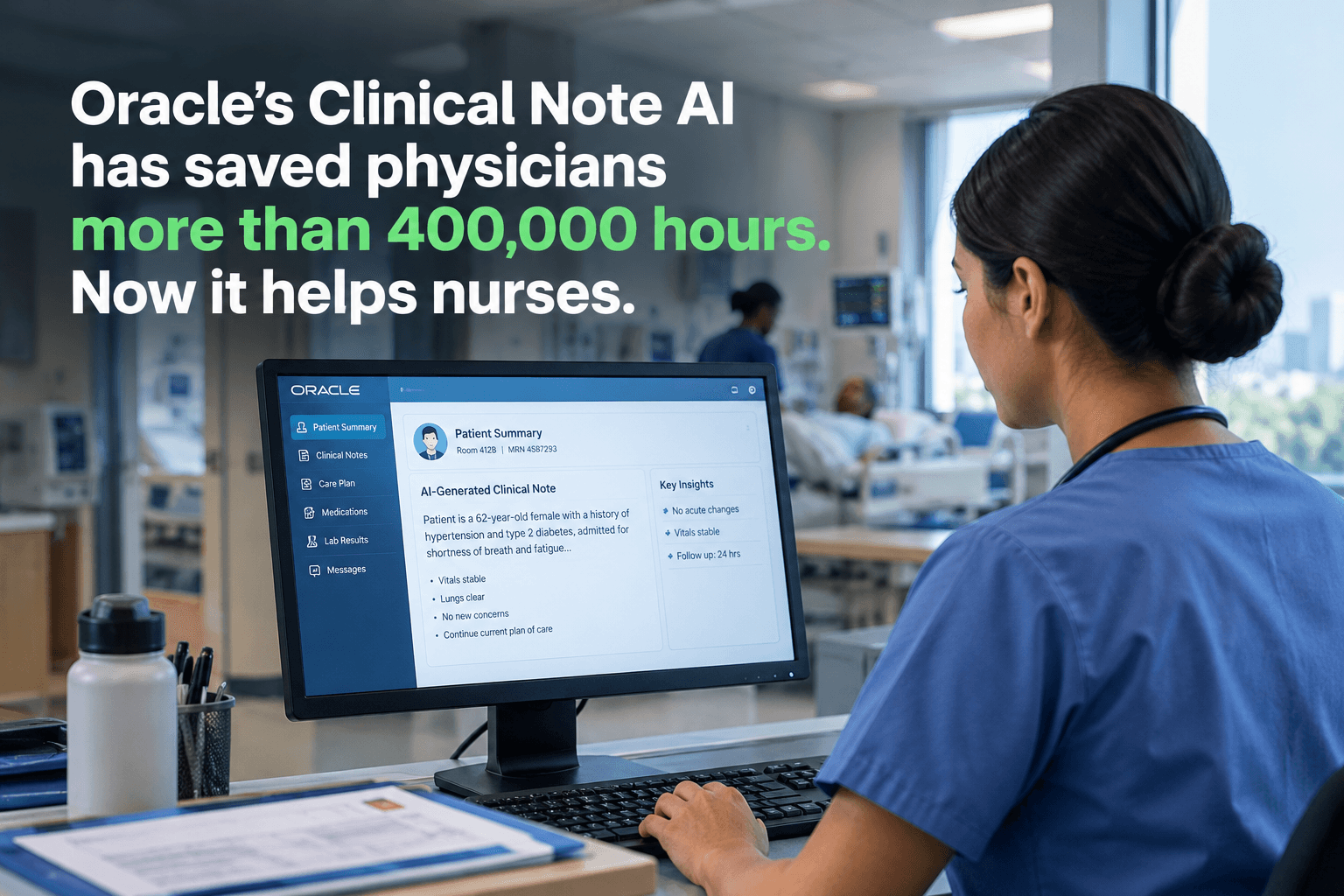
Oracle Health has launched a version of its Clinical AI Agent built for nurses, extending a documentation tool that the company says has returned more than 400,000 hours to US physicians since its 2024 launch.
The nursing release is now available in the US, embedded in the Oracle Health Foundation EHR.
What Nurses Get
Three capabilities make up the release.
Voice-driven chart navigation and search lets nurses find patient information using natural language commands rather than clicking through record screens.
AI-powered acute nursing summaries automatically condense patient history and current condition into a readable overview.
Voice-enabled discrete charting allows nurses to complete structured documentation at the point of care by speaking rather than typing.
The third one is the most consequential. Discrete charting means filling defined fields — vitals, assessments, intervention codes — rather than writing free text. It is the slowest and most repetitive part of nursing documentation precisely because it is structured, and it is usually done retroactively at a workstation rather than at the bedside. Moving it to voice at the point of care is a meaningful workflow change if it works reliably.
The 400,000 Hour Figure
This number has been in circulation since Oracle's August 19 announcement, and it is worth reading carefully.
It covers note generation specifically, for physicians, across US health organisations, over nearly two years. It is Oracle's own figure, based on Oracle's own methodology, and the company has not published how it was calculated.
Spread across the scale of Oracle Health's installed base and a two-year window, 400,000 hours is real but not transformative on a per-clinician basis. It is the kind of number that means something to a health system CFO evaluating aggregate labour cost and very little to an individual physician deciding whether the tool is worth learning.
It also measures time saved on documentation, not time redirected to patient care. Those are different things, and the healthcare AI literature has been fairly consistent that saved administrative time often gets absorbed by other administrative work rather than clinical contact.
How It Fits Oracle's Strategy
The nursing tool is the latest addition to an agent portfolio Oracle has been building steadily through 2026.
February brought automated order creation. August brought three more: automated professional fee coding for ambulatory workflows, clinician-controlled real-time dictation into any EHR text field, and AI-assisted chart review surfacing relevant context from across the patient record.
Oracle's framing is that these agents work as a system rather than as isolated tools, using semantic reasoning to understand clinical meaning, sharing context across workflows and collaborating in near real time — while keeping clinicians responsible for final decisions.
That last clause is doing important work. Every capability here is assistive by design: the AI drafts, the clinician reviews, edits and signs. That is both a regulatory necessity and a liability boundary.
The underlying platform is the cloud-based ambulatory EHR Oracle unveiled in 2025, built as a voice-first system with a semantic AI foundation capable of hosting Oracle's agents, integrating third-party models, or running agents built in-house.
Seema Verma, executive vice president and general manager of Oracle Health and Life Sciences, has framed the strategy around care teams not being able to afford hours spent on documentation and administrative tasks.
The Revenue Cycle Angle
Not all of this is about clinician wellbeing, and the coding capability makes that explicit.
Automated professional fee coding analyses ambulatory patient conversations and generates codes. Chart review, while presented as clinical, has a downstream revenue effect — physicians who enter an encounter with complete context document more accurately, which produces better-coded claims.
This is the EHR-as-revenue-cycle-platform thesis advancing, and it is the commercial logic that makes these tools saleable. Documentation burden is the pitch to clinicians. Reimbursement improvement is the pitch to the people signing the contract.
Why Nursing Matters Here
Nurses have been comparatively underserved by clinical AI, which has concentrated on physician documentation because that is where ambient scribing had the clearest product-market fit.
Nursing documentation is higher in volume, more structured, and more frequently interrupted. A nurse on a medical-surgical floor may chart on six or more patients across a shift, with regulatory requirements dictating much of what must be recorded and when.
If voice-enabled discrete charting reduces end-of-shift documentation backlog, the effect on nurse workload would be substantial. That is a genuine if.
What Isn't Known
Oracle has not released nursing-specific outcome data, which is expected for a product launching today but leaves the announcement resting entirely on the physician figure.
There is also no information on pricing, accuracy rates in noisy clinical environments, or how the system handles the interruption-heavy reality of inpatient nursing — where a documentation task started at one bedside is frequently completed twenty minutes later somewhere else.
Oracle is holding its Health and Life Sciences Summit in Orlando from September 22 to 24, which is the likely venue for more detail.
Sources
Related Articles