 TEKZARO
AI
Ringg’s AI agents resolve up to 65% of customer calls with OpenAI
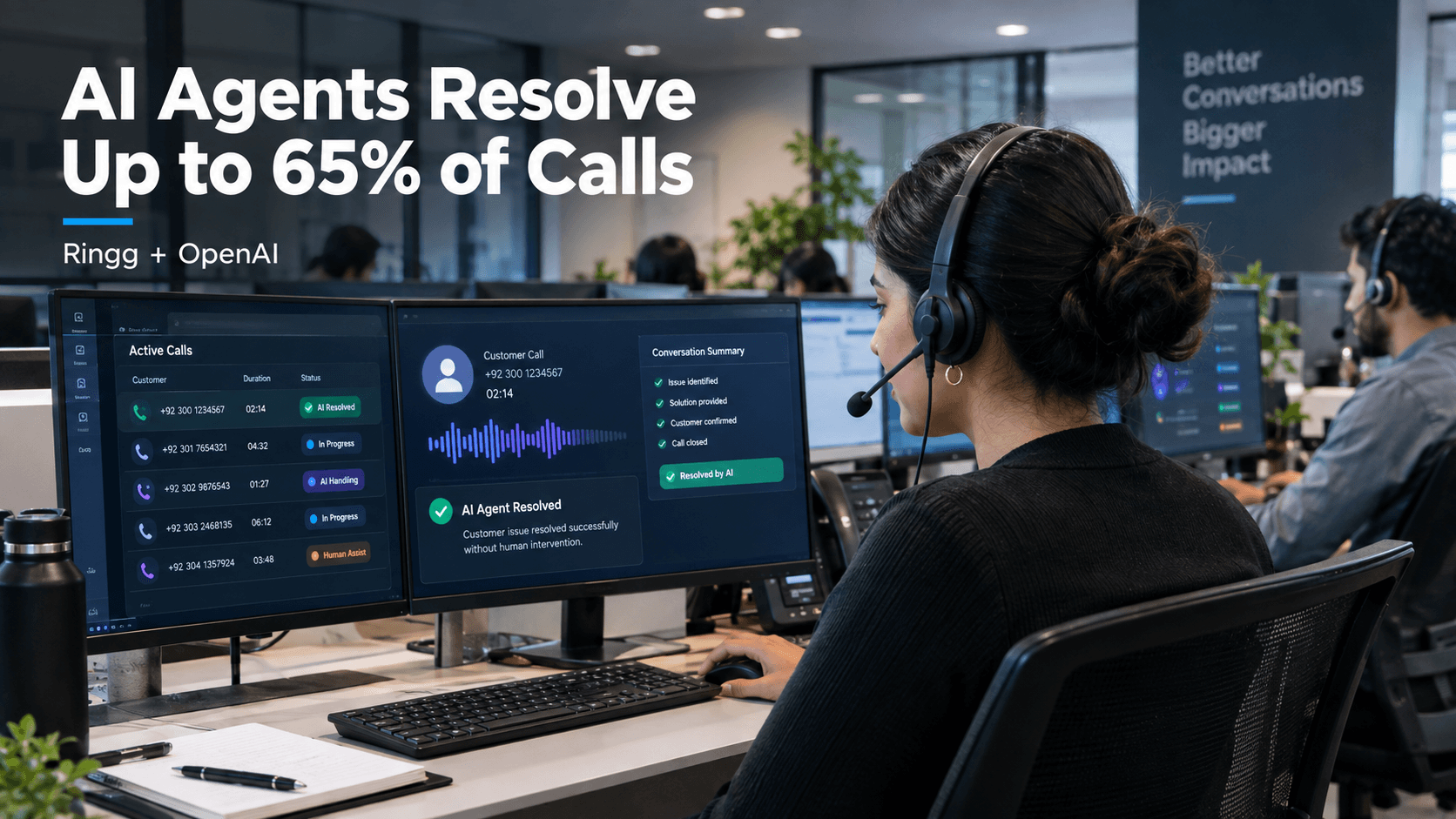
<br># Ringg's AI Agents Resolve Up to 65% of Customer Calls With OpenAI
Ringg, a voice and chat agent platform serving large consumer businesses in India, has published results showing its AI agents resolve up to 65 percent of routine customer inquiries without any human involvement — a benchmark it has reached after migrating its platform to OpenAI's GPT-5.6 models.
The Platform and the Problem
Ringg was built to address a specific operational challenge: large consumer businesses in India struggling to handle growing call volumes with fragmented, manual systems. Customer service agents were dealing with high ticket volumes across insurance purchases, appointment bookings, financial queries and more, in a market where more than 76 percent of consumers prefer calling a business over any other contact method.
The company now processes around seven million calls monthly across voice, chat, WhatsApp and browser channels. Enterprise clients include Policybazaar, Practo, Groww, CRED, Flipkart, Tata 1mg, DCB Bank and Shell.
The Results Across Clients
The headline 65 percent resolution figure comes from OpenAI's published customer story, but the per-client numbers are more instructive.
At Policybazaar — one of India's largest online insurance platforms — Ringg connects more than 57,000 customer requests monthly. 67 percent of calls are handled without human intervention. Average response time fell from 8 to 12 minutes down to under 60 seconds, an improvement of roughly 88 percent.
At Practo, a global healthcare platform operating across 1,200 clinics, Ringg's agents handle appointment bookings and service requests. The deployment achieved an 85 percent first-call resolution rate and response times below three seconds. Operating costs fell 70 percent compared to the previous human-led workflow. Ringg now completes more than 1,000 appointment bookings daily through this integration.
At Groww, an online investment platform, Ringg resolves 72 percent of inbound queries about IPOs, futures and options entirely through self-service.
The Model Migration
The improvement in economics came from migrating to GPT-5.6 Terra, OpenAI's latest model, from GPT-4.1. Ringg reports a 90 percent cost reduction for selected workloads after the switch, while its customer satisfaction score rose to 4.8.
Ringg evaluated OpenAI models against alternatives including Gemini 2.5 Flash across conversational quality, latency, instruction following, tool calling, multilingual performance, reliability and cost. It concluded OpenAI delivered the strongest overall balance for production workloads. In post-call analysis tests on common regional Indian languages, GPT-5.6 Terra achieved up to 97 percent accuracy — a metric that matters significantly in India's linguistically diverse market.
The Technical Architecture
Ringg's platform combines its own speech-to-text model tuned specifically for Indian speech patterns with an orchestration layer that executes actions across backend systems, escalating to a human only when necessary.
The knowledge layer combines structured filtering with semantic retrieval across datasets, PDFs, CSVs and business documents. For longer conversations, the system generates a structured summary at approximately 80,000 tokens to preserve context without resending entire conversation histories — a practical engineering solution to the context-window management problem that affects long customer service interactions.
Ringg is also developing browser-based agents using OpenAI's computer-use capabilities for onboarding, KYC processes, IT troubleshooting, incident support and claims processing. A cross-channel context layer is in development to allow customers to begin a request over voice, continue on WhatsApp and complete it in a browser without repeating information.
The Fundraising Context
In August 2026, Ringg secured a $10 million extension to its Series A led by Peak XV Partners. The company handled 20 million call attempts monthly at the time of that raise. The improvement in per-call economics from the GPT-5.6 migration is central to its ability to sustain and grow that volume while keeping unit costs viable.
What the Numbers Require
The distinction between deflection and resolution is worth stating plainly, because the two are often conflated in AI customer service marketing.
Deflection counts calls the system redirected — to a form, a human, or a callback — without resolving the underlying issue. Resolution means the customer's problem was actually addressed. Ringg's figures are reported as resolution rates, not deflection rates, which is the more demanding and meaningful standard.
At 65 to 85 percent first-call resolution across its client base, the platform sits at the high end of what Builts AI's 2026 benchmarks identify as the range for AI-native platforms, which puts first-contact resolution between 55 and 70 percent for top performers. Gartner has forecast that agentic AI will resolve more than 80 percent of customer service issues without human intervention as the category matures further.
Sources: OpenAI, TechCrunch, Inside AI News
Sources
Related Articles