 TEKZARO
AI
South Korean Stocks Jump Nearly 3% on Renewed AI Chip Optimism
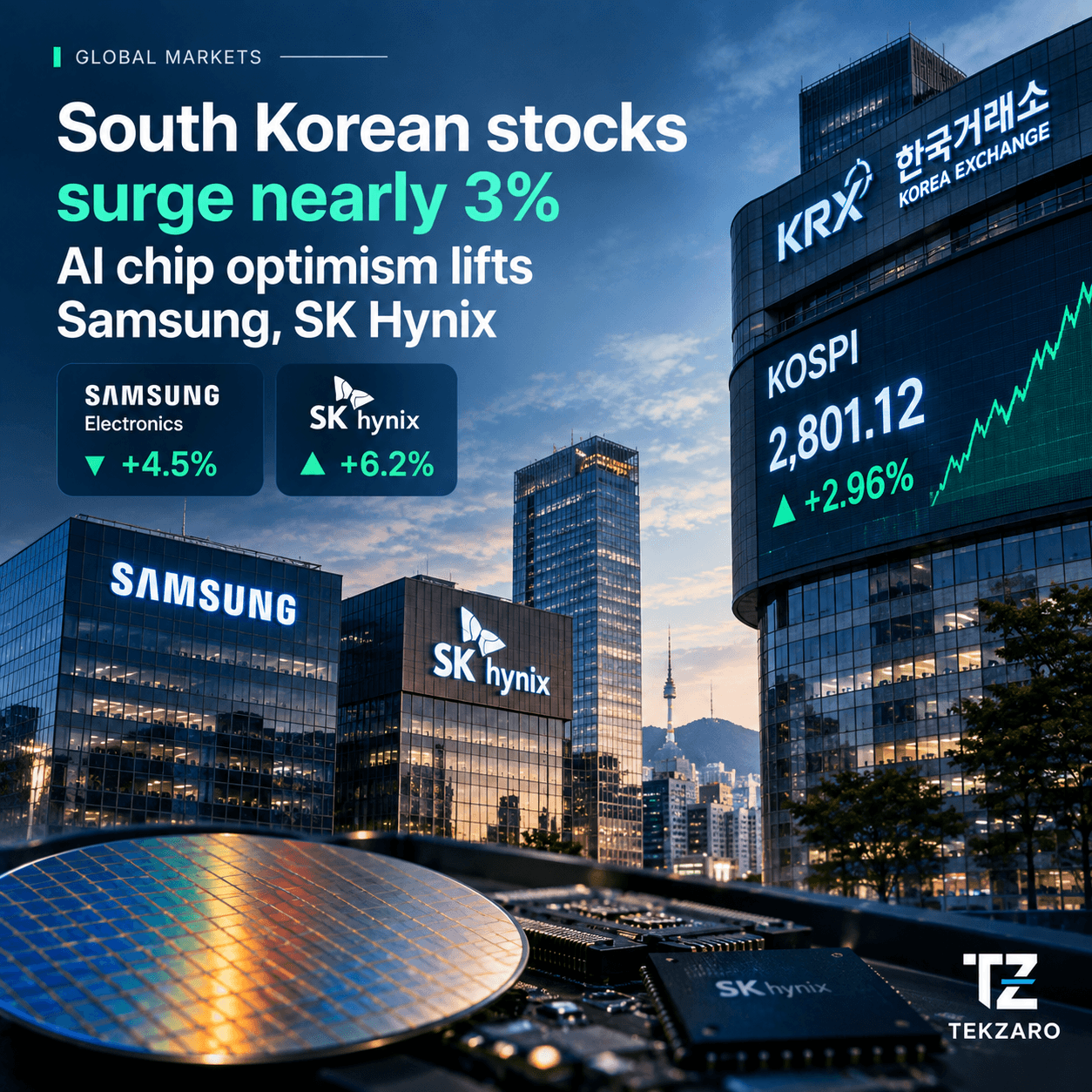
South Korean Stocks Surge Nearly 3% as AI Chip Optimism Lifts Samsung, SK Hynix
South Korea's benchmark KOSPI index surged nearly 3% Wednesday as investor appetite for artificial intelligence infrastructure returned to the market, driving sharp gains in the country's heavyweight semiconductor manufacturers. Samsung Electronics and SK Hynix—which together make up approximately 40% of the KOSPI—led the advance, each gaining between 4% and 7% as renewed confidence in AI spending cycles revived the memory chip trade.
The AI Infrastructure Catalyst
The latest leg of South Korea's stock market rally has been fueled by strong earnings reports from global technology giants demonstrating continued massive investment in artificial intelligence infrastructure. Supermicro and cloud provider CoreWeave both posted better-than-expected results, with the announcements signaling that the AI capex boom remains intact despite concerns about spending sustainability that surfaced in mid-2026.
This positive sentiment has directly benefited South Korea's chip manufacturers, whose fortunes are inextricably tied to demand for memory chips—specifically high-bandwidth memory (HBM) and DRAM—used in AI data centers worldwide. When global tech companies announce strong AI-related spending, South Korean semiconductors stocks historically respond first and most dramatically.
Samsung and SK Hynix Performance
Samsung Electronics advanced 4% on the latest rally, while SK Hynix gained 7%, continuing a pattern where the latter has outperformed throughout 2026's AI-driven market cycle. Earlier this year, SK Hynix posted a record single-day gain of nearly 30% following strong earnings from Amazon and Microsoft that validated the sustainability of enterprise AI spending.
The cumulative performance of both stocks over 2026 has been extraordinary: Samsung is up 258% for the year, while SK Hynix has surged 456%—among the best-performing semiconductor stocks globally. However, this performance has come with corresponding volatility, including sharp drops that wiped out months of gains when sentiment shifts.
Korea as the Global AI Barometer
South Korea's stock market has become unexpectedly important to global investors tracking AI infrastructure trends. Fund managers in London, New York, and Tokyo now regularly check Seoul's market before their local trading opens, using Korean semiconductor stock movements as an early indicator of broader AI sentiment.
"For fund managers globally, checking Korean stocks has become a new ritual before trading opens," according to market participants interviewed by global financial media. SK Hynix's American depositary receipts (ADRs) and Korea-focused exchange-traded funds are closely monitored overnight by international investors seeking signals on AI momentum.
This outsized influence reflects a structural reality: Samsung and SK Hynix are among the world's only suppliers of advanced memory chips used in AI data centers. Their dominance in memory manufacturing means that their stock performance directly signals market confidence in the sustainability of AI capex cycles.
Market Concentration Risk
The concentration of South Korea's market around Samsung and SK Hynix presents both opportunity and risk. While the latest 3% surge demonstrates upside potential when AI sentiment improves, the same concentration amplifies losses during downturns.
When Korean semiconductor stocks fell sharply from late June through early July 2026, Samsung and SK Hynix were responsible for a large share of the market's subsequent 6.8% decline. A single day's drop in memory chip sentiment can erase weeks of broader market gains because the two companies make up such a large portion of the index.
Morningstar's emerging markets benchmark analysis shows that Samsung, SK Hynix, and Taiwan Semiconductor Manufacturing (TSMC) together account for more than 26.7% of a key EM benchmark. These three stocks drove roughly 57% of the index's 30.3% gain over the past year—indicating that emerging market returns have become almost entirely dependent on semiconductor supercycle performance.
Global Memory Chip Demand Signals
The latest rally has been reinforced by specific signals about memory chip demand. South Korea's chip exports hit record levels, driven by sustained demand for memory chips in AI infrastructure. SK Hynix has reportedly been meeting with South Korean government leaders to discuss increasing investment in AI-focused chip production, emphasizing its role as a critical supplier to the global AI ecosystem.
This growing strategic importance of Korean memory manufacturers represents a shift from their traditional commodity supplier role. Rather than being price-takers in competitive memory markets, Samsung and SK Hynix have become strategically critical to the AI infrastructure buildout—a positioning that commands premium valuations.
The Volatility Question
The latest 3% surge continues 2026's pattern of sharp market swings. Earlier in the year, the KOSPI swung 16% in just 48 hours, driven entirely by movements in semiconductor stocks. June saw circuit breakers triggered when Broadcom issued disappointing AI chip guidance, demonstrating how closely Korean semiconductor fortunes are tied to broader chip sector sentiment.
This volatility reflects the fact that the AI trade has become the most concentrated single-narrative trade in global equity markets. When investors believe AI capex will remain strong, South Korean chip stocks soar. When doubts emerge about spending sustainability, they crash. There is little middle ground.
Technical Analysis and Market Outlook
Technical analysts have noted that the latest rally has broken key resistance levels, improving the near-term outlook for Korean equities. The iShares MSCI South Korea ETF confirmed a reversal pattern that looks "attractive technically for further near-term gains," according to technical strategists.
Memory shares, after being among the hardest hit during global technology sell-offs earlier in the year, have begun outperforming the broader tech sector for the first time since June—a signal that investor confidence in the fundamental demand for memory chips in AI infrastructure has stabilized.
Broader Market Impact
Beyond semiconductor stocks, the latest Korean rally has lifted other technology and automotive stocks. Hyundai Motor, LG Energy Solution, SK Square, and Kia have all gained on the improved risk sentiment accompanying the AI chip rally.
However, oil price volatility and geopolitical concerns continue to present headwinds for South Korea's import-dependent economy. The Korean won has strengthened as the dollar softened ahead of Federal Reserve policy decisions, which has also contributed to improved sentiment.
What Comes Next
The sustainability of the latest rally depends entirely on whether global tech companies continue demonstrating commitment to massive AI infrastructure investment. Strong earnings guidance from major cloud providers and AI systems vendors is the critical variable.
If the pattern of 2026 continues—with Korean semiconductor stocks swinging sharply based on global AI sentiment shifts—then South Korean markets will remain the most volatile major market globally, but also one with the clearest direct link to AI infrastructure demand trends.
For now, the 3% rally represents renewed confidence that the AI capex boom remains intact despite earlier concerns about sustainability. Global investors betting on continued AI infrastructure investment are once again piling into South Korea's semiconductor stocks, positioning the market as the global AI sentiment barometer.
Sources
Related Articles