 TEKZARO
AI
WhatsApp reportedly testing third-party AI agent chats on Android
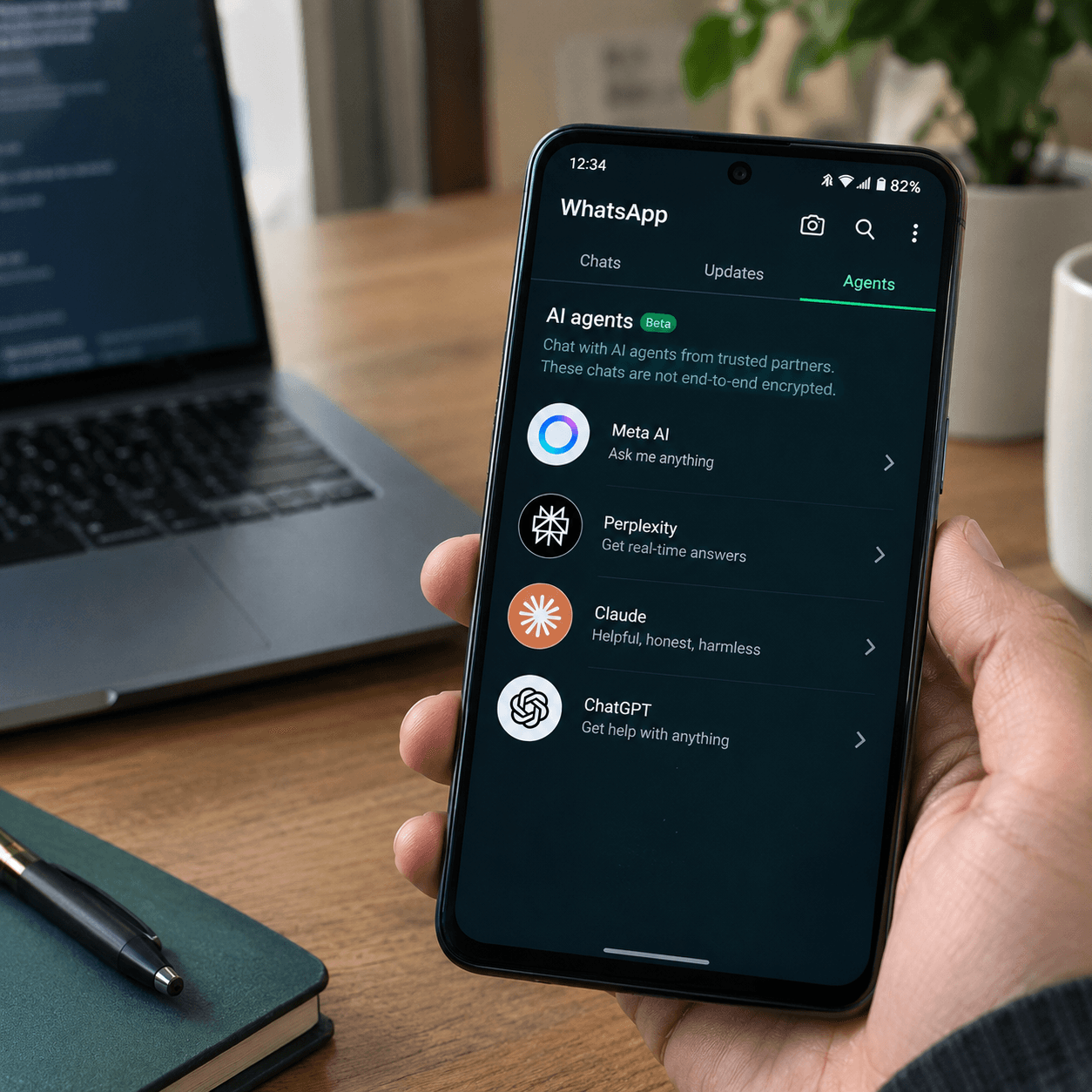
WhatsApp Explores Third-Party AI Agent Chats on Android App
WhatsApp is testing a new feature that lets Android users connect external AI agents directly within the messaging app, eliminating the need to jump between apps to access AI tools. The feature, discovered in WhatsApp beta for Android version 2.26.35.3, represents a significant shift in how the platform plans to integrate artificial intelligence—but with an important privacy trade-off users need to understand.
What's Being Tested
The new feature allows users to configure third-party AI agents through WhatsApp settings and access them through dedicated chats, just like regular contacts. Users can add up to five different agents to a single account, each with a custom name and profile photo. The setup process involves generating an API key that developers use to connect their agent to the chat.
This is not a dramatic overhaul of WhatsApp's interface. Instead, it's a straightforward integration: users open settings, configure their chosen agents, and then access them through individual chats in the message list. The agents remain separate from regular WhatsApp conversations and cannot access group chats, contacts, or media from other conversations.
How It Works
Setup requires three steps. First, users enter a name for the agent and select a profile photo—the name appears in the chat list for easy identification. Second, WhatsApp generates an API key. Third, users copy that key to the platform where their agent is hosted (the process varies by provider).
Once configured, users simply open the agent's chat and send messages as they would to any contact. The agent responds based on its capabilities. Unlike basic chatbots that follow predefined responses, AI agents can understand complex requests and potentially carry out tasks on the user's behalf. However, the distinction matters only if the developer built an actual AI agent—the feature also supports regular bots designed to perform specific functions or respond to commands.
The critical limitation: agents can only function in individual chats. They cannot be added to group conversations or WhatsApp Communities.
The Privacy Catch
This is where users need to pay attention. Unlike end-to-end encrypted messages between WhatsApp contacts, conversations with third-party agents are not end-to-end encrypted. WhatsApp processes and routes these conversations through Meta's servers on behalf of the agent developer, and the messages are stored unencrypted by the third-party provider according to their own data practices.
This represents a fundamental privacy difference. When you message a friend on WhatsApp, no one—not even Meta—can read that conversation. When you message an AI agent, both Meta and the third-party provider can access and potentially store your messages. Users should assume that conversations with AI agents are not private in the same way WhatsApp's peer-to-peer messaging is.
WhatsApp warns explicitly that AI agents may provide incorrect information. Users should verify important details before acting on agent responses.
The Strategic Context
This feature arrives alongside a significant shift in Meta's AI strategy. In January 2026, Meta banned general-purpose AI chatbots like ChatGPT and Perplexity from its WhatsApp Business API. Those consumer-facing AI assistants are no longer permitted on the platform.
The new third-party agent feature appears to be Meta's replacement—a way to allow developers to build proper integrations for WhatsApp while eliminating the uncontrolled consumer AI chatbot problem. Rather than anyone being able to add ChatGPT or Copilot to WhatsApp, developers now build agents specifically designed for WhatsApp using an API key system.
The distinction is important: AI agents built for WhatsApp are intentional integrations designed to provide specific value (customer support bots, scheduling assistants, etc.), whereas consumer chatbots are simply consumer applications squeezed into WhatsApp through hacks or workarounds.
Rollout and Availability
The feature is currently in beta testing on Android only. A limited number of users in select regions can access it. WhatsApp has not announced a timeline for wider rollout or availability on iOS.
This gradual beta approach is typical for WhatsApp's feature testing. The company rolls out to small populations first, gathers data on usage and problems, then expands slowly. Depending on how testing progresses, this feature could reach all Android users by late 2026 or early 2027—or could remain limited if technical or privacy concerns emerge during testing.
iOS users will likely have to wait longer. WhatsApp typically delays iOS features relative to Android as part of its general testing strategy.
What Developers Should Know
Developers interested in building agents for WhatsApp will need to follow WhatsApp's new guidelines. The platform supports both AI-powered agents (which can handle complex requests) and task-specific bots (which respond to predefined commands). Developers can use platforms and APIs from OpenAI, Google, Anthropic, or other AI companies to build the underlying agent.
The API key system provides a straightforward connection method. Developers host their agent on their own infrastructure or a cloud platform, users generate API keys in WhatsApp, and the two systems connect directly.
What Comes Next
For average WhatsApp users, the immediate impact is minimal—the feature is in beta with limited access. For those who gain access, it's an opportunity to experiment with AI agents without leaving WhatsApp. The lack of end-to-end encryption will be a deal-breaker for privacy-sensitive users, but for those comfortable with the trade-off, access to scheduling bots, customer support agents, or other specialized tools within WhatsApp could be genuinely useful.
For Meta, this represents a move toward controlled AI integration on WhatsApp rather than the chaos of consumer chatbots operating through unintended channels. It's a bet that developers building intentional agents will provide more value and fewer problems than general-purpose AI chatbots ever did.
The feature won't dramatically change how most people use WhatsApp. But for users who want AI assistance without opening another app, and for developers building specialized agents, this beta test is worth watching.
Sources
Related Articles