 TEKZARO
AI
Turk Telekom 'no-code AI agent' platform: what the supplied sources actually show
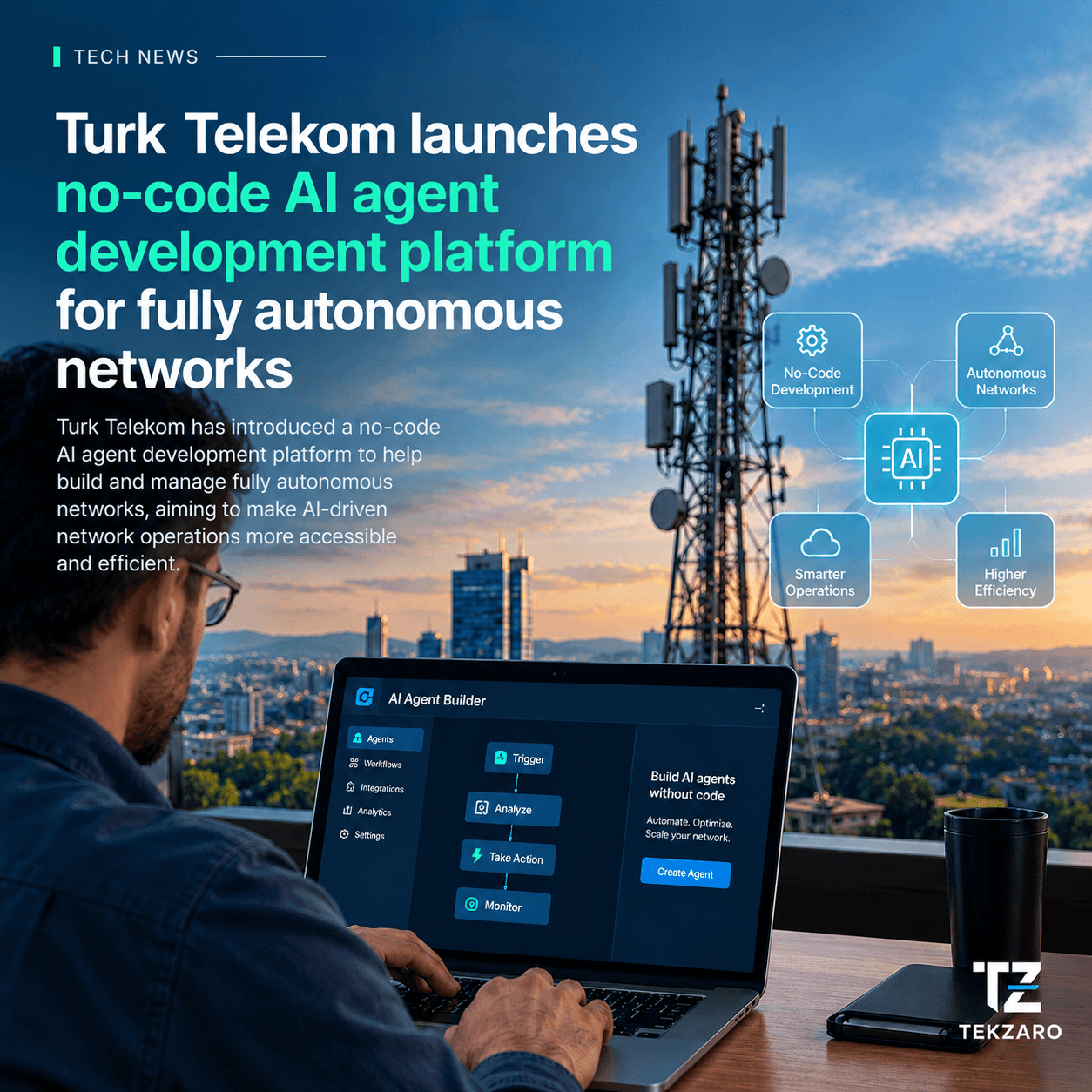
Turk Telekom Launches No-Code AI Agent Development Platform for Fully Autonomous Networks
Türk Telekom has announced the development of a pioneering no-code artificial intelligence agent platform, positioning itself at the forefront of autonomous network technology. The platform, developed by the company's research and development division, represents a strategic move to reduce reliance on external technologies while accelerating the transition toward fully autonomous network management.
Democratizing AI Development
The core philosophy behind Türk Telekom's new platform is the democratization of artificial intelligence development. By removing barriers that have historically required advanced coding expertise, the system empowers personnel across organizational levels to design intelligent digital assistants tailored to specific departmental needs.
This approach fundamentally changes how telecom companies can deploy AI within their infrastructure. Rather than requiring specialized data scientists or developers to write complex code, network operators, maintenance teams, and administrative staff can now contribute to AI agent development directly. This democratization has profound implications for how quickly organizations can scale AI capabilities across their operations.
Platform Capabilities and Architecture
The platform enables the creation of autonomous artificial intelligence agents without traditional programming knowledge. Users simply specify their intent, and the system handles the underlying complexity of implementation.
The infrastructure features an advanced analysis engine designed to understand user intent and facilitate communication between multiple agents. This multi-agent ecosystem represents a critical architectural advantage. Rather than deploying isolated agents for individual tasks, the platform supports diverse digital entities sharing tasks, developing strategies, and executing sophisticated workflows.
This multi-agent approach streamlines internal corporate processes and boosts organizational agility. Network operations teams can deploy multiple specialized agents that coordinate with each other, learning from interactions and improving collective performance over time.
Advancing Network Autonomy Standards
Türk Telekom is actively pursuing L4 and L5 international standards to achieve high-level and full network autonomy. These standards represent the highest levels of autonomous network operation, where systems operate with minimal human intervention and can handle complex, dynamic network environments independently.
L4 autonomy represents conditional autonomy—the network handles most operations but may request human intervention in edge cases. L5 represents full autonomy—the network operates completely independently across all conditions without any human intervention requirements.
The company's commitment to these standards signals that the no-code platform is not a one-off tool but part of a broader strategic initiative to build truly autonomous telecommunications infrastructure.
Reducing Reliance on External Technologies
A critical strategic advantage of developing internal platform capability is reducing dependence on external vendors. Telecommunications operators have historically relied on specialized vendors for network optimization, automation, and management tools. Türk Telekom's platform shifts this dynamic by enabling the organization to build these capabilities in-house.
This vertical integration reduces vendor lock-in, lowers long-term operational costs, and allows Türk Telekom to tailor solutions specifically to its network architecture and operational requirements. The company can innovate faster without waiting for vendor updates or product releases.
For other telecom operators considering similar approaches, the strategic benefits are clear: ownership of the technology stack, faster innovation cycles, and independence in how network operations evolve.
Patent Applications and Intellectual Property
Türk Telekom continues to lead in patent applications, focusing on 5G, 6G, and non-terrestrial network technologies. The no-code AI agent platform represents intellectual property the company can potentially commercialize or leverage in partnerships.
This emphasis on building a strong patent portfolio in autonomous networks, AI infrastructure, and next-generation technologies positions Türk Telekom as a technical leader in the industry, not just an operator but an innovator in telecommunications infrastructure.
Autonomous Network Management in Practice
The deployment of autonomous AI agents in network operations addresses real, documented challenges. AI agents can perform tasks including:
Predictive maintenance: Detecting potential network failures before they occur and triggering maintenance actions proactively.
Automated problem-solving: Identifying network anomalies and implementing corrective actions without human intervention.
Resource optimization: Dynamically allocating network resources based on demand patterns and predicted usage.
Self-healing capabilities: Automatically rerouting traffic when network segments fail, reducing downtime.
These capabilities translate directly into operational efficiency gains. Industry research from vendors and operators working on autonomous networks has documented improvements including 60% reductions in mean time to repair, 40% fewer incidents requiring human escalation, and 15-20% reductions in network energy consumption.
Market Context and Competition
Türk Telekom's platform announcement arrives as other major telecom operators are making similar moves. Deutsche Telekom, in partnership with Google Cloud, has deployed the RAN Guardian Agent for radio access network optimization. Turkcell has announced collaboration with Ericsson and Mavenir on autonomous network enablers and agentic AI. Vodafone is deploying autonomous network operations platforms.
This convergence of activity signals industry-wide recognition that autonomous networks powered by agentic AI represent the future of telecommunications infrastructure. Operators that fail to develop these capabilities risk falling behind competitors in operational efficiency and network reliability.
Implications for Turkey's Digital Infrastructure
For Turkey's broader digital transformation agenda, Türk Telekom's investment in autonomous network technology has implications beyond the company itself. As the nation's largest telecom operator, Türk Telekom's infrastructure modernization sets the template for how telecommunications networks will operate across the country.
Autonomous, self-optimizing networks with predictive maintenance and intelligent resource allocation create more reliable, efficient connectivity. This improved infrastructure supports Turkey's digital economy ambitions and creates foundation capabilities that other sectors (manufacturing, transportation, healthcare) can build upon.
Next Steps and Timeline
Türk Telekom has not announced a specific timeline for full platform deployment or commercialization. The announcement positions the platform as part of the company's R&D roadmap for autonomous network infrastructure.
Future developments likely include:
Expanded agent capabilities: Adding specialized agents for specific network domains (radio access, core network, backhaul).
Integration with operator workflow systems: Connecting agents to existing operations support systems (OSS) and business support systems (BSS).
Industry partnerships: Potentially licensing or partnering with other operators on platform capability.
International standard compliance: Ensuring platform components meet emerging standards for autonomous network operations.
The no-code AI agent platform represents a significant step in Türk Telekom's evolution from a traditional telecommunications operator to an infrastructure innovator. By empowering non-specialist personnel to develop intelligent agents, the company is preparing for an era where autonomous network operations powered by AI represents table-stakes competitive capability rather than innovation.
For the telecommunications industry globally, Türk Telekom's initiative underscores a defining transition: from networks optimized and managed by humans to networks that optimize and manage themselves with minimal human direction.
Sources
Related Articles