 TEKZARO
AI
Australian PM Albanese seeks Big Tech support for internet safety, AI regulation
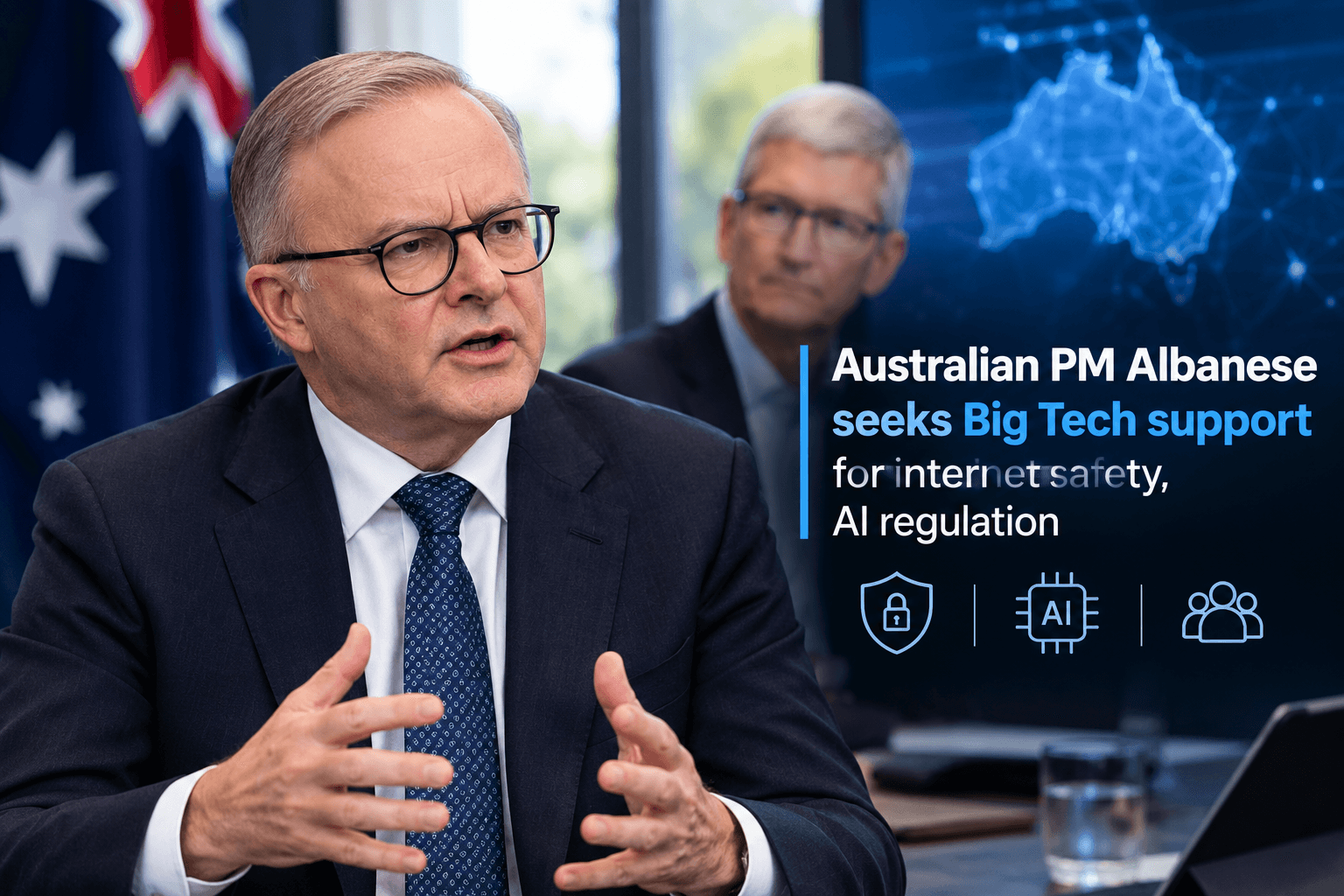
Australian Prime Minister Anthony Albanese has met Apple Executive Chairman Tim Cook at Apple Park in Cupertino, using the visit to press for industry backing on child online safety laws and AI regulation.
"Australia can't do it alone" when it comes to protecting children from the dangers of the internet, Albanese said following the Saturday meeting.
What Was Discussed
The two covered Australia's social media age ban, its proposed digital duty of care, and AI standards.
Albanese was shown a demonstration of Apple's new tools allowing parents to manage what content their children can see, who they can communicate with, and when they have access to apps. Cook said on X that he had shared new strong and intuitive controls to help keep kids safe online.
They also discussed Australia's work on new laws setting legally enforceable minimum safety standards for digital services.
"We all have a responsibility to make the online world safer for our kids. It's a belief Tim Cook and I share," Albanese posted.
The Framing
Albanese returned repeatedly to a single argument about control.
"Technology can bring enormous benefits, as it has. But we need to shape it rather than allow it to shape us," he said in a video accompanying his post. "How do we make sure, with any new technology, humans need to be in control? And that's a theme of all of the actions that we are taking: whether it's the social media ban, whether it is the digital duty of care, or whether it be the AI Australian standards."
Speaking to national broadcaster ABC, he put the AI concern more directly: "The risk is that AI develops in a way in which humans are no longer in control of what AI is producing."
Australia will introduce new AI standards by the end of the year.
The Legislation Behind It
Draft laws unveiled this month would place a duty of care requirement on the companies behind major platforms including Facebook, TikTok and Instagram, and would allow users to turn off their algorithms.
The bills go to parliament later this year after consultation with social media companies and industry bodies.
The algorithm opt-out is the more interesting provision. A duty of care imposes an obligation on platforms to identify and mitigate harm — a standard already familiar from other regulated industries. Letting users switch off recommendation systems attacks the engagement mechanism itself, which is considerably harder for platforms to accommodate without affecting their core business.
The government says Australians would also gain better protection from seriously harmful and illegal content across digital services, alongside more choice for social media users.
Why Australia Keeps Going First
Australia's social media age ban took effect in December 2025, and Albanese described the country as proud to lead the world on it.
A mid-sized market with a functioning regulatory apparatus and no domestic tech giants of its own is an unusual position. Australia can impose requirements without weighing the cost to a national champion, and it is large enough that global platforms find compliance cheaper than withdrawal — the same dynamic that made Australia's news media bargaining code a template other countries examined.
That is also why Albanese needs the industry's cooperation rather than just its compliance. Age verification and content controls only work properly when implemented at the operating system and app store level, which is Apple's and Google's territory rather than any individual platform's.
Hence the meeting at Apple Park rather than with a social media company.
The AI Timing
The AI regulation push comes after what Albanese described as dire safety warnings from industry leaders — a reference to the past fortnight, during which Anthropic's Dario Amodei called for slowing frontier development, OpenAI's Sam Altman backed pacing, and Meta's Mark Zuckerberg publicly rejected both.
Australia's existing framework has been in development since the government consulted on AI and appointed an expert group, producing a Proposals Paper for Introducing Mandatory Guardrails for AI in High-Risk Settings. That paper defines high-risk AI, sets out ten proposed mandatory guardrails, and offers three regulatory options for mandating them.
The Tech Council has estimated generative AI alone could contribute $45 billion to $115 billion a year to the Australian economy by 2030, which is the counterweight the government has to balance against restriction.
Albanese is in the United States for the UN General Assembly this week.
What This Actually Achieves
A meeting and a demonstration are not a commitment, and Apple's parental control tools were developed for its own reasons rather than Australia's.
What the visit does establish is that Australia is pursuing the cooperative route — bringing platforms into the design of requirements rather than legislating over their objections and litigating afterwards. That approach produces slower rules that are more likely to be implemented.
The test arrives when the duty of care bills reach parliament and the algorithm opt-out gets its first serious industry pushback. Parental controls are an easy area of agreement. Turning off the recommendation engine is not.
Sources: Al Jazeera, The Tribune, The Jakarta Post, Manila Times
Sources
Related Articles