 TEKZARO
AI
Google expands AI agent CC to help families manage household tasks
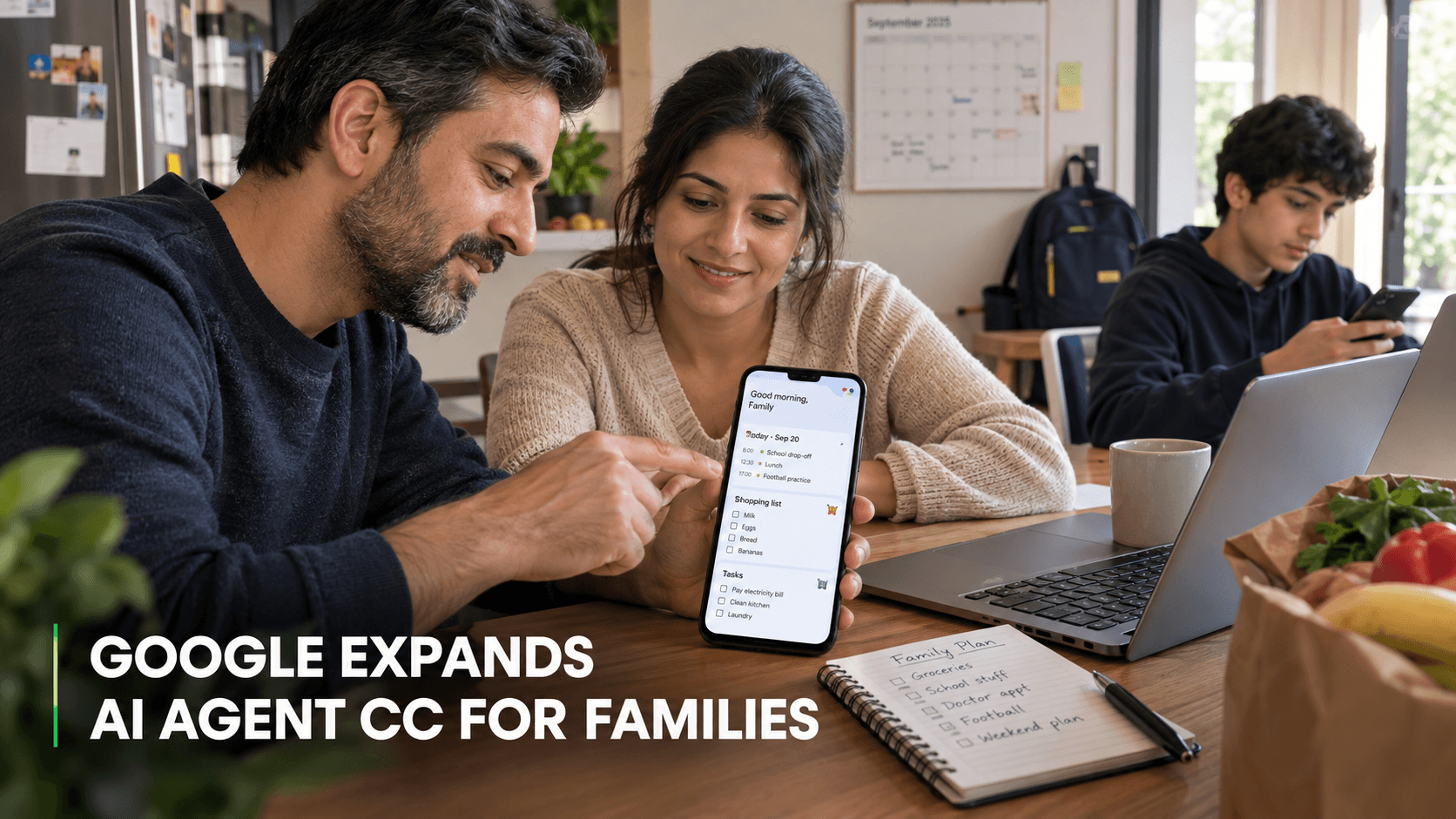
Google Labs has expanded CC, its experimental AI agent, from a personal productivity tool into a shared household assistant that can coordinate schedules, tasks and logistics for up to six family members simultaneously.
The expansion was announced on September 17, 2026 and is currently available to US users, with a waitlist for those who did not receive an invitation directly.
What CC Does
The agent connects to Gmail, Google Calendar, Google Drive, Google Chat and Google Maps to monitor shared information and act on it.
Each morning, CC delivers a "Your Day Ahead" brief to every household member — not just whoever manages the family calendar, but everyone. School announcements, practice schedules, appointment confirmations and reminders are pulled from across all connected inboxes and consolidated into one view of who needs to be where and what needs to get done.
Beyond surfacing information, CC can take certain actions on its own. It automatically adds events to the shared calendar when confirmation emails arrive — an orthodontist appointment, a teacher workday, a club meeting. It builds and maintains a shared task list. It pre-fills PDF registration and permission slip forms. It creates school supply shopping lists. It plans weekly meals. It checks live drive times between back-to-back activities using Google Maps. It creates shared Docs and Sheets.
When CC fills in a form or needs additional information, it asks. It also maintains a shared memory, updating what it knows about household preferences — a regular grocery list, recurring commitments, favourite dinner options — so it needs less prompting over time.
CC has its own verified Google account, which gives it a distinct identity and a central place to send and receive household information. Senders can be added to an auto-share list, and every week each member gets a private review of newly detected senders to approve or reject.
How Privacy Is Handled
Every family member controls individually what information CC can access. Nobody else's data is shared with the agent unless that person has opted in. Approved sources include emails, Drive folders, files, calendars and Chat threads — each selected separately.
The opt-in design is explicit. Google frames it as member-controlled access rather than a system that hoovers up everything in the household. What CC sees is only what each person has deliberately allowed it to see.
There is a structural limitation for families with teenagers. The system requires individual personal Google accounts, and participation is limited to adults aged 18 and older. Adolescents who do most of their school coordination through Google Workspace for Education or Chromebook ecosystems are outside the agent's reach, which is a real gap for the use case the product most obviously targets.
The Technology Behind It
Each CC instance runs on its own isolated cloud computer powered by Antigravity, Google's agentic harness, using current Gemini models. That architecture keeps household data separate across instances and allows CC to perform tasks across Google's suite of services rather than simply responding to individual queries.
The distinction matters. CC is designed to take actions — filling forms, creating documents, adding calendar entries — not just to surface information. That moves it from assistant to agent in a meaningful sense.
The History
CC originally debuted in September 2025 as a personal daily briefing tool that connected to Gmail, Google Calendar and Drive to produce a morning summary. In May 2026, that core functionality was folded into the Gemini app as Daily Brief.
The current expansion is Google taking the original CC concept further, in response to a user request that was consistently the top piece of feedback: help with running a household, not just an individual's day.
The agent is positioned against a small set of AI startups — Ollie and Fambot among them — that have been testing similar household delegation tools specifically for parents. Google's advantage is that the infrastructure is already in place. Gmail, Calendar, Drive and Maps are where the information already lives, which removes the need to build new data collection around a new product.
What It Does Not Do
CC does not make purchases. It does not have unsupervised authority over sensitive decisions. The agent produces a briefing, a task list, calendar entries and drafts — outputs the household then reviews before relying on.
Google explicitly recommends not treating CC as the sole source of truth for important deadlines, registrations or sensitive household decisions. A calendar entry CC created still needs to be checked.
The agent is also still experimental. It is a Google Labs product, which signals that the feature set and underlying behaviour are still being developed rather than final.
Why This Is Interesting
The domestic scheduling problem is real and largely unsolved. School notices, sports schedules, medical appointments, bill reminders and household logistics are currently distributed across individual inboxes, shared calendars with varying levels of currency, physical notes, and whoever is carrying the most mental load in the household.
CC's bet is that most of the coordination material already exists in digital form — emails, confirmations, calendar invitations — and that an agent with access to all of it can do the aggregation and routing that families currently do manually.
Whether it works in practice depends on uptake within the household. An agent with access to one person's inbox produces a partial picture. The value scales with how many members opt in, and persuading a teenager to grant a family AI agent access to their email is a different kind of challenge from a technical one.
Sources: Google Labs blog, TechCrunch, Android Authority, Hot Hardware
Sources
Related Articles