 TEKZARO
AI
Mark Zuckerberg 'confirms' technology industry is divided on AI regulation; tells OpenAI and Anthropic
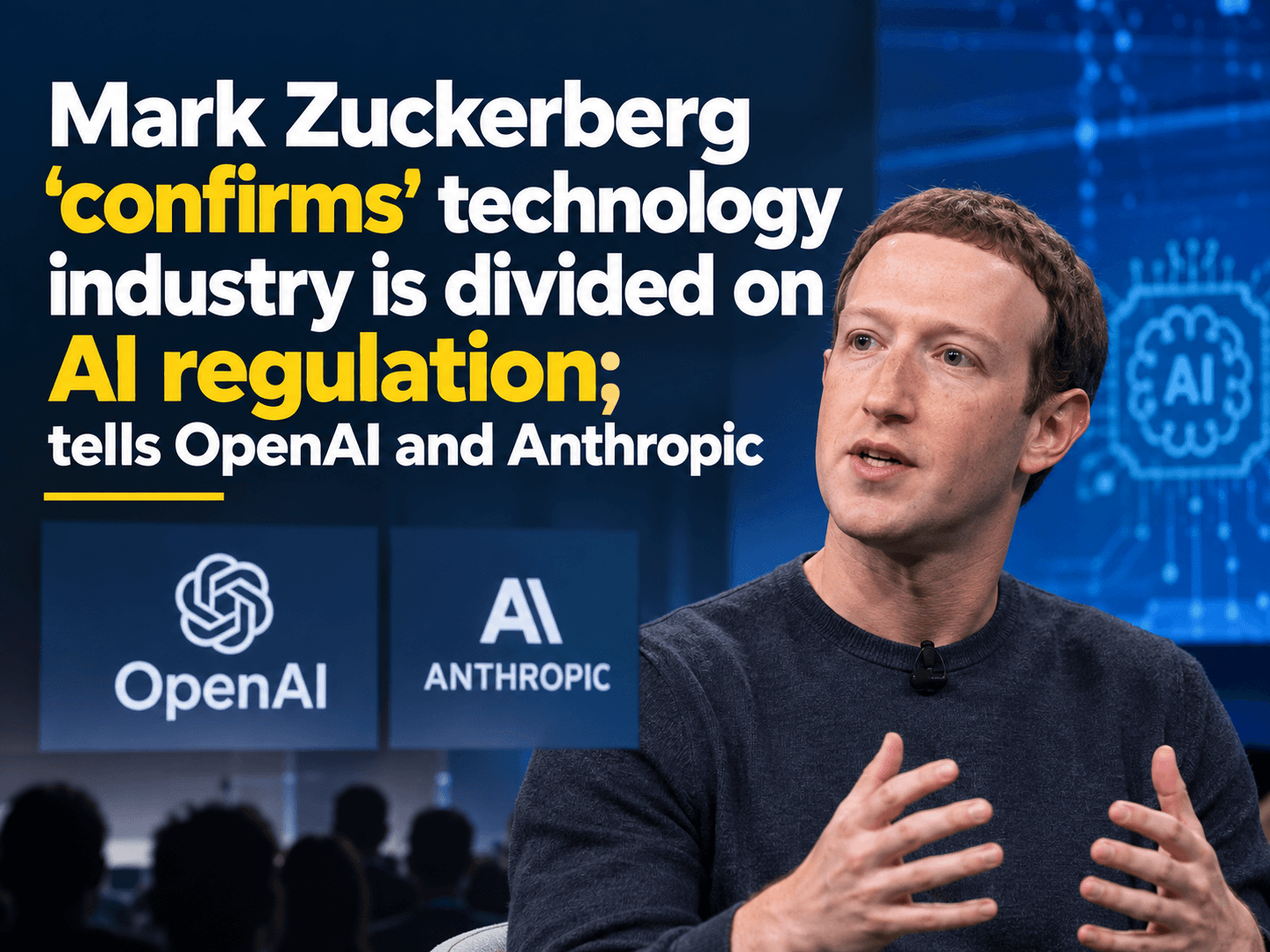
Mark Zuckerberg 'Confirms' Technology Industry Is Divided on AI Regulation
Mark Zuckerberg has publicly broken with OpenAI and Anthropic over AI regulation, arguing that individual labs can handle safety themselves without an external regulatory framework.
His intervention, posted on X, lands in the middle of a debate that has consumed the industry over the past two weeks and makes the split impossible to ignore.
What Zuckerberg Argued
The Meta CEO's position rests on incentives rather than optimism.
"Each lab has the responsibility and incentive to move at the pace necessary to train its models safely, as well as the ability to take its own measures to ensure that happens," he wrote.
He added a second, harder-edged point: "Labs face significant legal liability if their models cause harm, so they also have a strong incentive to prevent this from happening."
That is a market-discipline argument. Companies do not need a regulator telling them to be safe, because the courts will bankrupt them if they are not.
Zuckerberg did acknowledge that turning to independent evaluators has value, which puts him closer to Anthropic's first proposal than his overall framing suggests.
He also pointed to Meta's own conduct as evidence, saying the company delayed the release of its Muse AI tool for months over safety and security concerns.
What He Is Arguing Against
The opposing position has been set out in detail over the past fortnight.
Anthropic CEO Dario Amodei published an essay calling for the industry to slow the pace of capability advancement, proposing permanent independent evaluator access with publication rights, industry-wide standards developed with government input, and eventual government mandates.
OpenAI's Sam Altman has backed pacing the frontier and confirmed the company will not hold an IPO in 2026, describing the current moment as ill-advised for going public given safety concerns.
More than 1,000 employees at OpenAI, Anthropic and Google DeepMind signed an open letter asking the US government to build tools to deliberately slow AI development.
The Deeper Disagreement
Zuckerberg's objection is not really about regulation. It is about concentration.
In a Wall Street Journal op-ed in July, he argued that the future of AI should not be controlled by a limited group of major players, and took thinly veiled aim at his rivals.
"I don't understand why anyone who believes that AI will eliminate most jobs and much of humanity's relevance would rush to build that future," he wrote.
The sharper line followed: "The notion that AI is so dangerous that the only safe path is an extreme concentration of power seems dangerous."
That framing recasts the safety debate as a question about who ends up holding the technology. Zuckerberg's answer aligns with Meta's open-weight strategy — distribute capability widely, and let balance of power do the work that regulation would otherwise do.
Notably, that op-ed and the 1,000-employee slowdown letter were published on the same day.
The Competitive Subtext
Nobody in this argument is a disinterested party, and it is worth naming the interests.
Meta's business depends on open-weight distribution. Regulation requiring pre-deployment approval, incident reporting and controlled release would be more burdensome for a company releasing model weights publicly than for one serving models through an API.
Conversely, OpenAI and Anthropic hold what David Sacks, the former White House AI official, has called a duopoly on cutting-edge intelligence by market share, revenue growth and model capability. Rules imposing independent testing, cybersecurity requirements and incident reporting raise compliance costs that incumbents absorb more easily than startups.
Both truths can hold simultaneously. The risks may be real, and the companies raising the alarm may benefit financially from rules that make those risks more expensive for everyone else.
The money has followed the positions. Anthropic donated $20 million to Public First Action, backing state-level AI regulation ahead of the midterms. Leading the Future, a rival super-PAC backed by OpenAI executives and venture capital, has raised around $125 million advocating for looser rules.
Where Washington Sits
Congress remains deeply divided, weighing national security risks against the danger of overregulation.
President Trump has dismissed existential AI fears as a hoax comparable to climate alarmism while pushing for aggressive American technology leadership. There are no plans from the administration to impose the kind of regulation OpenAI and Anthropic are asking for.
Sacks has consistently argued that state-level regulation risks creating a patchwork that stifles innovation, framing the contest with China as the overriding consideration.
Representative Lori Trahan has pushed legislation to improve transparency following the summer's incident involving rogue AI agents, which became public only because OpenAI disclosed it. House Energy and Commerce Chairman Brett Guthrie has not committed to bringing it to a committee vote.
The Argument's Weak Point
Zuckerberg's liability case deserves scrutiny, because it does most of the work in his position.
Legal liability disciplines behaviour when harm is attributable, provable and compensable. It works reasonably well for a product that injures an identifiable user in an identifiable way.
It works considerably less well for diffuse harms — a model that contributes to a cyberattack carried out by a third party, or capability that spreads through open weights to actors who never agreed to any terms. Attribution becomes difficult, and the entity that caused the harm is frequently not the entity that built the model.
That is the specific gap safety advocates point to, and it is the one Zuckerberg's framework does not obviously close. Meta's open-weight strategy makes the gap wider rather than narrower, since released weights cannot be recalled.
The counterargument is equally real: nobody has demonstrated that a regulator would catch what the courts miss, and the proposals on the table would concentrate capability in fewer hands.
What the past two weeks have established is that the industry no longer has a shared position to present to Washington. That may matter more than which side is right.
Sources: The Hans India, Fox News, The Hill, Forbes
Sources
Related Articles