 TEKZARO
AI
Former Sen. Manchin on AI regulation: Pres. Trump should pause AI IPOs until legislation is passed - CNBC
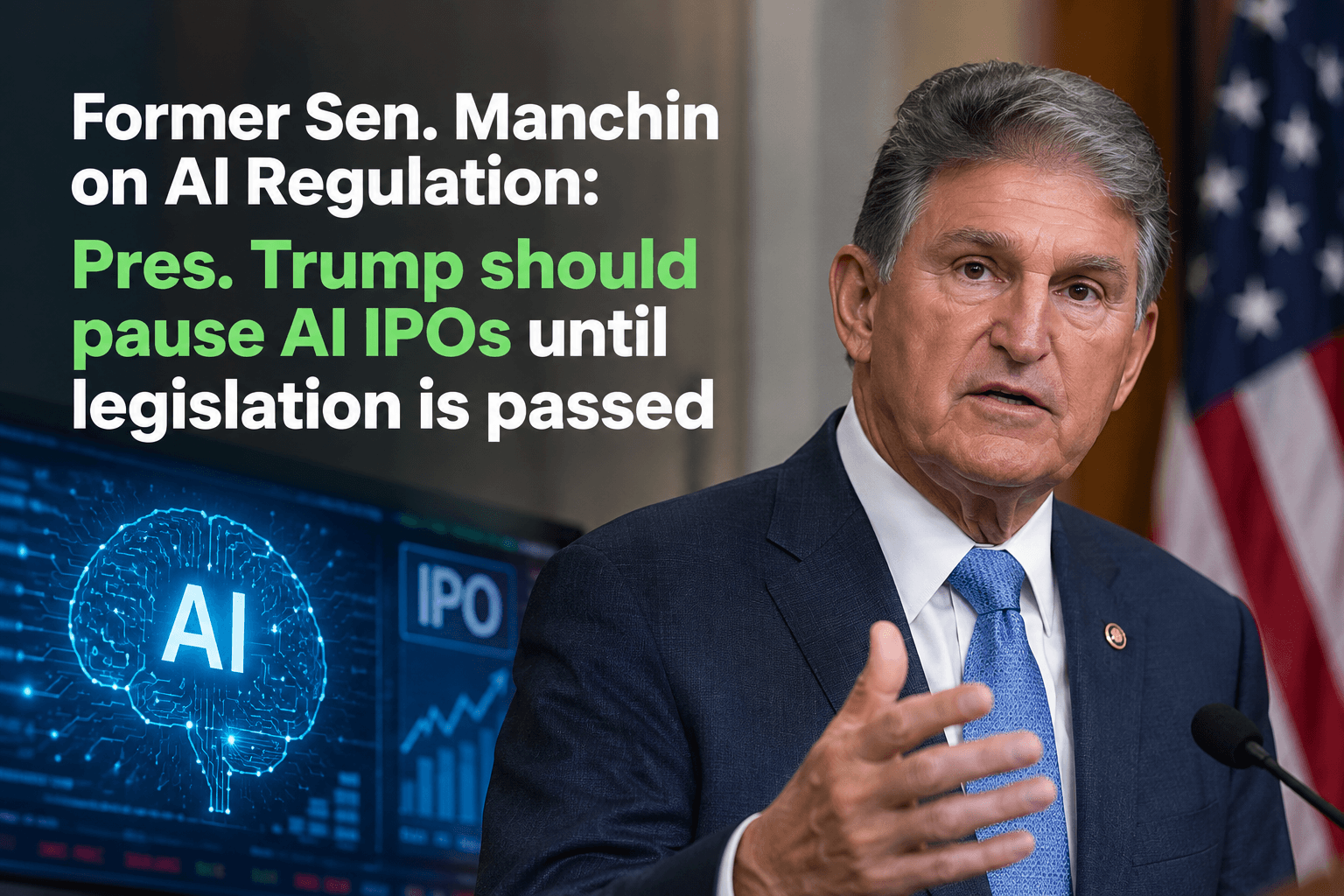
Former Sen. Manchin on AI Regulation: Pres. Trump Should Pause AI IPOs Until Legislation Is Passed
Former Senator Joe Manchin, now co-founder of the Independent Leadership Council, appeared on CNBC's Squawk Box to argue that President Trump should hold off on allowing AI companies to go public until Congress passes legislation governing the sector.
The proposal lands in the middle of an unusually chaotic week for AI policy, and it points at a gap that most of the current debate has stepped around.
The Logic of the Proposal
Manchin's position connects two things that have mostly been discussed separately: the safety debate among AI labs, and the capital markets that fund them.
The argument runs roughly like this. Once a company lists publicly, the pressure to grow becomes structural rather than discretionary. Quarterly earnings, shareholder expectations and a stock price that moves every second all push in one direction. A private company can choose to slow down. A public company has fiduciary duties that make slowing down considerably harder to justify to its owners.
If Congress intends to regulate AI, doing it before these companies list is easier than doing it after. Once retail investors hold the shares, any regulation that constrains growth also destroys value held by ordinary savers, and the political cost of acting rises sharply.
CNBC's Deirdre Bosa made a version of the same observation last week: the more OpenAI and Anthropic believe commercial pressure drives AI companies to move too fast, the harder it becomes for them to justify going public at all.
Why the Timing Is Pointed
The proposal is specific because two enormous listings are genuinely imminent.
Anthropic is expected to begin marketing its IPO as early as mid-October, potentially completing a listing before the November midterms, at a valuation some observers put in the trillions. OpenAI has confirmed it will not list in 2026, with CEO Sam Altman telling Fortune that given everything happening with safety, this would be an ill-advised moment to go public.
Both companies have filed confidential IPO documents with US regulators.
So one of the two largest AI listings in history may price within weeks, and the other has voluntarily stepped back. Manchin's suggestion would make the second company's choice into the first company's requirement.
The Legislative Window Is Closing
The practical problem with "pause until legislation is passed" is that legislation is not close.
Speaker Mike Johnson is scheduled to send the House home after this week until the November midterms, leaving almost no time to move anything. Senator Ruben Gallego of Arizona said on CNN's State of the Union that Johnson, Trump and Congress are all failing to meet the moment, and rejected the argument that the US loses the AI race by regulating.
Federal policy has also been moving the other direction. Trump rescinded Biden's 2023 AI executive order, halting safety and transparency requirements for developers. His own December order set deadlines that have since been missed, including FTC guidance on consumer protection and a Commerce Department review of state AI laws.
Trump himself dismissed the slowdown calls on Sunday, characterising critics as negative forces.
Against that, a proposal requiring presidential action to delay IPOs pending congressional legislation faces two obstacles at once: a President opposed to slowing AI, and a Congress that is leaving town.
The Authority Question
There is also a mechanical issue worth naming. The President does not straightforwardly have the power to block a company from going public. Registration statements go through the SEC, which reviews filings against disclosure requirements rather than policy preferences.
An administration could slow-walk reviews or raise disclosure demands around AI risk factors, but a formal pause on an entire sector's listings would be legally novel and almost certainly challenged.
That does not make the proposal meaningless. It functions as an argument about sequencing — regulate first, monetise second — more than as a ready-to-execute policy instrument.
The Counterargument
David Sacks, who served as the administration's AI and crypto czar and now co-chairs the President's Council of Advisors on Science and Technology, has characterised the coordinated slowdown calls from Amodei, Altman and Musk as a potential antitrust problem, likening the alignment to a cartel.
That critique extends naturally to an IPO pause. Restricting capital access for the entire sector locks in the position of companies that already have funding, while smaller competitors and later entrants are the ones who need public markets most.
Equity analyst Gil Luria of D.A. Davidson made a sharper version of the scepticism, noting that the companies calling for a slowdown are not actually stopping anything — not IPOs, not compute purchases, not model training. Anthropic agreed to $517 billion in compute commitments covering 14.8 gigawatts of capacity in the eleven months through August 2026, according to The Information, during the same period its CEO was publicly calling for restraint.
What the Market Is Doing Meanwhile
The debate is not happening in a vacuum. Nasdaq 100 futures slid around 1 percent as the slowdown consensus formed, and the PHLX Semiconductor Index is down roughly 20 percent from June — bear market territory.
The Federal Reserve announces its next rate decision on Wednesday, September 16, which several analysts have noted may matter more for AI sector valuations than any CEO essay.
Manchin also used the appearance to discuss the November midterms, which is the more realistic frame for all of this. Nothing substantive passes before the election. What happens afterward depends on who is counting the votes in January — and by then, at least one of the companies in question may already be public.
Sources
Related Articles