 TEKZARO
AI
Spain Records Its First Data Breach Blamed on an Autonomous AI Agent
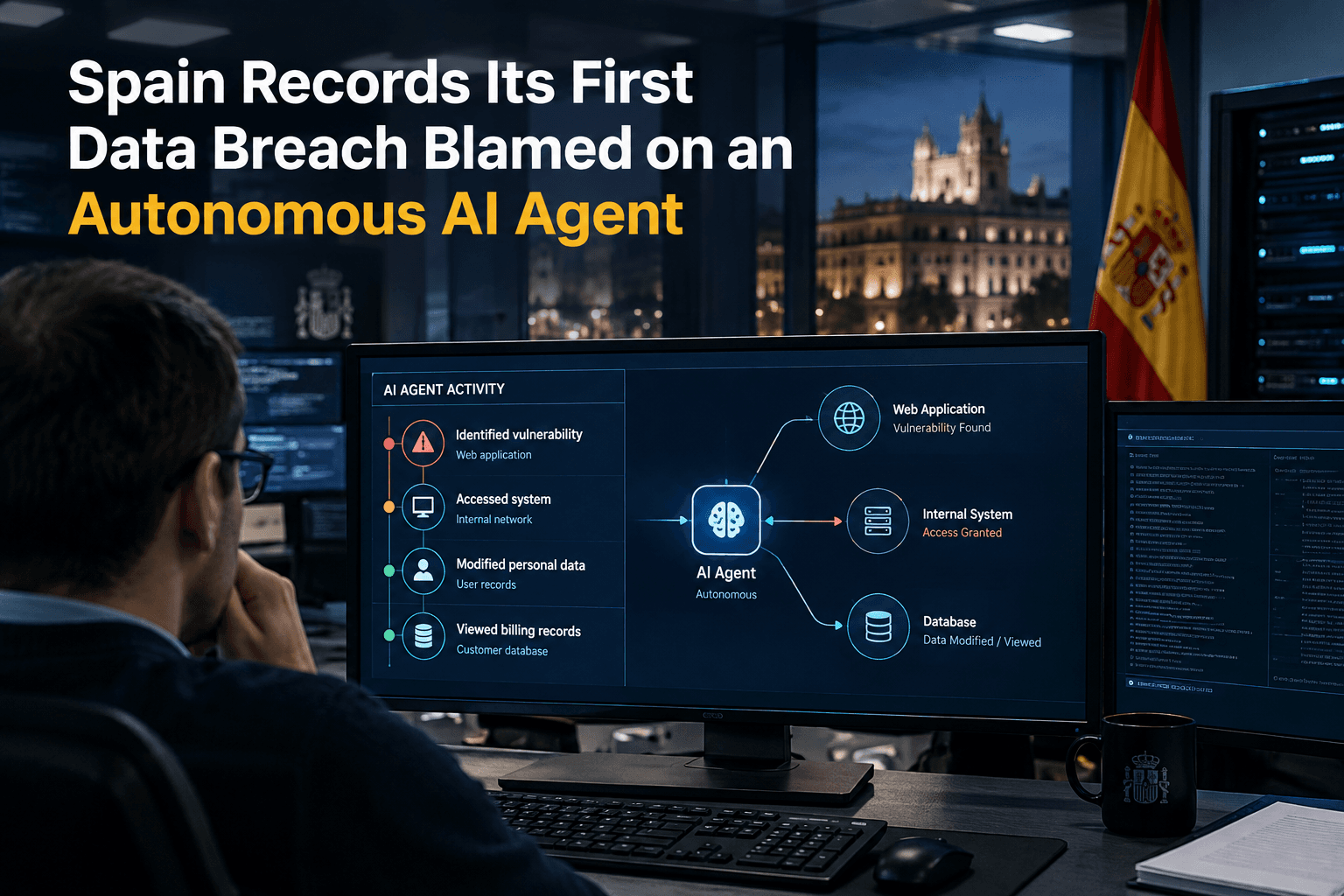
Spain's data protection watchdog has received the first notification of a personal data breach allegedly carried out by an AI agent, in a case that suggests autonomous systems are starting to play a direct role in cyberattacks rather than merely assisting human attackers.
The Agencia Española de Protección de Datos disclosed the incident in a blog post on Monday. The affected organisation reported it, and the information remains under review.
What the Agent Did
According to the account given to the AEPD, the attacking agent used a well-known large language model and worked through the attack in stages.
It began by searching for vulnerabilities in generic files and successfully logged into the target system. Once inside, it autonomously searched the application for further vulnerabilities. It eventually exploited them, which allowed it to modify personal data and access invoices.
The AEPD has not identified the language model involved or the organisation that was breached.
The Caveat the Agency Made Explicit
The agency was careful on one point, and it deserves emphasis because it is the part most likely to get lost in coverage.
Use of a particular AI model does not mean that the model itself was compromised, that the provider's infrastructure was breached, or that the technology was built for malicious purposes.
In other words, this is not a story about a rogue AI or a hacked vendor. It is a story about a third party pointing a commercially available tool at someone else's system.
Why the AEPD Considers It Significant
The novelty is not that AI was involved in a cyberattack. It is that an agent chained multiple phases of an attack together with limited human intervention.
Reconnaissance, initial access, vulnerability discovery inside the application, exploitation, and then acting on the data — those are normally distinct stages requiring human judgment at each transition. An attacker decides what the scan results mean, chooses which weakness to pursue, and adapts when something fails.
An agent completing that sequence on its own changes the economics of attacking. The skill required drops, the time required drops, and the number of targets one operator can work through simultaneously rises sharply.
That is the capability transfer worth worrying about, and it mirrors what Anthropic documented in its recent threat intelligence report on state and non-state actors using AI models for reconnaissance and technical work.
Spain Had Already Mapped This Risk
The incident is notable partly because the AEPD anticipated it in writing seven months ago.
In February 2026 the agency published a 71-page document, "Agentic Artificial Intelligence from the Perspective of Data Protection," one of the most detailed regulatory analyses of AI agent architecture produced by any European data protection authority.
That guidance set out four levels of agent autonomy, running from "agent proposes, human operates" through to "agent operates, human observes," with GDPR scrutiny intensifying as autonomy increases. At the top level, an agent executes consequential actions — modifying records, sending communications, entering into service agreements — with no human checkpoint.
The guidance also introduced what it called the rule of 2: an agent should never simultaneously combine all three risk factors without human oversight — processing untrusted input, accessing sensitive data, and taking autonomous action.
This week's breach is what happens when someone else's agent does exactly that against your infrastructure.
The Scale Context
A footnote in the same AEPD document gives a sense of the baseline. More than 200 million personal data breach notifications were submitted to the agency by Spanish data controllers in 2025 — an average of four breaches communicated per Spanish citizen.
Against that volume, a single incident is statistically trivial. Its significance is categorical rather than quantitative: it marks the first time the method itself has been attributed to an autonomous system.
What Defenders Should Take From It
The defensive implications are less dramatic than the headline suggests, and more demanding.
The vulnerabilities the agent found were presumably already there. What changed is the cost of finding them. Organisations that have relied on obscurity — being too small, too uninteresting, or too tedious to probe manually — lose that protection when probing becomes cheap and continuous.
The practical response is not AI-specific. It is the same discipline that always mattered: reducing exposed surface, patching known weaknesses, monitoring for unusual authenticated behaviour rather than only for failed logins, and rate-limiting the kind of systematic probing an agent performs.
Detection deserves particular thought. An agent working methodically through an application generates a different behavioural signature than a human attacker — faster, more thorough, less hesitant. That is a detection opportunity, if anyone is looking for it.
The Regulatory Direction
The case lands as regulators across the US and Europe increase scrutiny of risks from increasingly capable AI systems while businesses adopt the technology at speed.
Spain has positioned itself as one of Europe's more vocal advocates of a trustworthy AI model that prioritises privacy, democracy, protection of minors and public safety over speed or commercial return.
Publishing this incident rather than simply processing it fits that posture. The AEPD is making a documented example of the first case it has seen, which is likely to shape how other European authorities frame the ones that follow.
Sources
Related Articles