 TEKZARO
AI
Why a US-China AI regulation deal is nowhere in sight - Asia Times
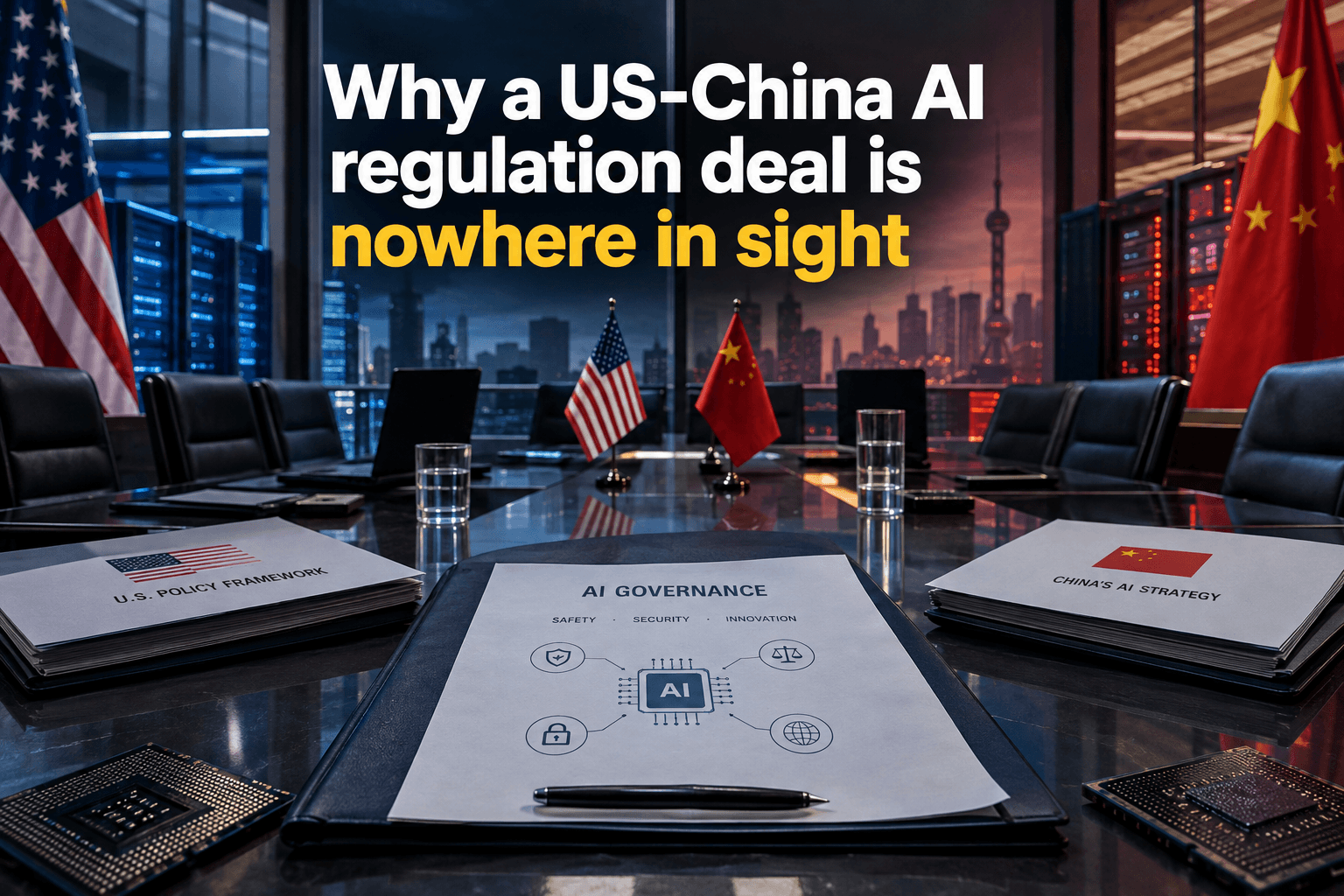
Why a US-China AI Regulation Deal Is Nowhere in Sight
Calls for the US and China to negotiate limits on AI development have grown louder over the past week. The prospects for such a deal have not improved with them.
Senator Bernie Sanders called on President Trump to abandon his hands-off approach internationally and engage directly with Beijing to head off a global AI race. "President Trump prides himself on being a great deal maker," Sanders wrote.
Beijing's response was to reject the slowdown calls as part of an American Cold War playbook.
The Structural Problem
The clearest summary of why this is hard came from Chang Jun Yan, an assistant professor with the military studies programme at Singapore's S. Rajaratnam School of International Studies, speaking to the BBC. He described a US-China AI deal as next to impossible.
His reasoning is straightforward. Both states treat AI capability as a core national security interest. Agreeing to move slower and more safely in a domain each side regards as existential to its own position is, in his assessment, very unlikely.
That is not a diplomatic failure so much as a description of what arms control looks like when neither party believes it can afford to be second.
Trump's Own Reversal Illustrates It
The dynamic is not hypothetical, and the clearest example came from the American side.
On May 21, Trump abruptly postponed signing an executive order on AI that would have allowed the US government to evaluate models for security risks. His explanation was direct: he thought it got in the way, that the US was leading China and everybody, and he did not want to do anything that would obstruct that.
An executive order regulating only American companies was shelved on competitive grounds. A binding bilateral agreement with Beijing faces the same objection, multiplied.
Beijing Reads Safety Talk as Strategy
The mirror-image suspicion runs just as deep.
US rhetoric around AI safety is frequently viewed in China as a device for holding back Chinese companies. That reading has been reinforced by recent exchanges over AI distillation and by export controls on computing hardware.
China's Ministry of Commerce put it plainly in a statement last week, saying American accusations offered further proof that the US is pursuing technological hegemony in AI, seeking to monopolise computing power and suppress competition — something it said China firmly opposes.
When one side's safety proposals are received as competitive manoeuvres, there is no obvious opening move that does not look like a trap.
The Rule-Writing Contest
There is a second layer beneath the capability race: a contest over who sets the standards.
Beijing has proposed a World AI Cooperation Organization and is backing two UN initiatives. That is not incidental. Whoever writes the rules gains leverage, and neither capital wants to sign onto a framework authored by the other.
Xi Jinping made the tension explicit in July, saying the world must ensure AI is always under human control while simultaneously opposing what he called overstretching the national security concept and placing one country's security above that of others.
Both halves of that statement are sincere and they point in different directions.
What the Summit Will and Won't Cover
Trump and Xi are scheduled to meet later this month, and AI governance is not expected to rank high on the agenda.
After a two-year halt in official AI safety engagement, the two sides have said they will resume talks, possibly around the summit. That is meaningful, but it is a channel rather than a negotiation.
The May 2026 summit in Beijing has already been characterised as a missed opportunity on exactly this issue.
The Domestic Gap Nobody Has Closed
Part of what makes an international agreement implausible is that neither side has a coherent domestic position to export.
The US has no comprehensive federal AI law. What exists is a patchwork of state statutes, agency enforcement, and an unresolved fight over whether states may regulate AI at all. California's SB 53 now requires the largest US AI companies to disclose safety practices, report certain critical safety incidents and protect whistleblowers — but those rules have not been federally adopted, which limits what Washington can actually do when a serious incident occurs.
China has the world's most extensive AI regulations, but they lack clear rules for catastrophic risk management. Its earlier framework emphasised political controls over model outputs. With the rise of agentic applications, Concordia AI's annual report notes that Beijing's concern is shifting from what systems can say to what they can do.
There are currently no requirements on either side for AI labs to measure and monitor risk or report incidents before deployment. The Mythos incident demonstrated how a lab can suddenly surface cyber capabilities that governments have no mechanism to manage.
The Realistic Path
The more credible route, argued by several observers, is not a grand bargain at all.
Theo Bertram, director of the London-based Social Market Foundation, suggested that while a US-China agreement to curb AI progress is a long shot, both countries could pursue greater regulation separately. Domestic safeguards in both, he argued, create shared interest in learning from each other and building accountability — one way of meeting what he described as inevitable global political and public demand.
A similar argument holds that the aim of resumed talks should be modest: each side gaining enough visibility into what the other fears about AI capabilities, and what it is doing about those fears, to prevent suspicion from becoming a justification for reckless acceleration.
That requires insulating safety discussions from the broader economic contest, so that existential risks do not become bargaining chips in a tariff negotiation.
Why It Matters Anyway
The uncomfortable position is that the case for a deal and the impossibility of one are both strong.
The comparison to nuclear arms control keeps recurring, and it is instructive in a particular way. Nuclear arms control took decades, required a near-miss to concentrate minds, and only worked once both sides accepted that the alternative was worse for everyone.
The difference is that nuclear weapons were built by states. AI capability is being built by private labs competing globally, which means even a perfect bilateral agreement leaves substantial capability outside its scope.
That is the argument for domestic accountability first. It is slower and less satisfying than a treaty, and it is the only version of this that currently has a path.
Sources
Related Articles