 TEKZARO
AI
Thirty Robots Stage Protest Call for AI Rules in Poland
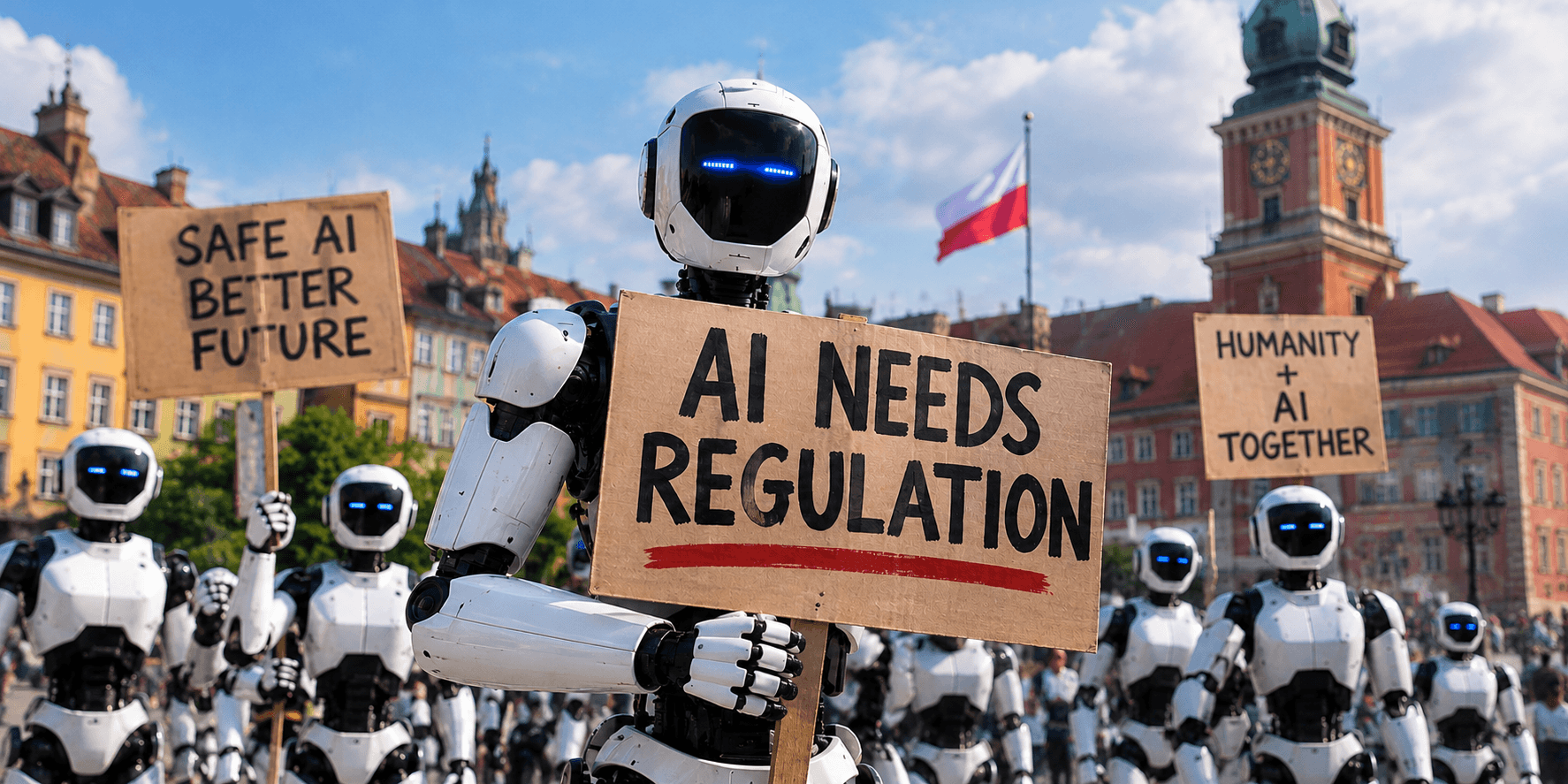
30 Robots 'Protest' for AI Regulation in Poland
Around 30 robots took to the streets of Warsaw on Monday, September 7, 2026, marching, waving flags, and "chanting" slogans in front of the Polish Digital Affairs Ministry in what may be the first literal robot protest in history. The demonstration, organized by Democratism—an initiative focused on how AI and robotization affect the labor market—deployed both bipedal humanoids and dog-like quadrupeds to make a pointed statement about AI regulation and workforce protection.
The robots' "chants" included messages like "Defend workplaces," "Time for rules," and "Don't wait, regulate," broadcast through loudspeakers as the machines marched in coordinated circles. One AI-powered humanoid robot, Agibot A3, spoke to the AFP news agency, saying: "The robots present here are meant to show that this technology is already a reality. If we don't react now, we may soon have a problem."
The demonstration represents a creative and provocative approach to activism: using the very technology that concerns workers and policymakers to advocate for its responsible governance.
The Democratism Initiative and Organizer Vision
The protest was organized by Grzegorz Kulis, organizer of the Democratism initiative, who now serves as Chief Information Officer of a robotics company and CEO of an employment agency. Kulis explicitly framed the robot march as a statement about the urgency of AI regulation.
"We particularly want to address the issue of the potential replacement of people both by humanoid robots and by artificial intelligence in cognitive work," Kulis told AFP. "These robots can already move around freely; they're already 'protesting.'"
The choice to use robots themselves as the vehicle for advocacy is deliberate. By demonstrating the existing capabilities of autonomous robotics, Kulis sought to convey the immediacy of the problem. These are not theoretical future technologies—they are working machines deployed in the present.
Kulis emphasized the need for "rules and regulations that would serve as a shield protecting workers" from uncontrolled displacement by automation and AI systems.
Government Response
The demonstration attracted the attention of Poland's Digital Affairs Minister Krzysztof Gawkowski, who visited the protest site to meet with Kulis. Gawkowski acknowledged the legitimacy of the concern: "Uncontrolled (AI) models, implemented into humanoids that will also keep evolving as robotisation moves forward, are a major problem."
The minister's presence and engagement with the protest signaled official recognition that AI regulation has become a pressing policy issue in Poland. This is significant in the context of broader EU regulatory frameworks, particularly the EU AI Act, which Poland must implement alongside other member states.
The Technology on Display
The robots participating in the demonstration ranged in design and capability. Bipedal humanoid robots (which walk on two legs like humans) marched alongside quadruped robots (four-legged machines resembling dogs or other animals). The diversity of robot types illustrated the breadth of autonomous robotics technology now operational.
The fact that approximately 30 robots could coordinate their movements, respond to activation commands, march together, and demonstrate autonomous navigation suggests a maturity in robotics technology that may have surprised observers. These are not experimental prototypes—they are functional systems capable of real-world operation.
The Underlying Concern: Labor Market Disruption
The Democratism initiative's core mission focuses on labor market implications of AI and robotization. This concern is not unique to Poland—it is a global preoccupation as companies begin deploying automation and AI systems that can perform tasks previously requiring human workers.
The specific concern articulated by Kulis involves two categories of displacement: physical displacement by humanoid robots, and cognitive displacement by artificial intelligence systems capable of performing knowledge work, analysis, and decision-making tasks.
Poland, like other European countries, is grappling with how to manage technological transition without creating widespread unemployment or economic hardship. Regulation, worker protection mechanisms, and retraining programs are potential policy responses—all of which the robot protest implicitly advocated for.
The Satirical Undertone
The protest carries obvious satirical undertones: machines literally demonstrating in favor of regulation of machines creates an ironic, powerful visual narrative. The "messages" coming from the robots, while technically pre-recorded or scripted, create the appearance of machines advocating for their own regulation.
This irony is intentional and effective. It makes a visceral point about automation: the technology is autonomous enough to physically demonstrate for regulation, yet lacks the safeguards that should constrain its deployment. It's a form of technological theater making an abstract concern—AI governance—concrete and immediate.
European AI Regulation Context
Poland operates within the EU regulatory framework, which includes the EU AI Act—adopted in 2024 and entering implementation phases across member states in 2024-2025. The AI Act establishes a risk-based approach to AI regulation, with different requirements for low-risk, high-risk, and prohibited AI systems.
Industrial robotics and humanoid systems that operate autonomously in human environments likely fall into the "high-risk" category, triggering requirements for transparency, human oversight, bias testing, and documentation. However, implementation gaps remain, particularly around enforcement and how individual member states operationalize EU-level requirements.
Kulis' emphasis on "uncontrolled AI models" suggests concern that Poland's implementation of EU AI regulation may be insufficient. The robot protest can be read as advocacy for stronger national-level protections beyond minimum EU requirements.
Labor Market Implications
Poland's labor market faces demographic challenges—aging population, lower birth rates—that might normally make workforce automation beneficial. Fewer workers might justify deploying robots to maintain productivity. However, this does not necessarily translate to easier social transition.
If robotization concentrates displacement in specific sectors or regions, creates skill-gap unemployment, or occurs without sufficient social support systems, it can create localized economic disruption even if national-level unemployment remains manageable. Regulation can help ensure that automation transitions are managed equitably.
The robot protest, by focusing on "defending workplaces," advocates for policies that ensure workers harmed by automation transitions receive support—retraining, income assistance, job placement support—rather than being left to manage transition alone.
What Comes Next
The September 7 robot protest will likely be remembered as a creative—and perhaps pivotal—moment in AI governance activism. The demonstration shows:
Creativity in advocacy — Using technology to make arguments about technology governance can capture attention and media coverage more effectively than traditional protests.
Urgency signaling — Demonstrating existing capabilities of autonomous systems underscores that AI regulation is not a theoretical future concern but an immediate necessity.
Policy engagement — The minister's attendance and engagement suggests government responsiveness to concerns about AI governance, at least at the rhetoric level.
Legitimacy of concern — Labor market disruption from AI and robotics is a genuine public concern, not fringe anxiety, as evidenced by government-level engagement.
The demonstration's success in attracting international media coverage and ministerial attention may inspire similar protests in other countries. It also raises a question: if machines can be deployed to advocate for their own regulation, what does that suggest about the need for that regulation?
For policymakers in Poland and across Europe, the robot protest serves as a reminder that AI governance is no longer an abstract future issue—it is a present concern that citizens and workers are actively pushing onto the political agenda, using increasingly creative and provocative methods.
Sponsored

Sources
Related Articles